

“Those who tried to understand the general course of events, and to take part in it by self-sacrifice and heroism, were the most useless members of society, they saw everything upside down, and all they did for the common good turned out to be useless and foolish…
In historic events the rule forbidding us to eat of the fruit of the Tree of Knowledge is especially applicable. Only unconscious action bears fruit, and he who plays a part in a historic event never understands its significance. If he tries to realize it his efforts are fruitless.” - Leo Tolstoy [War and Peace, IV.1.4]
It is no secret that America has become a country of widespread discontentment with our government, political system, culture, economic structure, and almost any other metric you could think of. One could pick out any number of data points, but take for example a Pew survey from June of this year which found that 69% of people are dissatisfied with the way things are going in this country; 59% feel our best years are behind us; another incisive data point is that 63% of people feel that on the issues which matter to in the last few years their side has lost more often than it has won, meaning many still feel its going badly when their own team is in power. Modern America has become a country of political division, oligarchy acrimony, political recriminations, constant unsuccessful wars, and crushing national debt, all with a complete lack of common purpose. Virtue is laughed at while vice is praised, hopelessness is becoming endemic, and talk of civil war is not uncommon, though typically such a thing seems far-fetched until it happens very suddenly so no one can say if that is a likely scenario at this time.
The question then becomes “can anyone save the American Republic?” One could lay out a variety of policies that might do so, but there’s no way to get them implemented. The reality is that if a man were to try and govern virtuously with a view towards the common good and restore the power of our ancient institutions, he would inevitably be facing opponents acting in bad faith and persistently attacking liberty and the separation of powers in support of their own partisans. It doesn’t seem anyone under this system could genuinely challenge the power international capital has over this country. My own feeling on this is that one cannot fight the course of history, and the American Republic entering its Principate Era is all but inevitable, the question is just what struggles we go through first and if we will have a leader of the quality of Augustus to take us there (highly doubtful.)
I should note, quickly, that with the rapid growth in power of AI on all of our minds, it may seem quaint to even show concern with this or to believe history will follow established patterns. I would say, firstly, it is a fool who thinks his times are so unique there is nothing to learn from the past. Secondly, the rise of AI makes this all the more likely, as the four core scenarios here are: widespread unemployment and discontentment because it works; it crashes the economy entirely; it breaks the technology which makes the modern world function; there is a self-replicating robot apocalypse. In none of these scenarios does “Let’s vote for wise and virtuous politicians who will restore the Constitution” seem to be the path Americans can or will take. The scenario I fear more than any of those is a tech oligarch putsch that makes an AI the prince. The point is, our form of government may not even feel like the biggest concern we face right now, but nevertheless we are where we are, and our corrupt populace is unlikely to restore a proper republican system.
America’s founders were deeply interested in the fall of the Roman Republic, moreso than the much later loss of Rome to barbarian forces. In the works of the great historian Sallust, writing in the final decades of the Republic, his description of the founding of the city and it gaining its liberty has much in common with the times the Founders lived in, whereas his description of his times mirrors our own. As Sallust writes,
“Though they were of different races, dissimilar languages, living each in a different way, after they came together within a single city’s walls, it is incredible to relate how easily they coalesced: in so short a time did a disparate and wandering crowd because of internal harmony become a state.” [Catiline’s Conspiracy, 6.2]
Even more crucial to our Founding, is what happened when they overthrew the kings and became a republic,
“Once liberty was attained, it is incredible to recount how great the state became in a short time. So strong was the desire for glory that came over them...for men like this no hard labour was unfamiliar, no place was harsh or difficult, no armed enemy brought fear; their manly virtue had dominated everything.” [ibid, 7.3-5]
Further,
“They cared for their constitution and themselves in two ways: they were fearless in war, and, when peace arrived, they were fair...in peacetime they exercised political power more often with kindness than with fear and, when they received an injury, they preferred forgiveness to prosecution.” [ibid, 9.3-5]
However, as happens in prosperity,
“Greed for money grew, and then greed for power...avarice undermined trust, goodness, and other noble qualities, and in their place taught pride and cruelty…At first, these things grew gradually, they were punished occasionally; afterwards, when this contagion invaded like a plague, the state changed, and political power which had been most just and best became cruel and intolerable.” [ibid, 10.3-6]
It is not to make the mistake of glorifying the past and condemning your own time only because one is distant and one is present to see that it is obvious that this is a way in which America has changed.
The Roman Republic of Sallust’s time had been riven by internal division (he was himself a partisan of Julius Caesar, and by legend was one of the few men to dine with him the night before he crossed the Rubicon.) The empire was large and diverse, with a massive lumpenproletariat and constant disputes over land reform. Italy was in the process of being turned into a garden worked by slaves (which is to say, decorative landscaping for the elites instead of productive agriculture.) While Romans had brought many people in, it was only around 50 years prior, as part of the settlement to the Social War- which saw Rome’s vassals turned against it and it was reduced in territory within Italy to basically only the city and miraculously still triumph- had ended in Roman citizenship was granted to all Italians. Up to that point, a variety of agreements had been made with the Italian cities and tribes, many of whom at that point had only been under Roman control for a couple of centuries or less. Most importantly, Rome, for a long time a poor but powerful city, had become awash in wealth and luxury. This is typically considered to have began when Marcus Claudius Marcellus sacked Syracuse and brought its treasures home in 212 BC. However, it is also the case that the Macedonians kept most of the Persian treasury intact and when it was captured in the mid-2nd century, Rome seized so much wealth that personal taxes were ended for a century (the treasury at Persepolis had 2,500 tons of gold, or roughly 300 billion dollars today, and that was just one form of wealth in one location, and this is in a society that did not yet have South American or South African gold.) It should also be mentioned that in Sallust’s time Crassus, the richest man in the city, had recently come to his ignominious end after launching an ill-advised war in Persia.
Of course, in our case it was after WW2 that we suddenly developed levels of wealth previously unknown and became soft. True, much of it was from genuine productivity as opposed to looting, and like the British before us we see an empire mostly as a market and let an ideological attachment to free trade hollow us out. It has created a situation quite like Rome, where financial interests own most the farmland and bring in a class of foreign slaves to work it, we’ve just learned its cheaper to use free labor (something Rome seemed to begin to discover around 150 years after Sallust, lines in Pliny the Younger’s letters signify a transition away from slavery.) We have become a nation of bureaucrats, of eunuchs, neurotically averse to physical harm while gambling on brutality. It is common on the left to say that the famed “strong men create good times” cycle meme is made up, but basically every ancient historian believed in it, and there is no doubt where in that cycle we are, though that is not the only cycle governing human affairs. Unfortunately, a government is commonly a reflection of the virtues of those who live under it, which is why ours has become little but debt, quarrels, recriminations, and rent-seeking.
While I am mostly freelancing, there is obviously no real market for 5000+ word ruminations on what the cycle of constitutions means for us, outside of you, the person reading this. Please consider a paid subscription:
In classical political theory there are typically considered to be six types of government, though they are really three broken up into a good and bad form.1 The standard view is that these constitutions have a natural cycle, and that if it cannot be avoided entirely it can be slowed and made less acute by having a mixed government that has democracy, aristocracy, and kingship. As this works in Madison’s original Constitution, the House of Representatives is the demos, the Senate is the aristocracy, and the President is the prince. It should be noted that in a sophisticated system of government such as ours these things are abstracted through representation. We have no direct parallel of the Tribunes of the Plebeians but the House of Representatives is meant to be the demos itself, given that we cannot reasonably all gather in a forum. The states themselves were the aristocracy before the 17th Amendment. The now-maligned system of voting for electors had the public selecting the most virtuous among themselves to choose a President, who was thus neither specifically of the commons or the aristocracy, though as in Republican Rome, it was almost always people of the upper order entrusted with this responsibility by the commons.
One of the main benefits to this design is that landed interests are conservative in the sense of behaving responsible and wanting to preserve their property, while monied interests hold no principles and can find a way to benefit from anything that destabilizes society. There is an idea that rich people are conservative, but that is imagining the rules of a country club, not Goldman Sachs sponsoring a pride parade knowing that if they undermine family, religion, and other public morals, dissolute and profligate individuals will only be able to look to bank loans for help. Burke talks about the natural conflict between these two species of wealth at length. It is important to understand that every serious thinker throughout history believed that class struggle- both between the rich and poor and between different classes of wealth or other interests- were a core part of history until Marx was enough of a maniac to believed class conflict could be permanently won, and many went much too far in reacting to him. Regardless, Burke writes,
“In the state of real, though not always perceived warfare between the noble ancient landed interest, and the new monied interest, the greatest because the most applicable strength was in the hands of the latter. The monied interest is in its nature more ready for any adventure; its possessors more disposed to new enterprizes of any kind. Being of a recent acquisition, it falls in more naturally with any novelties. It is therefore the kind of wealth which will be resorted to by all those who wish for change.” [Reflections on the Revolution in France]
It is important that the demos feel represented and can express themselves to relieve malignant humors which build up in a body politic, as well as to serve as a check on the consolidation of power and prevent abuses by the economic elites. However, democracy must be limited as the demos can always be bought off by financial interests due to its perpetual need of money and credit.2 In a properly balanced mixed government these currents can be in conflict without causing serious harm; indeed, it is one of Machievelli’s great innovation that the Conflict of the Orders strengthened Rome and was the origin of most great laws safeguarding public liberty. In a society where virtue prevails, productive compromise can be found.
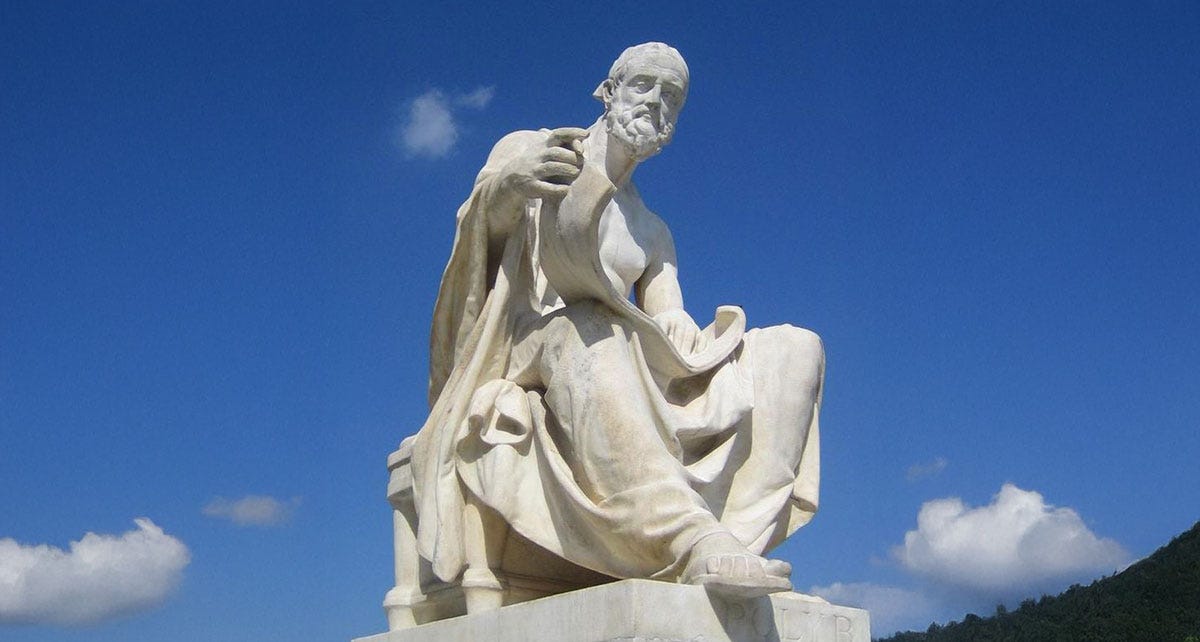
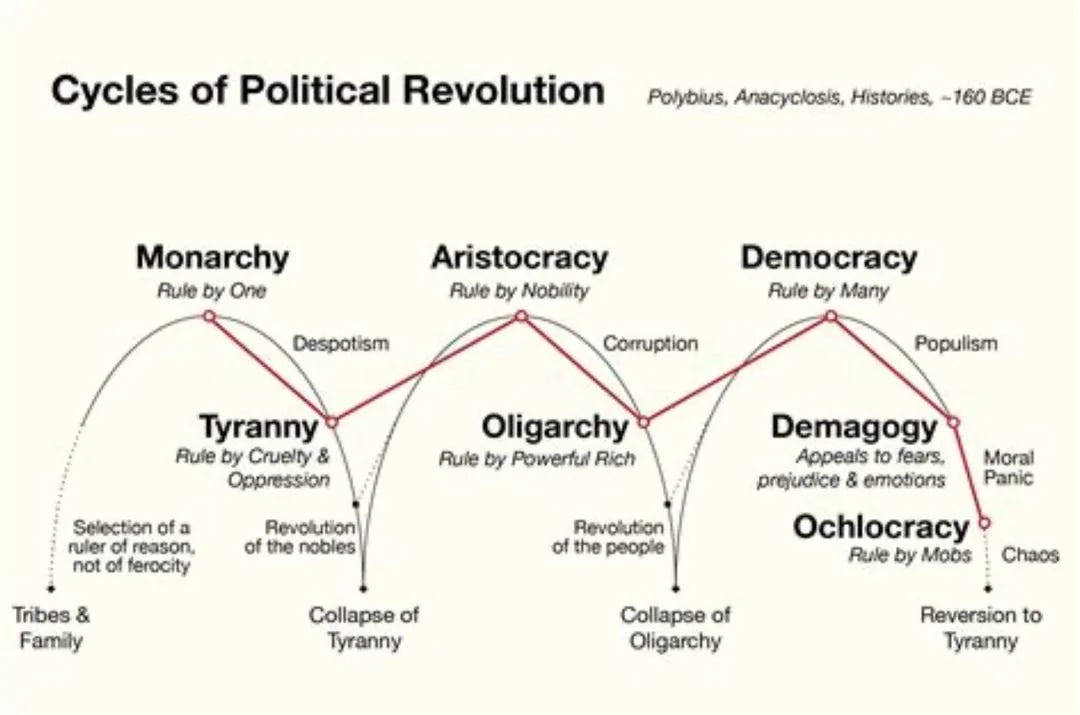
Polybius, the great historian of the consolidation of Rome’s power across the Mediterranean, provides the clearest explanation of the cycle of constitutions, The cycle “starts” when after some catastrophe (in Britain’s case, the decline and fall of Rome,) men are put back into small bands and then as society recovers some great consolidator is recognized as a king. Britain was one of the only countries in Medieval/Renaissance Europe to have something genuinely resembling the mixed constitution of Rome, though the currents of the upper and lower orders exist in any state. Famously, the nobles moved against the king when he became tyrannical and managed to get the Magna Carta. The commons also grew in power over time and democracy became ascendant with the 1832 Reform Act, but that is outside of our story. It is a little bit complicated where America breaks off from Britain in the cycle, but there is no need to split hairs.
Please forgive the lengthy quotes as I go through this section, as they are apt and its safe to assume few have read Polybius Book VI (his influence among political theorists has declined, which is entirely unmerited, but few in our age appreciate the classics.)
When America was colonized the system of government was a benevolent kingship. The King had little power over the colonies, but they were happy to maintain their allegiance. Of course, as is well known, the King became tyrannical, Polybius writes of how kings become ostentatious and rapacious and drive resentment against themselves,
“They felt that rulers should dress in a fashion that distinguished them from their subjects, that their food should be presented and prepared in distinctive and elaborate ways, and that they should be allowed total sexual freedom, even to the extent of sleeping with inappropriate partners. This behaviour aroused people’s resentment and disgust, which in turn kindled hatred and hostile anger in the kings, and so kingship gave way to tyranny. At the same time the seeds of its dissolution were sown, as conspiracies began to be formed against the tyrants. These conspiracies arose not in the lowest strata of society, but among the most noble, high-minded, and courageous men, because they are the ones who find it hardest to bear insolence from those set over them.” [VI.7]
It is, of course, famously the case that the main “Founding Fathers” were the elite of colonial society and the only major one who was a social climber was Hamilton. It is, however, poorly understood how much of the tax dispute was purely insolence on the part of the King (and Parliament.) People believe that Americans just “didn’t want to be their taxes” but in fact colonial governments were consistently giving Britain whatever amount of money it asked for, they were just raising those funds themselves it wasn’t direct taxation on the public. (It should be noted as well that according to Burke there wasn’t any unusually high degree of smuggling and duty avoidance in America compared to Britain, where people also ran boats up rivers to avoid duties all the time.) The Crown was trying to prove a point more than anything, and suffice to say, in the long run the opposite point was proven.
With the adoption of the Constitution, America became an aristocracy. Again, this is abstracted as state supremacy. Part of that was that state legislators chose Senators, but even moreso it is simply how much power states had over their own affairs and most governance was done at a state and local level. However,
At first, these new leaders gladly accepted their assignment. They made the common good their top priority, and managed all the private and public affairs of the general populace responsibly and carefully. But then, the sons in their turn inherited this position of authority from their fathers. They had no conception of hardship and just as little of political equality or the right of any citizen to speak his mind, because all their lives they had been surrounded by their fathers’ power and privileges. And so they either dedicated themselves to rapaciousness and unscrupulous money-making, or to drinking and the non-stop partying that goes with it, or to seducing women and preying on boys, and in the process they changed aristocracy into oligarchy.” [ibid, VI.8]
This is somewhat of a less direct parallel. What happened in America was more accurately that the upper orders within the states did become increasingly corrupt and ossified. However- and this is a rare instance where this is acknowledged in America- in the North it was industrial (and thus, financial) interests whereas in the South it was the landed interests who took control of states, and the two species of wealth went to war. Slaves are, of course, a type of landed wealth. Following the war, state power was drastically weakened and democracy began its ascendance. As well as the concept of federal supremacy, when the public began to vote for for Presidents instead of electors the President began to be more of a Periclean “first citizen” than a prince. Later, the 17th Amendment completely broke Madison’s design, and the country became functionally a pure democracy with with vestiges of its prior mixed form.
It is crucial for understanding this that the control of financial interests is what you get in democracy and presumably the people pushing the 17th Amendment knew this, so it is no contradiction whatsoever that the country doesn’t “feel” very democratic. There is no system of democracy that does not give moneylenders excessive power. This is why every communist state is politically an aristocracy, or an oligarchy, depending on how you want to look at it.
For a number of decades Congress- now with both houses representing the demos, and by extension financial interests- was ascendant but for the most part things ran well enough and challenges were faced and traditional liberties respected. Even when, for example, Franklin Roosevelt had seemingly concentrated a huge amount of power unto himself and was reforming the country in his own image, it must be remembered that he had an overwhelming majority in Congress so was doing this on a Congressional mandate (in one term, there were under 100 Republicans in the House.)
However, human affairs are always in motion,
“While those who had experienced oligarchic excess remained alive, they were content with the existing regime and were fully committed to equality and the right of every citizen to speak his mind. But by the time a new crop of young men had been born and democracy was in its third generation, the principles of freedom and equality were too familiar to seem important, and some people began to want to get ahead of everyone else. It was especially the rich who succumbed to this temptation and longed for power. But then, finding that their own resources and merits were not enough to enable them to get what they wanted, they squandered their fortunes on bribing and corrupting the general populace in all sorts of ways. Once this inane hunger for glory had made the common people greedy for such largess and willing to accept it, democracy in its turn was overthrown, and replaced by violence and government by main force.” [ibid, VI.9]
The era we are in now is one of growing ochlocracy, or mob rule, government by main force. In our system this is what the growth of Presidential power represents, given that it is two evenly matched sides in a vicious contest to put their leader in power who can then do almost whatever he wants. Our over-extended, over-diverse country means that there is a constant competition for factions with little regard for the good of the state, because the interest is in bribing the public. The financial interests who manipulate the mob seek its constant growth and have convinced many that it is fascist to want a coherent, and thus functional, body politic.
While we have admittedly retained some safeguards, they are failing. No major political faction genuinely believes in free speech, be it the Biden Administration’s deranged quest to control the internet or Trump’s anti-anti-Semitism drive. While the 1st Amendment itself specifically relates to government, a respect for free speech is also a general moral sentiment that should be held by the public in a free state. The justice system is correctly understood to be unfair. The public overwhelmingly believes corruption is a major problem. Loud voices on both sides consider every election stolen. The Democrats want to get rid of even the vestigial electoral college, which will have the obvious impact of making Presidents lose all concern for localities or creating any sort of balance across the diverse interests within our continent-spanning nation.
Things very obviously can’t go on like this. It must be admitted that while liberals mistake the cause and the effect, they are instinctively correct about where America is in its political life in that democracy is dying, or almost entirely dead and that there is a risk of dictatorship rising. It’s true that Trump has authoritarian tendencies, but princes are supposed to be restrained by mixed government because that is to be expected. Biden and Obama were also entirely lawless they just made hypocritical professions of of respect for the institutions. They liberals bear more responsibility for killing our Constitution than conservatives do, though there is no shortage of blame to go around. Nevertheless, the belief that progress is making democracy more “direct” was always going to have the impact of speeding up the cycle, which can only be delayed by co-equal branches setup to be unable to harm each other, or at least they can vary in relative power over time without disaster.
Some event, be it economic or technological collapse, military defeat, or environmental disaster will surely break this system that seems beyond redemption. We come now to the point where we obviously are, a failing, deeply indebted government where the political class nevertheless must give endless handouts to buy the loyalty of a public who well knows they do not deserve loyalty,
“Once people had grown accustomed to eating off of others’ tables and expected their daily needs to be met, then, when they found someone to champion their cause—a man of vision and daring, who had been excluded from political office by his poverty—they instituted government by force: they banded together and set about murdering, banishing, redistributing land, until they were reduced to a bestial state and once more gained a monarchic master.” [ibid, VI.9]
Though it is common such a man comes from the lower orders- for two really famous examples, Hitler and Mussolini both grew up poor- it is not always the case. Augustus, for example, certainly did not.
While we can be sure where we are, one can never know when history’s great events will happen. The fall of the Roman Republic lasted over one hundred years, from the death of Tiberius Gracchus in 133 BC to 27 BC when Octavian was declared Augustus. It is as Polybius says,
“A clear grasp of the theory may not deliver the ability to make infallible predictions about when some constitutional event will happen in the future, but provided one’s judgement is not biased by anger or resentment, one will rarely go wrong about what phase of growth or decline a system has reached, or about what transformation it will undergo next…the Roman constitution is a superb example of a system whose formation and growth have always been natural, and whose decline will therefore also conform to natural laws.” [ibid]
And indeed, Polybius was writing at a time where democracy was taking ever more power from the aristocracy, until the state fell into chaos until monarchy restored order. While Machiavelli is critical of Julius Caesar’s role in the end of the Republic, it is hard to see how it could have been saved, and Western Empire survived another 500 years because of the changes made by Augustus, the East 1500.
It is theoretically possible for the cycle of constitutions to be broken and for the American Republic to be restored, but it is highly unlikely. Machiavelli teaches,
“Once a city has begun to decline through the corruption of its substance, if it ever manages to rise again, this occurs through the exceptional ability of a single man who is alive at the time and not through the exceptional ability of the people as a whole who support good institutions, and as soon as that man is dead the city returns to its former habits…The reason is that no single man can live long enough to train well a city long accustomed to bad habits…unless they have, at the risk of much danger and bloodshed, brought about its rebirth. Thus, such corruption and so little aptitude for living in freedom arise from an inequality that exists in the city, and if one wishes to bring the city back to a state of equality, it is necessary to employ extraordinary measures, which few know how or wish to employ.” [Discourses, I.17]
While it seems unlikely we can be restored to a state of equality, we may get a system where we have a princely figure who can get broad popular support instead of being hated by half of the population. The reality is that our country and its imperial interests have grown too large and unwieldy and our oligarch class has too much wealth for a normal political process to function.
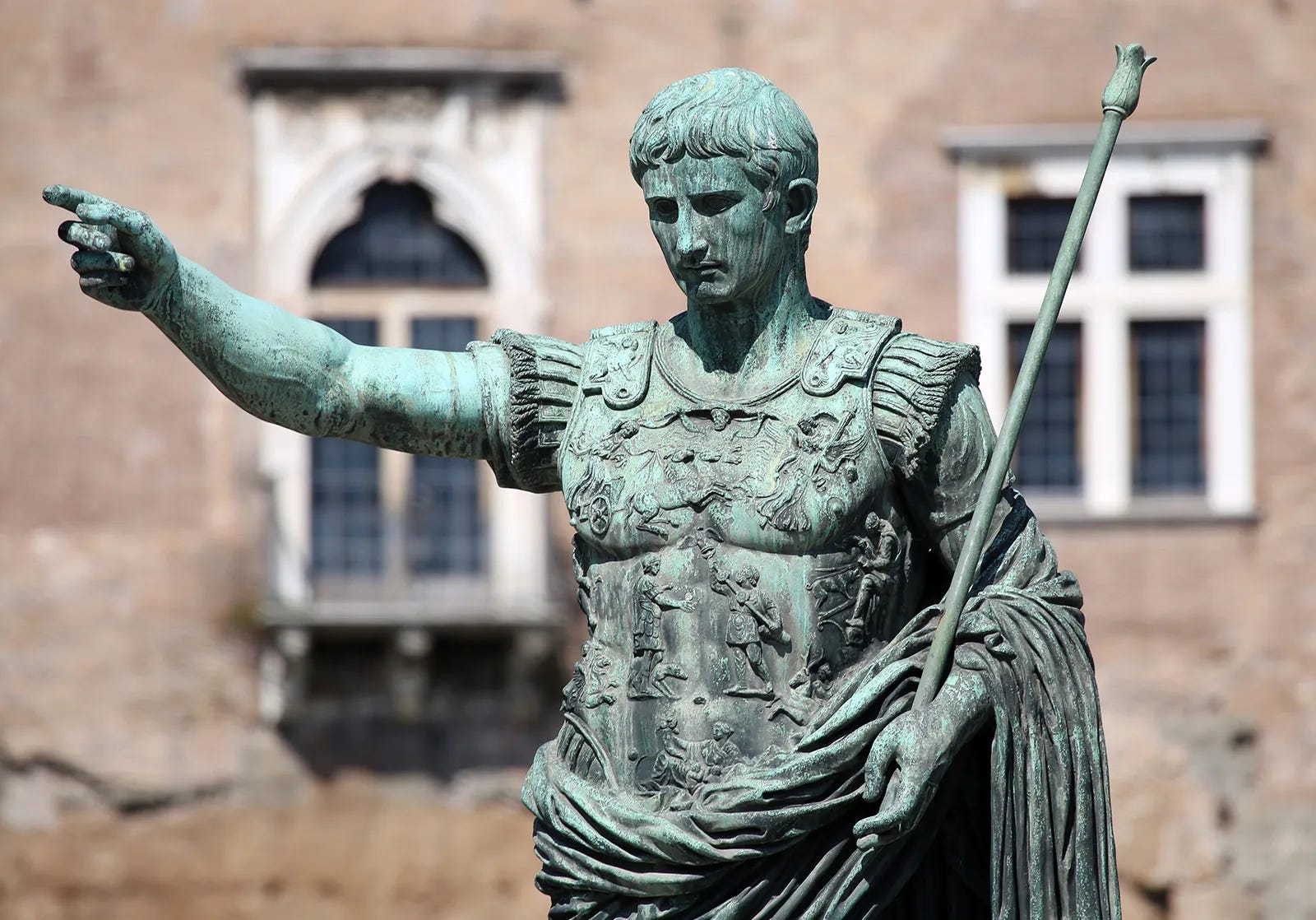
In Book 52 of his history, Cassius Dio imagines the debate that took place between Octavian’s two closest companions, Agrippa and Macaenas, about forming the Principate following their victory in the civil war against Antony. This section is an unjustly ignored gem of political theory. It should be noted however that it must be almost entirely made up, but is nevertheless, provides us with the view of a third century Roman Senator on such events. Agrippa takes the position that Augustus should restore the Republic, whereas Macaenas argues that he will surely perish, and Rome with him, if he gives up the monarchy after having held it during the war. What they land on is keeping the ancient from while wielding monarchical power. Macaenas, in favor of the Principate, says the following, regarding the problem that nothing can be done properly and the right men are rarely appointed and everything is governed by the representatives of factions,
“Every democracy suffers from these abuses - since the most powerful men compete for the principal offices of state, hire the weaker citizens and their supporters and reduce everything to chaos - but these evils have appeared most frequently in our country, and there is no way of checking them save the one I propose. The proof of my words is in the inordinately long periods during which we have engaged in civil wars and civil strife. The cause is the immense size of our population and the magnitude of the issues at stake. Our population embraces every variety of mankind in terms both of race and of character; hence both their tempers and their desires are infinitely diverse, and these evils have gone so far that they can only be controlled with great difficulty.” [LII.15]
It is hard to imagine any circumstance where our country does not continue to struggle from such evils. Perhaps it breaking up would be for the best, but federal supremacy is as such that no one is being let go. We are instead living through a permanent crisis such as cannot go on. One way or another this system will give way to monarchy it is merely a matter of how much we must suffer along the way. All of the proposed reforms speed up instead of slow this process. I had, some time ago, intended to write an essay about reforms to save the Republic- and some are fairly simple, such as repealing the direct election of Senators and allowing the President unlimited non-consecutive terms- but no one is going to make such changes. The country as it exists now is just for distributing wealth to a variety of aggrieved groups in the hope of buying their political loyalty.
No one thinks that the reality of our country is that the political and bureaucratic class will get things together, lead in a fashion that over half the country accepts or approves of, deal with the challenges we face constantly, and govern with a view for the well-being of the general public. Instead we are simply exhausted from constant crisis, both real and invented, and a creeping feeling that everything is getting worse all the time. The best hope of many is merely the permanent suppression of the other faction. Politicians are always claiming if you don’t elect them it could be “the last election” but sooner or later it is bound to be true. Events have shown that it is hard to see how participation could conceivably improve anything. The wealthy are buying off the public, the public are grown accustomed to eating at the tables of others, and the treasury is not only empty, it is the largest debt in human history. Nominally, current US debt is greater than the 2003 global GDP, though adjusting that for atrocious inflation is beyond my skill level. There is no way that a democratic system fixes any of this, and anyhow the public no longer has shared values of hard work, honesty, equality before the law, freedom of speech, freedom of religion, or any of it. We are all existing in a state of hyper-agitation while knowing our country is fundamentally broken. It is an inevitability that one man takes control of this disaster, though what it looks like is an open question.
What only time can tell is by what process this happens. The Principate was shockingly informal. For much of the 40+ year reign of Augustus as sole ruler of Rome he didn’t hold the major formal positions of state but had “proconsular” powers, which is something like being a regent. He was also given tribunician powers for life, and the powers of the censor, while technically holding neither office. It’s peculiar the system worked at all or lasted so long. His successor, Tiberius, who began virtuous and later reached the worst depths of corruption, rarely gave clear orders and spent the last 14 years of his reign in a villa in Capri, never entering Rome, and basically having Sejanus as the regent for his regency for some of that period while the ancient form of the state remained. It wasn’t until around 300 years later that Diocletian formalized the Imperial system, which is sometimes called “the Dominate,” though this classification is controversial. While this all sounds peculiar, it is less uncommon than you might think. There are multiple 20th century examples of monarchies where the king is not allowed to enter the country while the regent claimed to support a restoration, for example. Pretending to want to restore the Republic was also quite common in Rome. For another example, Stalin was the Chair of the Communist Party but held no position in the Soviet government whatsoever for the majority of his reign, though made himself Prime Minister during the war to spare Roosevelt and Churchill the embarrassment of having to make agreements with a man who wasn’t even part of the Soviet government.
As this might work in America, assuming we have someone smart enough to not antagonize the public by senselessly abandoning our ancient forms, the most likely position for our new Princeps is as Speaker of the House. It is a peculiarity of American government that this position does not require being a member of the House of Representatives. As far as I know, there are no real prohibitions on holding it at the same time as other positions, outside of the separation of the military and civil government. It is not at all hard to imagine that after extended crisis and civil strife, knowing that nothing in our government is working, some prominent man with designs against the freedom of the state gets placed in that position with full bipartisan support and from there controls the government for decades, later choosing his own successor. It is, for that matter, not all that hard to imagine the Speaker being given his own forces, particularly as they already have the ability to hire investigators with power and put on trials and there is an existing Capitol security force under the Speaker’s power. It’s been a joke that Rubio is given ever more positions, and similarly it does not seem impossible for the Speaker to also be the Secretary of State and Defense or whatever the case may be. The Constitution is hardly followed now, so any formal prohibition can be waived easily enough without the public caring, so long as it is not being a General. which would presumably be a line with the public, but of course implicit in all of this is that someone does “cross the Rubicon.”
It should be clarified that I don’t want any of this to happen. I would love to have lived in times when the Republic was healthy. However, one really can’t change the course of history, which is governed by forces about which we are ignorant, I would have felt much better trying to save the era of aristocratic prominence when “democracy” was not held in religious reverence by corrupted individuals with no sense of God, virtue, or eternity. That is not, however, my fate. Still, this leaves the question of what one should do that is not merely being helpless. The pull of political participation is strong, despite that, as Sallust says,
“Of all of the paths to glory it seems to me that at the present time political office and military power, indeed all public service, is utterly undesirable, since the honour of public office is not granted for virtuous action and those who use fraud to enjoy these offices are not more secure or more honourable because of it…It is the height of madness to labour in vain and to acquire from one’s efforts nothing but exhaustion and hatred; unless, of course, one is possessed by some dishonourable and dangerous desire to sacrifice one’s self-respect and freedom to the powerful interests of the few.” [The Jugurthine War, 3]
It is perhaps useful to look at the last 10 years of American political life and realize that the only good thing that has happened from all of our struggles is merely that the “vibe shift” finally made social life in this country less stifling, and that shouldn’t have been an electoral politics matter- it didn’t, in fact, even meaningfully relate to state policy! It’s also the case things only got bad enough to prove a reaction because of politics antagonizing the public.
My first piece of advice about surviving our era and whatever comes next is to try to stay alive while doing whatever lets you sleep at night. You only live once and do not want to waste it being miserable about events beyond your control, nor to throw your life away for people who will never miss you. Despite my tendency towards being a right wing partisan, as it stands I hope to do as well as I can at staying out of whatever events may come. Still, it is understandable if you cannot watch all of this and live with knowing you didn’t try. On the other hand, I would not recommend making any serious moral compromises given that it won’t change anything anyway.
Secondly, I would try to orient your life in such a way that you have some insulation from hard times. This is not to say devoting all of your resources to survivalism, but nevertheless it is good to have diverse and practical skills and some amount of stocked resources.
Lastly, I would say that though it is frustrating as all hell, it is still sensible to maintain involvement in local affairs which may seriously impact the lives of yourself and your children. This is an area where you could actually make a difference, while also building up experience that may help you when the time comes. Anyhow, if we enter into a protracted period of even worse chaos, you will certainly want your municipality to have its sewer system in good condition at the start, or whatever the case may be. It is not uncommon for some wise local ruler to maintain a haven in his fiefdom in an era of widespread chaos.
As to the future, I hold out no hope whatsoever for the restoration of the American Republic or the solving of any of our problems under the current system. My only real hope is that whatever prince we get likes my class of people and is actually a human, not a robot. While there were many bad Emperors when the title passed from Augustus, and we read about their perversions, crimes, and horrors, it is primarily only prominent men engaged in affairs of state who actually suffered. The public, at least, got better bread and circuses than we have enjoyed for many years and were rarely impacted by the perversion on the throne. The feeling that our government should belong to us and we should have control over it but quite obviously don’t is driving us all crazy. We may, at least, find that we are made to feel better by the end of our illusions, and regardless, you can’t fight history.
Thank you for reading! The Wayward Rabbler is written by Brad Pearce. If you enjoyed this content please subscribe and share. I am available for freelance work and can be contacted by email at pearcebrad@hotmail.com. You can see my shitposting and serious commentary on Twitter @WaywardRabbler.
I must, as ever, note that it is more or less impossible to refute Hobbes’ argument that you can’t consider something a different type of government based merely on whether or not you happen to like it, which is exactly what the 6 system model does.
There is a direct quote to this effect in one of the classic texts but I have not seen it in a number of years and cannot find it to save my life. If someone can locate it, please let me know. Regardless, this principle is obvious throughout history.