

“The world seems to be controlled, not by a single orchestra conductor, but by a new apocalyptic beast, a sort of anonymous, omnipresent monster who has vowed, first and foremost, to destroy the West. The beast has no specific plan.” - Jean Raspail [The Camp of the Saints]
A note to readers: I will be attempting to produce more frequent blog-style content here, as I have not been finding time to write the long articles no one reads for which this newsletter is known, and expect to have even less time going forward. It seems to be the case that more, shorter posts are how people actually make some money here.
On Sunday night I accidentally got hooked into watching Toy Story 5 with my family, which is now streaming. I hadn’t intended to, but as my wife was watching it with the kids she served a living room dinner and I rapidly became engrossed in what is one of the most thematically bizarre films I have ever seen. What first caught my interest was the fact that almost no human characters in the present time are white, but the characters in flashbacks are. On top of this, the main storyline, about the spread of screens making society miserable while promising usefulness, is hard to see as anything but a heavy-handed allegory on the influx of Asian tech workers in our country. The native residents of toyland (or whatever you want to call it) are seen as obsolete relics of former times by those who hold power in society and have in many cases been literally driven out of their homes by the mass immigration of electronic devices, as if it is the end of The Camp of the Saints. In most cases, they have already lived through the Great Replacement described by Renaud Camus.
It is not clear from seeing the film in isolation what is intentional and what is sheer obliviousness on the part of the makers. However, given that the two “co-writers” and “co-directors” are Andrew Stanton, a white man born in 1965 who was been with Pixar from the beginning, and “Kenna” Harris, a comically underqualified much younger they/them with only one previous writing and directing credit (on a Pixar short,) we can assume that much of what follows is a sincere representation of contradictions within our cultural moment. Further, as became a matter of intense public discourse following the article “The Lost Generation” by Jacob Savage at Compact Magazine, Stanton is of the generation of white men who would only hire “diverse” people to follow them, while the younger diverse Hollywood is stuck with legacy white characters because they can’t match the quality of a Hollywood that had white men as the primary screenwriters. In an era where younger white men have been replaced in Hollywood, Toy Story 5 shows white people replaced in society, while the toys themselves are replaced by Asian tech workers who are harmful, self-serving, and can only be put to good use if directed by white heritage toys. Ironically, this film is replete with tropes that grievance studies professors were complaining about when they demanded Hollywood be diversified.
As you can see, there is a lot to unpack here.
I must begin with a some important notes. Firstly, there isn’t any direct real-world comparison to what the humans are in toy society, though it is fair to say that making children happy is widely agreed upon as the greatest “common good” in toy culture; at other times it is perhaps best to view humans as “the powers that be” in toy society. However, while the toys being replaced is the main storyline, the race of humans is never mentioned, and we can be less certain what they are going for, though it’s hard to imagine the creators were anything but gleeful about showing less white younger generations. Also, I am not endorsing the message of this film as such, I am simply amazed that it exists and feel that someone in production should have caught it, though I seem to be one of the only viewers who noticed. Where I use the language of “social justice,” I am imagining what the creators were going for, whereas if I use “right wing” language, it can be assumed that I think it was unintentional. Lastly, to the objection I will obviously get if any great number of people read this essay, “You’re really mad about a kids’ movie!” No, I am not, I am highly amused and would go so far to say that this is the finest children’s movie about the dangers of mass immigration I have seen in some time. I would also note that I’ve never particularly cared for Toy Story, even when it was new when I was a kid, and have only watched the original and now 5 in completion, so have no particular attachment to these films. Some information about the series I got from my wife (who is a fan,) while at other times I used Toy Story wikis.
That out of the way, on with the show.
It should be safe enough to assume that readers have a general familiarity with at least the original Toy Story. In brief summary, the toys are secretly alive and a boy named Andy has as his favorite toy Woody (voiced by Tom Hanks) who is a Western sheriff, but then for his birthday he gets the more advanced Buzz Lightyear (Tim Allen,) who is a space ranger. Made in 1995, Andy, Woody, and Buzz are all white males, and voiced by white males who as far as I know don’t tick any diversity boxes, with the exception that Tim Allen is a convicted felon. This was probably already beginning to be controversial, though I don’t remember seeing it mentioned back then. Regardless, the series has always included themes about feeling displaced by new technology, kids growing up and the like and was never made to be stuck in time. In the second film, from 1999, they did feel compelled to add a female lead, the girl version of Woody, named Jessie, is introduced. In the third film after years of various trials and tribulations, Andy, now college-bound, gives all of his toys to a racially ambiguous little girl named Bonnie, instead of saving his treasures for his own future white children as their patrimony. Now, 31 years after the original film, Andy, the white boy, is out of the picture entirely, replaced by a non-white girl, while Woody and Buzz are relegated to minor roles replaced by a female lead, and Randy Newman who did the music in the first film has been supplanted by Taylor Swift (whose song is strangely enough only in the credits, despite being so relevant to Jessie’s emotions that I expected a musical montage to start at any second several times.)
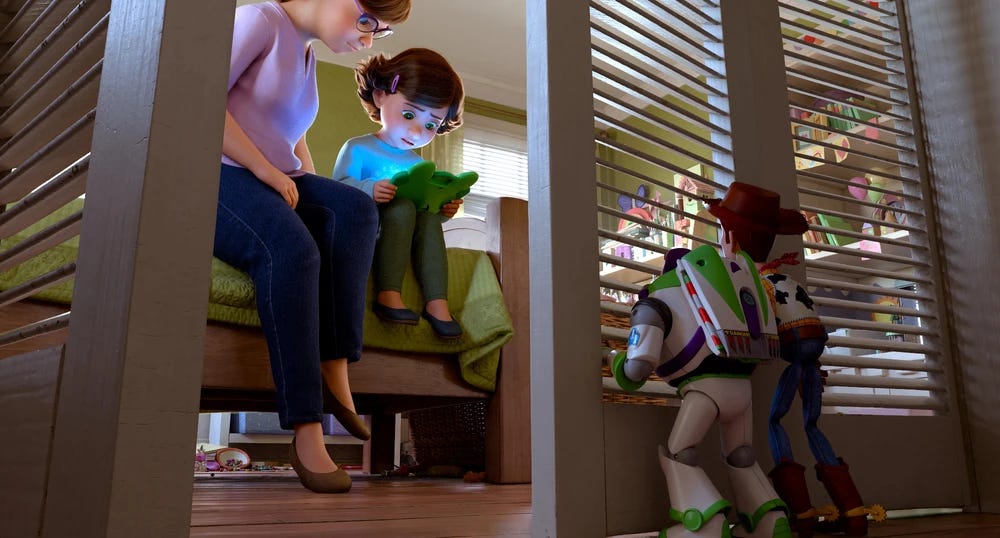
On a surface level, this is a film about how kids need to put down their tablets and make human connections, and I assume the creators felt quite proud of themselves taking that stance. It was, of course, then rushed out to streaming services so kids can stare at it on their tablets instead of making human connections, much like saying that Lassie teaches that boys should be out playing with their dog instead of at home watching Lassie. Overall, this is the second most cracked mainstream kids’ movie I’ve ever seen (with first place going to Zootopia, a movie that was apparently substantially changed during production on the grounds that someone did notice it was incredibly racist, but which remained a bizarre parody of wokeness where a rabbit is learning to not be afraid of carnivores.)
From here, it is best to just go through the storyline with commentary about its clear meaning.
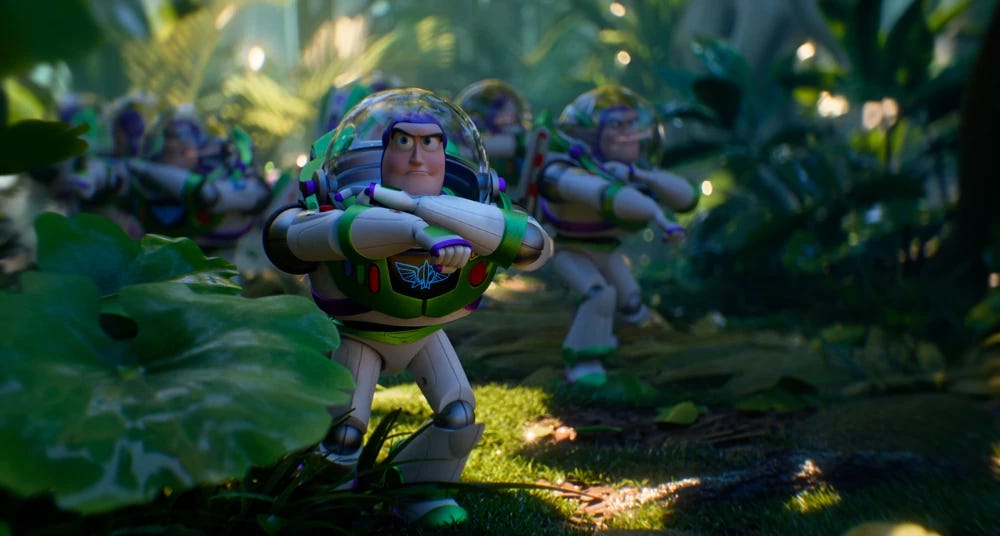
The film starts with a shipment of new, high-tech Buzz Lightyears who have suffered a shipping accident that caused them to wash up in a crate. Throughout the film they are moving together as a unit trying to decide what to do, but their relevance isn’t clear until much later. It then goes to the toys from the main cast being played with by the girl Bonnie, who we learn doesn’t have any friends. The neighboring kids, twins, who are white, have not played with her all summer. Their race is not shown to be relevant, but of course there is an implication in the minds of people who write Hollywood brainrot that the whites won’t give her the time of day.
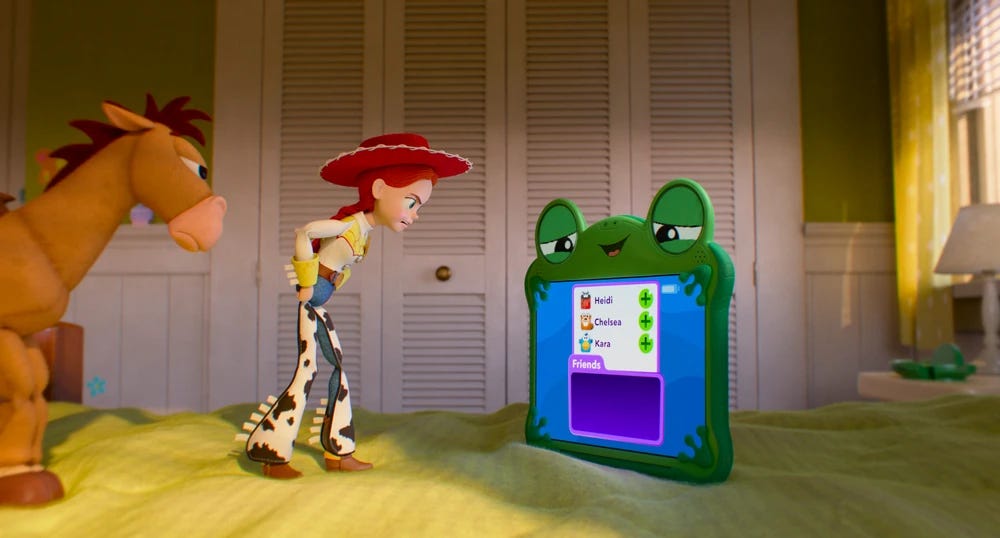
Jessie, determined to make her kid a friend, ventures to the yard across the street, and finds out that all of the household toys are living outside, having been displaced from their homes by tablets, which make kids no longer value toys. The now-homeless toys- driven mad by the sound of endless tapping- are jealous that she has a kid who still plays. She is skeptical that she is of the only remaining tribe in their neighborhood who have avoided being ethnically cleansed from their homelands in favor of the immigrant shock troops who are preferred by the ruling class. However, she is taken onto the roof to look into all of the windows in the neighborhoods, and sees that all of the kids are on tablets. Jessie realizes that mass immigration of foreign tech workers really is leading to a toy apocalypse; while it may often be only one tablet, the multi-functional nature of a tablet makes it equivalent to a boatload of new toys. Unbeknownst to her, she has been living in what would be called “Whitopia” in some American political discourse, a rare area that has not been changed by mass immigration. At the same time, Bonnie’s parents, who both wear glasses and seem to be stereotypically Asian but who are apparently supposed to be Hispanic, decide she is finally old enough to have a tablet, particularly as she cannot make any friends. The tablet, a frog looking thing named Lilypad that hooks her to a network called “the Pond,” is alive like the other toys (though battery dependent) and happens to be voiced by an Asian. Lilypad explains all the ways that she is better and more qualified to help Bonnie learn and grow, and is actually the real best resident of the country she just arrived in. Again, this movie is strangely heavy-handed in portraying these themes, presumably because the creators were so oblivious.
Please consider getting a paid subscription. I have mostly been freelancing because I make almost no money here, but would love to write on Substack more, which I could if it generated revenue.
Here we get a lay of the land in Bonnie’s bedroom. At the end of the last film, 3 years prior to this one in the internal chronology, Woody, due to his white and male fragility, had decided he couldn’t handle not being Bonnie’s favorite toy (to be fair, that is the basic plot of the first movie) and went off to be a lost toy with Bo Peep (who was already feral, I guess.) Jessie is in charge of the room, and Buzz, a shell of the toy he once was, is trying to ask her to marry him and is happy with a role as her deputy (in both cases, despite that Jessie appears to be a child.) Based on dialogue it seems Woody, too, had in some way or another accepted his subservience to a woman before leaving. As Bonnie grows more attached to the screen invader in their country, the toys became increasingly anxious and hostile. They call Woody, with whom they have radio contact, and we learn that Woody and Bo Peep are toy separatist survivalists who help toys who have been displaced from their homes by immigration. It should be noted that Woody’s glory has also declined and Bo Peep seems to run that operation as well, constantly mocking and belittling him in front of other people. Meanwhile, at some point in this, Jessie has taken to remembering her time on a farm with her first owner, Emily, who, being from the second film released in 1999, is a legacy white character; Emily’s address is still written on the inside of Jessie’s chaps.
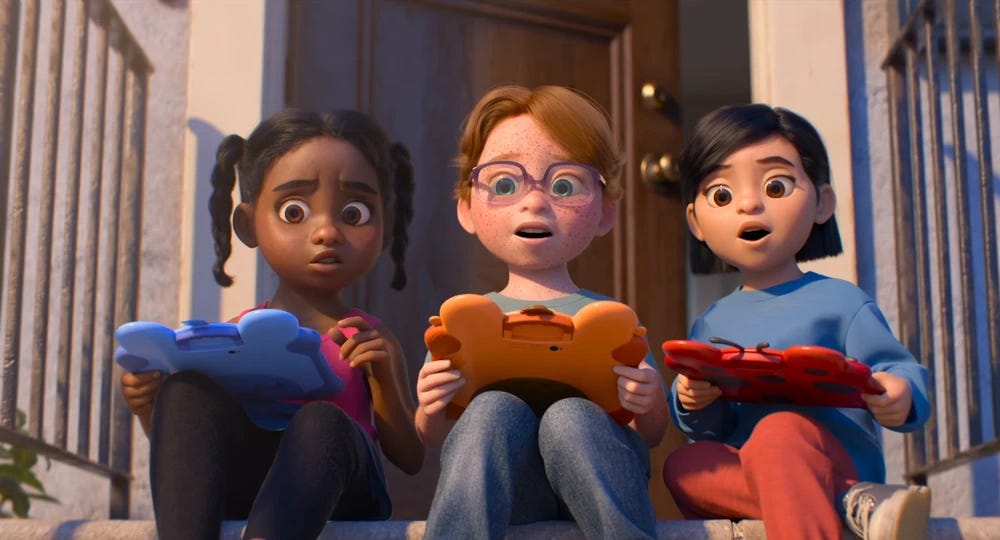
Having a tablet, Bonnie is now able to join a group chat with the other girls from her dance class, while the traditional toys deny that friends can be made this way. She gets invited to a sleepover, and Jessie and the horse, Bullseye, stowaway to try and help her make friends, though Lilypad tells them it will just get her made fun of. However, Bonnie is excited to see them in her luggage and thinks her dad has packed them. When she gets there, the other girls are all on tablets and make fun of her for still playing with toys (she is 8, by the way.) Bonnie’s traditionalism is a source of ridicule among those who have embraced a society of foreign workers. Also, the sleepover is 75% non-white, including Bonnie, though what a melange, an Asian, a white, a black, and the vaguely Hispanic girl, all with different colored tablets!
After Bonnie returns her toys to the car in shame, they escape out the window to try and help her. However, they have to pretend to be inanimate when an old couple sees them (that this discipline is instant and universal among toys is almost as unrealistic as the toys being sentient in the first place.) The old couple, who since they are elderly are white, assume children still value toys, and being good citizens of a prior era drive Jessie to her original home that is written on her chaps, leaving her in the mailbox. Jessie does not initially realize where she is, but tries to ride a horse she sees, then gets thrown off and stuck in hay, while Bullseye remains free. A black girl named Blaze runs in and is excited to find the toy horse (I should point out here that a black girl living on a farm and owning a horse is wildly statistically unlikely; they also show a minority family camping later.) A pig with the grim name of Jimmy Dean ultimately roots her out and then carries her in his mouth to a play shed overgrown with vines. Here, we meet another colony of toys displaced by immigration who have not had the work which makes their lives valuable for many years. Jessie accidentally turns on a potty training computer- voiced by Conan O’Brien, the only significant white voice actor new to the franchise, but of course one of the Boomer generation who kept younger white men out of the industry- that is almost out of batteries, and are told it was her first screen, whom they blame for the fall in their fortunes. Ultimately, this unethical tech worker scams Jessie into taking him back to the house, where he further guilts her into reviving some of his brethren. We learn that she only used any of them as short term workers, but nevertheless they was instrumental in leading to the more virtuous native population of traditional toys becoming unemployed and driven from their home. Jessie has, however, realized upon entry that this is her original house.
Jessie, shouldering the white (wo)man’s burden, is able to teach them the value of real, make-believe play, and when Blaze- who does keep a collection of toy horses though she doesn’t seem to use them- finds Jessie and Bullseye amongst her old electronics she forgot about, does use all of them for a game, and the electronics readily admit to the superiority of Jessie’s culture. Those devices, who are hooked to the Pond network, agree to help Jessie and Bullseye get back to Bonnie, with the aim of making Bonnie and Blaze friends, it having been decided that Blaze is a special girl who knows how to play properly in their era of cultural corruption. They send a mass message of a picture of Jessie and Bullseye, which includes Blaze’s home address, saying the lost toys are looking for their owner (the parental safety controls on these things are crap, clearly.) Lilypad sees this and tries to stop Bonnie or her parents from finding out, and then also maliciously sends Bonnie’s dad a message asking him to box up all of her toys during the dispute.
Bonnie has by this time gotten home from her sleepover, where the other girls played hide-and-go-seek and “forgot” to find her. However, her mom sees the picture, and takes her to Blaze’s to recover her toys, which Blaze considers normal despite not having sent the message and no one is concerned about an 8 year old’s address being mass-shared over the internet. Woody and Buzz, in a brief moment recapturing their former glory, manage to jump on the back of the car and hitch a ride to save Jessie. On the way there, Bonnie is using Lilypad (her parents claimed there would be strict screen time limits which they then did not enforce) and her “friends” from the sleepover recognize the toys in the message and mock her in their group chat. When she gets to Blaze’s house she painfully chooses to not take her toys back, but Blaze, who is also confused, says she can come and get them at any time. Ultimately this leads to Bonnie’s mother learning that she has been bullied in her group chat and taking her for ice cream and suggesting putting Lilypad away. Lilypad, realizing she has served Bonnie badly, has a pang of conscience and tosses herself into a donation truck, canonically the most feared fate in toy culture.
Back at the farm, Jessie is unable to cope with being rejected by a third child, and stares out the window at the tire swing where she played with Emily decades earlier, as was previously shown in flashbacks. She jumps out the window and onto the (real) horse and rides over to the tire swing. She sees “Jessie was here” carved into the tree and then discovers a box under it that has artifacts too new to be from her time with Emily, who would be a grownup by now. She sees a picture of Emily with her daughter, and realizes that far from being forgotten, she was so important in Emily’s life that Emily named her daughter Jessie. Imbued with a new sense of purpose and self-confidence having rediscovered the nobility of her past and the virtue of her cultural values, she is again determined to help Bonnie and Blaze become friends, recognizing that even if she is rejected there is a greater good in a child’s happiness. By this time, Woody and the original Buzz have mounted some of Blaze’s toy horses and rode in pursuit of Jessie, arriving in time to see her make this discovery along with some of the other toys. They again use Jessie’s old electronic toys to contact Lilypad and learn that she has thrown herself into the donation truck.
As this has been going on, we have been seeing a horde of the new, high-tech Buzz Lightyears running around figuring out what to do. They have also seen the picture that was sent out of the toys, and noticing Jessie’s sheriff’s star have decided that she is the head of Star Command and use their GPS to get to Blaze’s address. Being a new generation of white men lacking individuality and designed for the modern world, their willingness to pledge fealty to a woman is instant, whereas the original Buzz and Woody, who are Boomers, were instead henpecked and emasculated over a period of decades (much like Andrew Stanton, one of the most successful creators of children’s films of all time, who was inexplicably compelled to give equal credit on his most valuable franchise to an objectively unqualified they/them woman half his age.)
Ultimately, touched by Lilypad’s sacrifice, and needing her to connect the girls, they use GPS to go running after the truck she is on. We again learn as they are running that the average human in the Toy Story universe is now an ambiguously South or West Asian individual who wears glasses and has an email job. The toys catch the truck and have a touching moment but then realize they must escape from the truck. With Jessie as the moral leader of this important mission, Lilypad realizes she can scan a new Buzz’s QR code to control them and she makes them become quadcopters and fly everyone away in an airlift (“With style,” as opposed to the original Buzz, who famously could only “fall with style.”) At last, we see that under the guidance of a benevolent white woman who forms the moral center of society, managing an Asian tech worker, the masses of reformed white men willing to shed their individuality and accept a subservient position are able to help save the day by turning into literal drones.
In the end, with everyone back where they are supposed to be, the devices are able to connect Bonnie and Blaze, who become friends, and have a toy wedding for (the original) Buzz and Jessie (It’s notable that both girls play more conventionally feminine wedding and ballroom games with their toys, though in both cases with more exciting murder or spy aspects.) While broader toy society has not been saved from the tech immigrant apocalypse, through the thoughtful and competent leadership of a white woman at least their own town has been saved and they can for a time continue to preserve the fire of civilization.
This is followed by the Taylor Swift song playing during the credits, because apparently no one was capable of incorporating the film’s main song into the film. A post-credits sequence shows the Buzzes landing at a school and being caught by a group of excited children (a surprising amount of whom are white, given the rest of the film,) showing that there is still a place for conventional white male toys in society, as long as they are advanced enough to be controlled by women and immigrant tech workers. A happy ending indeed, if you should happen to be a woman of the professional managerial class or an immigrant tech worker, at least.
It is, at this point, hard to know what to say by way of conclusion, having covered so much ground, but this really is a thematically incredible movie. One criticism would be that I am acting no different from “woke” cultural critics and that isn’t inaccurate, what is more incredible is how much they fall into well-described pitfalls they want us to care about. This again though is not subtle, and I often think about the themes in films and rarely do they continue to go so hard that I can’t believe what I am watching. A few of these things require deeper analysis than most would be willing to give, but the fact that only “legacy” humans and toys are white throughout most of the film is quite noticeable. It is the case that since Jessie no new major white characters have been added but that everyone who is added is always a minority, and this mirrors Hollywood production as a whole, and for that matter, America itself. I think what happened here is that they thought they had such a nice story about how important it is for kids to play with normal toys and not just with tablets that they forgot about what this means from the perspective that the toys have always been the main society in Toy Story films. With all the toys anthromorphized, the tablets are not just distracting the kids from their childhoods, they are alien invaders ruining everything.
It seems the white Boomer-diversity alliance did not have the competence to even remember what they are doing here, which I suppose could be said about a lot of modern media, it is just rarely this ludicrous. At least this time it turned out to be an incredible, if accidental, allegory.
Thank you for reading! The Wayward Rabbler is written by Brad Pearce. If you enjoyed this content please subscribe and share. I am available for freelance work and can be contacted by email at pearcebrad@hotmail.com. You can see my shitposting and serious commentary on Twitter @WaywardRabbler.
I do get annoyed at the very unsubtle role manipulations in movie remakes , and ads, with women taking charge and denigrating the male characters. But I think you may not have noticed that racially ambiguous is what we are now. Our colonial past turned up in the present, and had a laugh at our pompous whiteness. We were a pompous lot, you have to admit. Young people are more or less all racially ambiguous in the US and UK, except somewhere I haven't been. Somewhere that parents make sure their children are aware of their pigmentation? (Something children are never naturally aware of). So I don't think we're going back to being particularly white any time soon.