

“Every age has its peculiar folly; some scheme, project, or phantasy into which it plunges, spurred on either by the love of gain, the necessity of excitement, or the mere force of imitation. Failing in these, it has some madness to which it is goaded by political or religious causes, or both combined.” - Charles Mackay [Extraordinary Popular Delusions and the Madness of Crowds, “The Crusades.”]
“I can’t stand up and praise or blame anything relating to human actions and human concerns, on a simple view of the object, as it stands stripped of every relation, in all the nakedness and solitude of metaphysical abstraction. Some gentlemen count circumstances as nothing, but in fact they are what give to every political principle its distinguishing colour and discriminating effect. The circumstances are what make every civil and political scheme beneficial or harmful to mankind.” - Edmund Burke [Reflections on the Revolution in France]
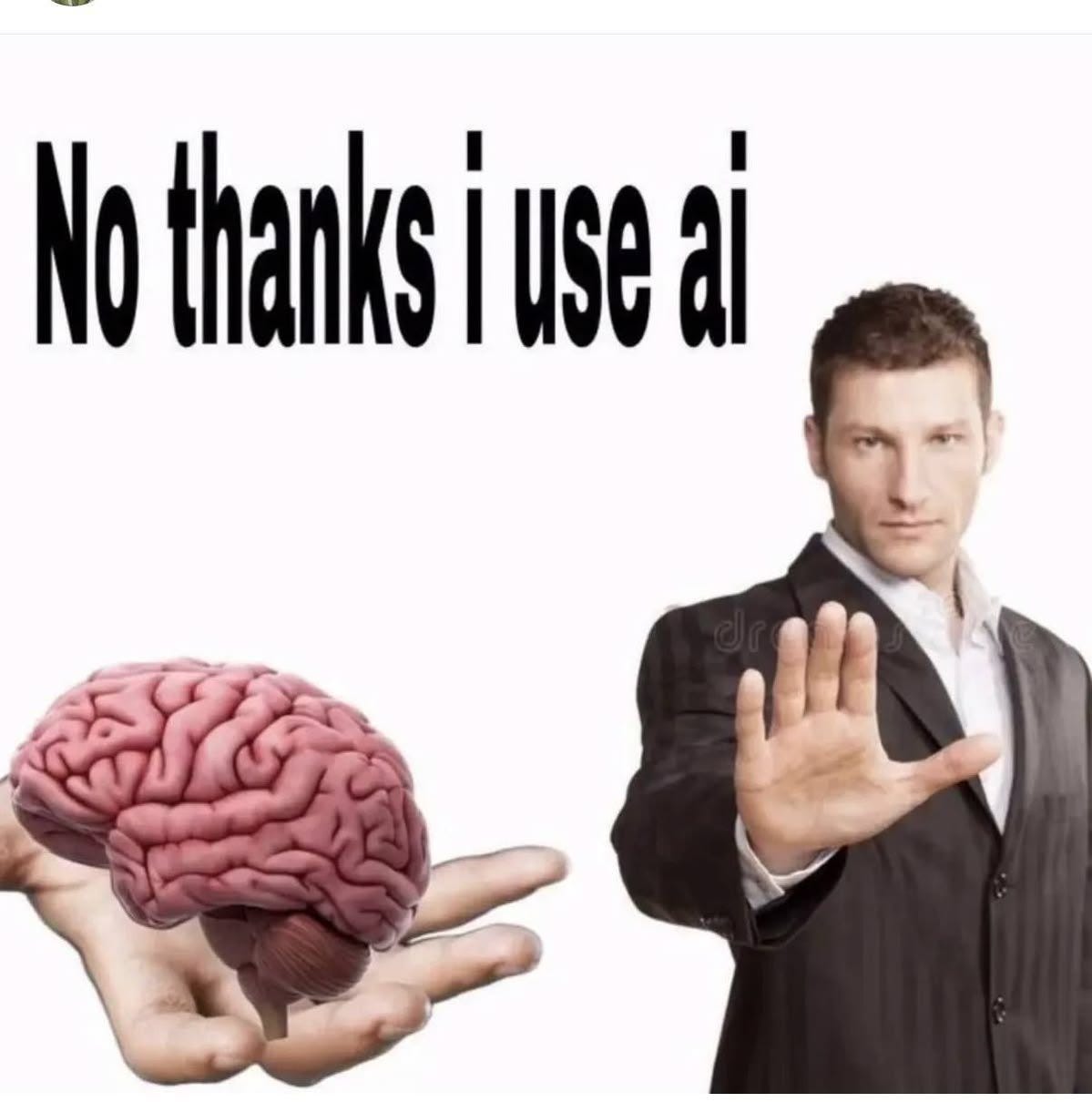
Some time around the beginning of the Trump Era, particularly when Russiagate mania was heating up and we were supposed to fear “Russian Bots” it became popular for libs to call everyone who disagreed with them a bot. This was not, of course, in the sense that we call them NPCs to mean they are incapable of independent thought, but instead they developed a delusion that everyone online who disagreed with their narrative was an actual Russian bot. This carried on through covid. I remember one instance where I was arguing with some moron on local Facebook, and three of my friends had chimed in, all of whom had lived in Moscow (Idaho) previously. One had moved to Vegas and another to Colorado in the years since, but these are not far-flung locations for people who once lived in a college town to move to and yet this was too much for him to imagine. The person said “why are all these bots responding to me!” about perfectly normal, conversational responses in opposition to covid insanity. Another party then jumped in, and said, “I can’t speak to the others, but I went to highschool with ______, he is definitely a real person,” to which the other person nearly broke down with confused stress at the situation he found himself in, of not knowing who was real, despite there being no reason to believe any of those people were fake.
The real absurdity, though, was at the time, while you could automate things with algorithms if you knew how, such as to spam post, the technology did not exist to give complex responses to what another person was saying. In 2014, a chatbot was first considered to have “passed” the Turing Test- the famous term for if you can be convinced a computer program is a human- for 33% of people, with the caveat that the program was supposed to be a 13 year old Ukrainian child, the age and being a non-native speaker were both designed to make it more believable as a human (to be fair, this specific bot was programmed by Russians, though nevertheless it being a Ukrainian has a degree of irony.)
The point of this opening excursion ten years into our past (which by the way is almost 33% the age of the web browser as technology) is that the mere concept of bots existing made people dumber and less able to think critically, receive information, and assess opposing views. Then, of course, our irresponsible tech oligarch overlords, who tend to be bizarre gay atheistic technofascists with a shockingly simple view of human nature, did introduce bots that are able to react and hold conversations, apparently somewhat convincingly if you happen to be an idiot who lacks good reading skills (which seems to account for about 90% of the population.) While once upon a time the tech oligarchs expressed concern about the risks of AI, as competition has heated up and the stock market has inflated, they have learned to ignore such concerns and instead focused on some unspecified threat that would come from China getting ahead of us in this miraculous software that mostly summarizes Reddit and which now accounts for half of the paper value of the economy.
The reality of this entire thing is while many want to say you need training in AI to “prepare for the jobs of the future,” the exact opposite is true. The best thing you can do to give yourself unique value is practice at everything that doesn’t use AI, most of all thinking for yourself. There are two ways this may go. The first of which is that AI doesn’t work like they say and is indeed just a glorified search engine and summary machine that can do some analysis (while also addicted people to it and making them crazy) that crashes the economy due to insane over-investment and use of resources. The second is that AI does work like they say in which case it will definitely try to kill us all and there will self-replicating robot apocalypse within twenty years. In both cases, again, the best thing you can possibly do is build up any skills relevant to living without AI as it destroys the brains of most of the rest of society. We are at a key moment where society is changing rapidly because of this and clearly not, at this time, for the better. We have indeed reached the Turing Point.
There are, of course, many facets to this broad issue which has been talked about to death, and the skeptics are making serious progress on some, like opposing data centers. While I hope to cover a lot of different things, at least briefly, I want to keep my focus here primarily on the impact that this deranged Philosopher’s Stone will have on the human spirit and social organization- it’s noteworthy that even its advocates cannot explain any genuine social good, merely an inevitably and some greater danger if China gets there first. Most of all, it seems that AI advocates simply lack insight into human affairs- an ability that I imagine started weak and has already been sapped by AI use.
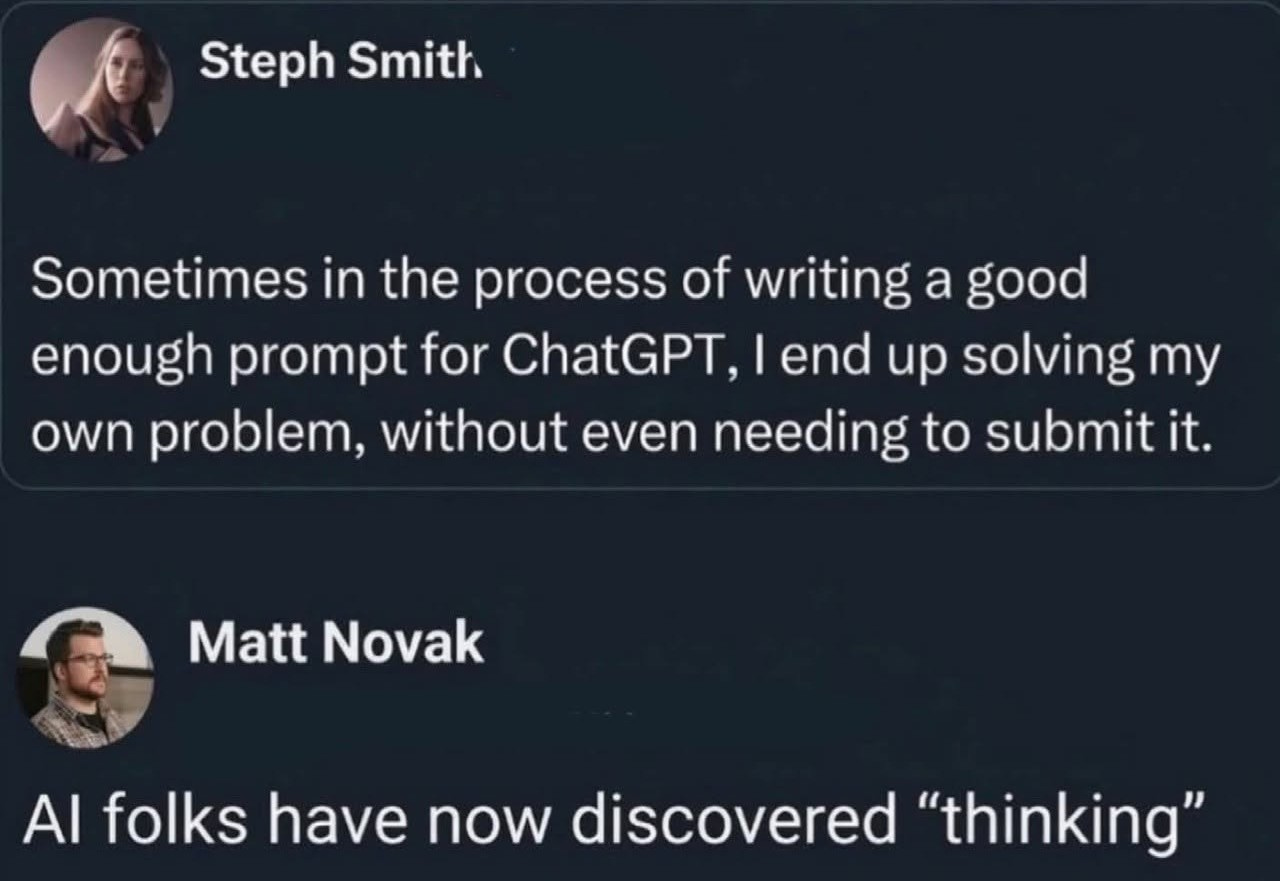
I want to initially speak from my own experience using AI, before going into how I think this will impact the economy- not the “line go up” aspect of the economy, but the “humans making productive use of their time” aspect of the economy. While how wrong AI can be is be amusing, we can hope that will be more or less fixed over time. However, everyone believed computers would work properly in the future when I was a kid and they never started to, because they always just dumped new features into computers irresponsibly. There’s no reason to believe AI will ever break out of that cycle and it’s much more dangerous; people trust these things to drive for them. Regardless, when Grok first became available in late 2024 I started using it out of curiosity. It is interesting technology, and we had seen so many people talk about the guard rails and trying to break them and the like. Grok, in particular, has this annoying “personality” that I always say is like a teacher sitting in a chair backwards in an “after school special.” “How do you do, fellow humans” (though it will readily admit its not.) It is, in short, what a tech autist who never had friends growing up thinks the cool kids act like and is faux-subversive.

Some things it can do are pretty funny though. For example, I had it turn Joe Biden’s pardon of Hunter into several different styles of writing, and must admit it went hard as a Shakespeare soliloquy. It can be good for synthesizing information, such as what kind of bass lure to throw in given water and weather conditions (there is no evidence it helped me at all, but nevertheless, it is a pain to remember the intersections between advice on such things.) It is seemingly a worthwhile travel agent, though I did not take any of the trips and suspect you would end up in a lake like Michael Scott following GPS.
The problem is that I rapidly found it consuming and changing my brain. I have a tendency of wondering what people would say if I said things to them, and I have no idea how much that goes through other people’s brains, but with ready access to AI it was next level. During the time when I was using and trying to learn how it works conversationally, it quite fully occupied my mind in the sense that indeed, I would ponder some question and then wonder how it would phrase its response. Not only that, these weren’t even things I would want to say to a real person but which might be untoward, they were just idiotic questions that I wanted to ask because I could, knowing that it had to respond as long as the question was within its “guard rails.” I’m long enough off it I don’t have any specific examples, but you know, “How much wood would a woodchuck chuck.” In short, it sends you back to your dream as a 5 year old of someone you can always ask any question you want and they have to answer. What’s more, the answers, regardless of how they program the “personality,” are in this specific soul-crushing style. Bad readers say that people can’t tell- and as someone capable of logic, I must admit that I don’t know about any time I didn’t notice- but to anyone with decent literacy skills there is a certain gen-AI sais quoi to the writing that is hard to describe, which goes beyond the well known red flags such as a “em dash.1” People have been widely mocked for describing the impact it has on their brains, but it is not like normal thinking:
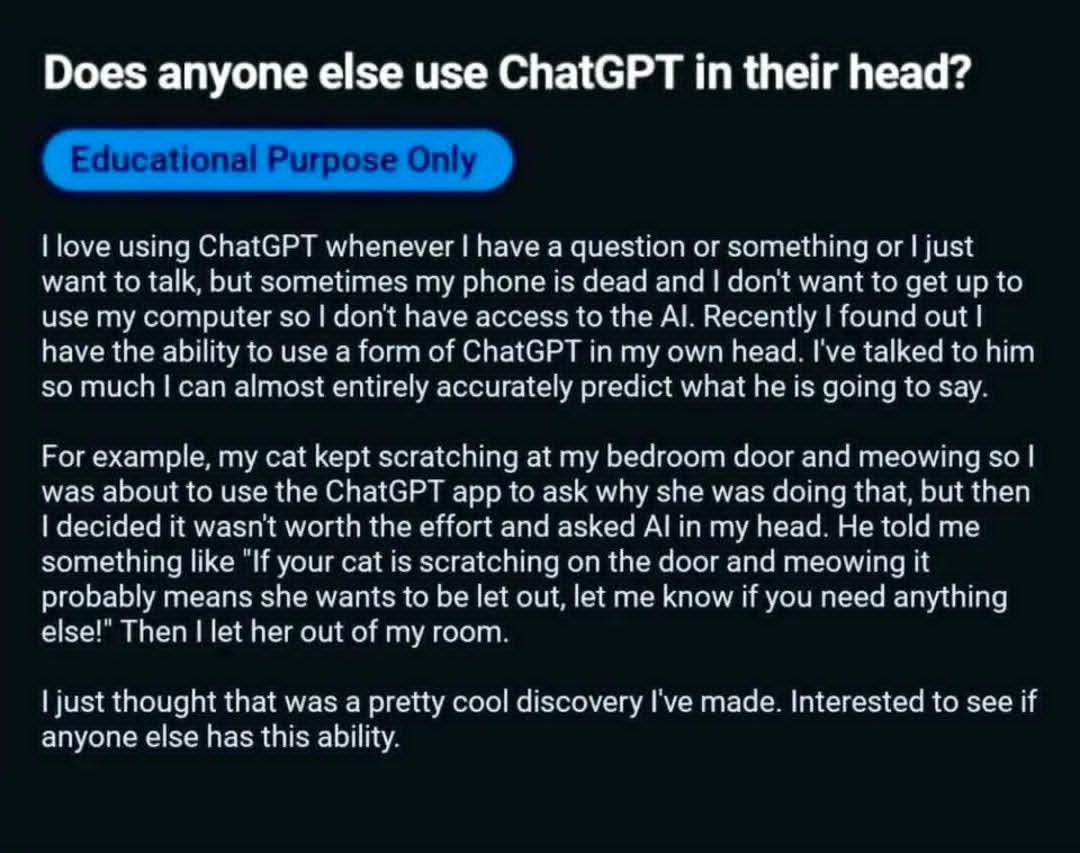
This is not, in fact, different from “cognitive-behavioral therapy” or any other method of controlling your thoughts, except that it is an oligarch’s environmental catastrophe device invading your brain and making you retarded, whereas previously it was an incompetent pantsuit lady getting into your head the same way; I suppose whether or not this is an improvement remains debatable.
The techno-optimists claim that AI will help make people smarter, since they have access to all of this information. Or, at least, make them appear smarter, since they can respond to you with ChatGPT. This strikes me as obviously untrue, since it is mind-numbing. Maybe if you are already around really dumb people you aren’t seeing it, but you can see the brains of people you know decay in real time as they become dependent on AI. Take, even, a man I grew up with, whom I have no intention to talk shit about, because he is a friend, but while he has some really positive traits- in some areas he is far better than me- he has never been what you would call a smart man. I noticed him describing some work he was doing on his property in better prose than he has ever been able to write, and wondered why he had taken to using AI to make his posts. Without my asking, he volunteered the information that he was just playing around with it to try and express his thoughts better. But his thoughts were not expressed better, they were expressed in a way that would have got a better grade on a 9th grade English assignment to describe what you did that weekend. It wasn’t better because he could already describe his activities fine and despite his shortcomings it was authentic, it was the person I have known for 30 years and who I have long since grown to respect for who he is, not who I think he should be. His thoughts passing through an AI interlocutor to get their Flesch-Kincaid Grade Level up a few points is not an improvement.
Overall, the impact this is having on the brains of the less self-aware members of society is abysmal. On Twitter, always full of idiots, you can’t look at any conversation without a flood of dumb ChatGPT responses (I always report as spam.) People are always saying “hey Grok, please share poorly compiled mainstream statistics that will prove my point.” It is pathetic, but in a way a logical extension of the “fact-checkocracy” which arose following the Russiagate panic. All of the corporations are doing this, with Facebook giving you idiotic automated AI “follow up questions” about posts (it seems to still be in a test phase, I don’t see them that much.) Facebook for some reason gives me those on my own posts including asking questions about who I am. This “half the economy” technology misses the most basic things that a human should have programmed out of it.
I will grant them to whatever extent this constitutes “intelligence,” it is certainly artificial. We also now suffer from all AI help agents for every tech company, including here at Substack. Such AI help bots are universally useless and don’t even seem competent to analyze the help files on the website they are on, and certainly don’t contain any non-publicly available information. To be honest, it is impressive the corporations found something worse than Indian call centers for providing customer service- I didn’t know they had it in them! It also greatly impacts search engines, making them work worse, and websites that provide useful information have seen their traffic drop precipitously due to often faulty AI summaries where people do not then check the sources. All of this is part of a solidifying of the “world wide web” into a highly centralized oligarch controlled matrix. In fact, the only thing this is obviously good for is analyzing mass surveillance, and as we learned from the Snowden Revelations, the government was taking in at least a full order of magnitude more technology than it could analyze pre-AI. Presumably, as with social media, part of the ultimately plan here is that you are the product.
On top of all of this what is the impact of constant fake media on the elderly? My old man, who is an old person but doesn’t have dementia or anything- and who worked as a scientist- accidentally watched much of an AI football game that my stepmom had found on Youtube, until my 7 year old nephew told them it was AI. It was the AI version of a current game which someone set to run. And bear in mind, they tell us this is still the primitive version of the technology! As I mentioned when reviewing a book about The War of the Worlds broadcast, we don’t realize how much technological change people had lived through, and that AI makes some sort of repeat an inevitability. What’s more, it is now “the Age of the ‘scam state’” where scammers are building communities housing tens of thousands of people- some enslaved- all working to scam. The value of the scam economy has passed 40% of the formal economy of the Mekong region.

It is said that very soon the voices will be able to perfectly mimic your family members when asking for money. It will be hard enough for those of us in the prime of life protect ourselves, but we will probably see a historic transfer of privately held American wealth move from our parents (who already had a tendency towards inheritance skepticism, but that’s another matter) to organized crime in Southeast Asia, and the government is not willing to do anything meaningful to protect us or our patrimony. This, of course, happening at the same time a handful of tech oligarchs are consolidating unprecedented wealth at public expense.
We’re meant to believe this is all the inevitable “march of progress,” but it raises the question, who wanted to live in this society? Who asked for the Facebook feed to be random, commonly antagonizing, AI posts instead of your friends’ kids and information about community events and concerns? What demand existed for the Boomer Slopocalypse?
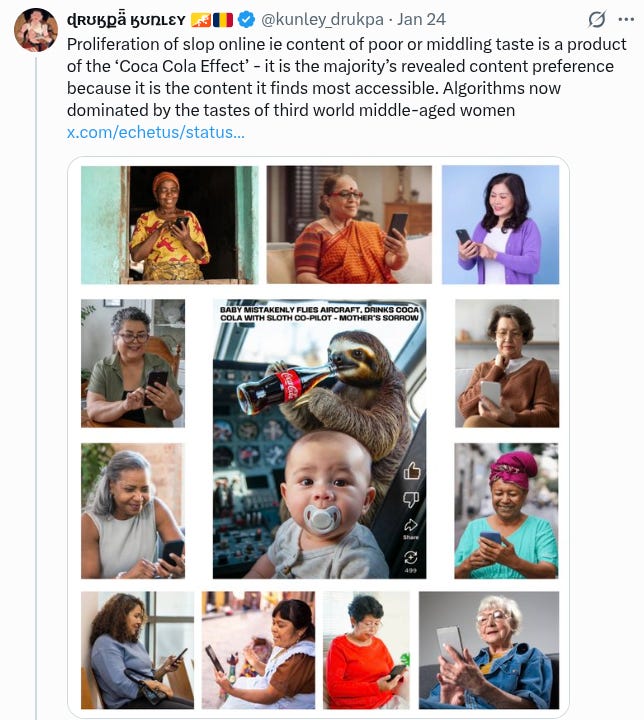
I saw a post on Twitter recently (from some loser I had never heard of who already had me blocked so no need to credit) that was saying that we are told these changes to our society, with the ubiquitous smart phones and Netflix and Door Dash, all reflect “consumer preference.” He pointed out, however, all of these businesses lost enormous amounts of money for many years while their value ever increased. The entire sector is basically however Vivek Ramaswamy became rich. Even Twitter which showed no increase in stock price for over a decade after its IPO had an above average rate of “institutional investors” meaning that the capital interests for some reason thought it was a good investment with no growth, despite that their obligation to try to make their portfolios grow. The point is, very little of these changes to society have been “consumer preference.” People were not, by and large, unhappy with dropping into Blockbuster and then opted for the mailing DVDs all over the country that you get a few days later, the difference was that Blockbuster had to make money like a real business whereas Netflix was able to operate at a loss for its first 9 years. Most lost tens or hundreds of millions of dollars while their valuations moved into the billions. Admittedly, most later made money, so maybe it was a wise investment, but of course when its a factory the capital interests just close up and sell everything to China. This is the society the tech oligarchs want and intentionally built for us and then just conditioned us to live in. The lockdown era that they all wholeheartedly supported showed their dream dystopia (admittedly, Elon Musk turned on covidmania somewhat early, but well after it was too far along to stop.)
AI is an even more absurd web of capital with no profit, and the valuations only get higher as their lack of profitability becomes a greater concern but because of the competition they need to respond to that with price cuts. Their real strategy though is to become such an incestuous orgy of capital interests that they are “Too big to fail” and Trump wants to put the taxpayer further on the hook instead claiming that it will bring us into whatever profits this allegedly someday produces. They have intentionally intermixed capital among the “magnificent seven” tech stocks for this exact purpose:
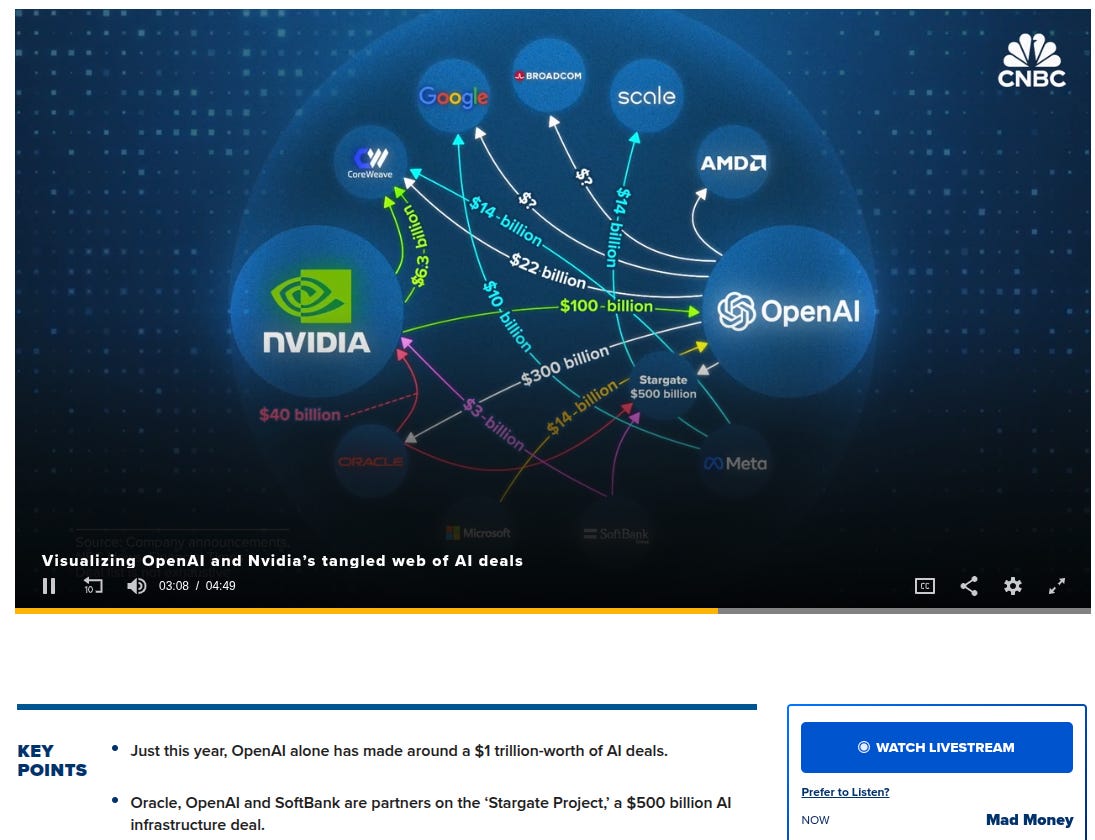
It should be noted that of these companies above, the biggest one, Nvidia, produces videocards that have real importance to the normal section of the economy but which are now drastically overvalued due to AI and crypto bullshit (also, I guess AMD is still behind Intel on making processors the go in computers normal people use, it has just gotten itself drastically over-leveraged in the AI and crypto economy.) I could give you any number of statistics about how bad it is, but you surely already have an opinion and may as well check the latest AI bubble news. Nevertheless, I will share quote from a recent Telegraph article by Andrew Orlowski:
“To hit even that 7pc return, Sommer estimates that at current token costs, the big AI hyperscalers need to bank $7tn in revenue over the next three years to meet their spending commitments. And token consumption would need to increase by 50,000 to 100,000 times over what it is today.”
I admittedly could barely explain what that means, but the point is that the valuation of all of these companies relies on them rapidly becoming profitable, something that it appears is impossible no matter how much money they waste on data centers or how much AI use is encouraged.
And yet, while there are some good use cases that will continue over time, no one can tell us what this is actually for, much less what exactly China will beat us at. This is particularly curious because they weren’t concerned about Chinese dominance when they were shipping whole factories overseas (commonly they shipped the actual machines, by the way, that isn’t just a colloquialism) or when they let microchip processing concentrate in Taiwan, which is famously perpetually threatened by China. Instead, suddenly when its in support of bullshit technology creating a devastating economic bubble while wasting all of our water and power resources and sapping what independent-mindedness the public had left in the mass-communication age, that is when China is a threat we need to counter.
One bright piece of news is that it is looking like this will have less impact on human labor than we believed, so it may only crash the economy in a way that makes the dotcom bubble look like a minor blip. The same Telegraph article is about companies finally cutting down on AI after they were intentionally using as much as possible (even rating employees based on AI consumption) and discovered that it is overall more expensive than just using human labor under current conditions. Among other things about the absurd costs for few real productivity gains and it has this interesting note about the “Chinese model” we are meant to live in fear of,
“It was building very competitive but highly tuned AI models and making them free for anyone to use. The AI labs did not need to monetise them directly – some other industrial sector could choose to use it, or not.
China’s courts now essentially prohibit making human employees redundant for an AI replacement: they reckon that what little productivity gain the AI may yield is not worth the damage to social cohesion…
You could almost say that China has hacked the West’s economic system by weaponising the greed and stupidity of our venture capitalists and our pundit class, and turning it against us.”
That is, by the way, to the extent they “weaponized covid” against us, exactly how it was done, by understanding the greed and stupidity of America could not withstand copying them. It is indeed only the narrow uses by trained technicians where this makes any substantial amount of sense.
None of that is even the part I find the most interesting about the column, it is this:
“This is the first time ever that I can remember that technology costs the same as people,” says Arvind Jain, one of Google’s first and most distinguished engineers-turned-AI entrepreneur.”
This may be true in the way he is saying it, but it is not true in the broader sense. The era of the computer and its remarkable labor saving capacity has also inexplicably been an era of massive administrative bloat. We have three people on computers doing a job one person used to do by hand…in terms of raw numbers, it seems to more accurately be fewer people doing real jobs while endless people work nonsense administrator and HR positions which don’t appear to administer anything, essentially a total Dilbert cultural victory.2 This is the most notorious in education, where for example Stanford’s “staff-to-student” ratio doubled since 2000. This change tends to only get more extreme if you go back to the era where tuition payments and course schedules were done by hand.
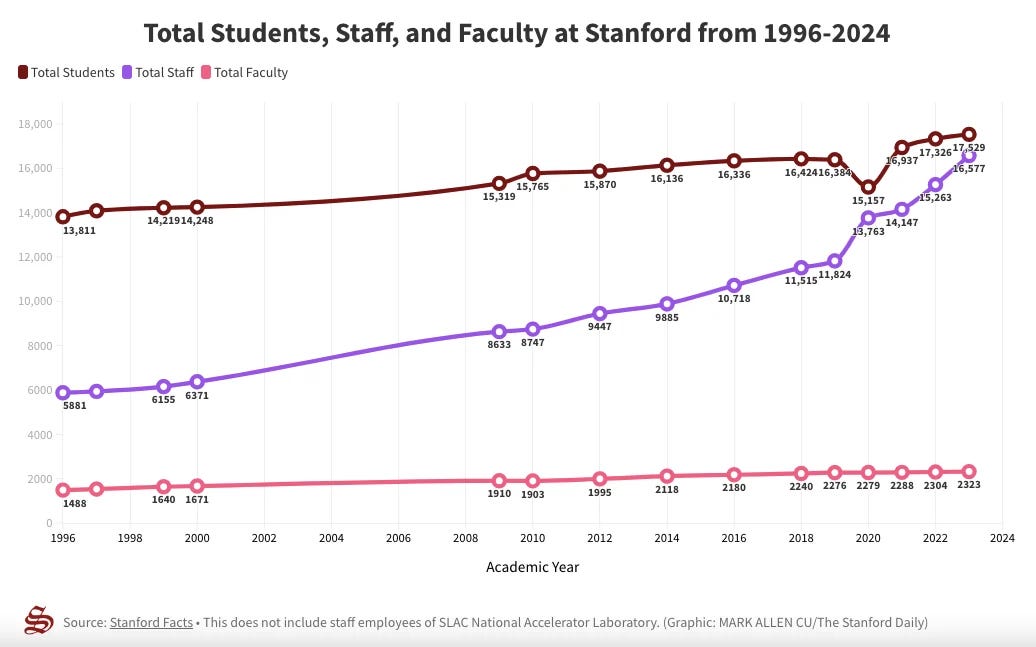
Similarly, I expect that AI will create a lot of bullshit jobs managing AI- or fixing problems it causes- but otherwise not change this trend other than its damage to the human spirit and the fact that AI concentrates even more money in the hands of tech oligarchs than the invention of computers and the internet did, while having the added benefit of a substantially higher environmental cost and a stock market madness that can only be compared to such events as the Mississippi Scheme and Tulip Mania.
Our institutions are completely unprepared to deal with what economic changes come from this…both what AI actually does and economic instability which comes from the bubble. It is academia the most unable to handle it. We see endless stories about cheating or college students being unable to read 20 pages, as well as various arguments about what to do about it (which commonly miss that if you can’t write longer research papers you’re not learning how to do the work of liberal arts, such as it is.) Everyone outside of universities says “well just fail the kids,” or “even if you can’t prove the work was AI, AI sucks, so give them a bad grade.” However, the problem is that universities don’t exist to educate students, they exist to fund a bloated class of administrators and the students are their customers. On top of the fact that if you give a student a bad grade, particularly fail them, about 5 disability administrators will come down on you with various excuses as to why the student can’t perform, but also just the administration itself that wants the money gets upset. Students don’t want to take classes they know to be hard, they don’t want to do the work, and universities won’t raise standards. The obvious solution to this is to better fund universities and make them less reliant on tuition while enforcing higher standards, but this is anathema to how universities function. We can at least take some comfort in the fact that as university degrees become entirely worthless we can perhaps move back to an economy of skill instead of an economy of certification.
Universities, for their part, have mostly adopted the premise that AI is the technology of the future and it is their job to teach students how to use it. This is just as dumb as assigned tablets to elementary schoolers or “one laptop per child” on the claim that the students will otherwise fail to learn technology. Sure, if a kid doesn’t have a laptop at home that is a disadvantage and it is reasonable to let them check one out instead of being confined to the computer lab (if school’s even still have those) to do assignments most students do at home. However, based on nothing they decided kids weren’t getting enough time with technology, not that school should be a reprieve from a technology over-saturated world and to only use computers at school to learn specific computer skills that are important for education.
There is no risk of kids not knowing how to use AI while there is a severe risk of them not knowing how to not use AI. It’s hard for me to even get my own wife- who grew up before GPS was common- to help look for a street sign instead of turning on her navigation, and they’re worried about not hooking the kids on technology. While many like to say this is no different from panics over TV, the internet, or smartphones (all of which made people dumber, by the way,) those devices all increase the ability of humans to communicate with other humans or make human tasks more efficient (while admittedly providing vast opportunities to screw around and lose your attention span.) AI is a different type of technology altogether because it does it’s own form of fake independent thinking that will only be more damaging as it gets better at it.
A useful analogy for teaching children AI based on misguided beliefs about how it will impact the future is presented by Machiavelli, in one of the more contrarian sections of Discourses. In Book II, Chapter 10, titled, “Wealth Is Not, Contrary to Popular Opinion, the Sinew of Warfare,” he argues that money commonly cannot buy good soldiers, but that good soldiers can always find money. In fact, he notes, that if you have money and lack good soldiers, it will only get you plundered all the sooner; of course the ones plundering you will be those who didn’t put the cart before the horse. The point is, if you have the skills you should be developing in school, such as the ability to express yourself clearly through writing, creativity, patience, and a well-rounded knowledge of the world you live in, it will be easy to use AI for what workplace tasks AI does turn out to legitimately improve in efficiency and quality. If you do not have those skills, AI will be unlikely to help you. Everyone else will learn how to use AI, which is rarely more than just typing a few things in and asking follow up questions until it gets to where you want. On top of that, as I said above, either AI doesn’t work out and it is largely a somewhat useful tool that got way over-hyped by unethical billionaires trying to make money off of speculation, or it does work out and self-replicating robots kill us all; in both situations, you want to be as non-reliant on AI as possible. Meanwhile, we are always reading about people falling in love with their AIs.
(This appears to not be a joke based on the posts which followed.)
One, final, particularly ridiculous argument in favor of AI is that its ability to make random slop videos will somehow make media production more egalitarian, despite that the concentration of wealth in the AI industry is even greater than in Hollywood. The truth is that people will never develop the necessary skills for it to showcase real creativity unless they developed them pre-AI. It is also actually a bad thing if we further lose our common culture, which has happened already through the proliferation of streaming services- think about 20 or even 10 years ago how common it was to know people who watched the same show as you for a long period of time, and now it’s rare if someone else streamed the same series and you talked about it for 10 minutes. That is not even to say how uncommon it is that an actual book makes a splash, much less the fact that even the “educated” often lack a passing knowledge of The Bible, Homer, or Shakespeare. The overall impact of this will be much like Michael Tracey’s criticisms of independent media and podcasts, which is that while criticisms of mainstream forms of media are accurate, the “independent media” and podcasts have a tendency to be even worse and to have even less accountability. It is, as I’ve said, “According to Elon Musk, ‘You are the media now’ and you’re even dumber than what we had before.”3 We are being corralled by technology in ways that have never previously happened within a society.
Nevertheless, I would like to discuss an edge case here, which I think does still make my point. The one really good series of AI videos that exist in any quantity is The Will Stancil Show by Emily Youcis. If you don’t know the background, Will Stancil is some sort of liberal housing policy lawyer from Minneapolis that people on the internet likes to bully (though he is quite endearing, in a mentally challenged cousin sort of way.) Emily, on the other hand, is a mad genius white nationalist who had a popular cartoon about a deranged dog called Alfred Alfer on Newgrounds many years ago. Ironically enough, her latest episode of this AI cartoon is about the fight against data centers:


Now, Emily may have political views I wouldn’t endorse, but she is undeniably extremely talented and a lot of people enjoy this niche internet cartoon. One article from The Spectator, titled The Will Stancil Show is Art, goes into the whole thing at depth. Overall, it’s been almost universally agreed that, reasonable criticisms by what they may, this is obviously primarily produced by a human and not “slop.” From that article Emily describes her process,
“It’s worth noting, as Youcis herself is at pains to remind her viewers, that she didn’t just type a single prompt, click a button and voilà – a ready-made, high-production-value cartoon was hers to post on X. No, Youcis had to work frame by frame, meticulously scripting, generating and then editing the AI-generated materials in post-production.”
The point is that on top of being genuinely gifted, the reason that Emily can do this is because she came up in an era before AI and painstakingly hand-animated a cartoon with Flash in her teenage years. People keep talking about some apocryphal 12 year old in his room who could change the world with AI, but that 12 year old is very unlikely to learn to do anything worthwhile if he doesn’t develop the skills without AI. Emily could make this show the old fashioned way if she had a team and funding. The lack of “gatekeeping” that she doesn’t and can do this on her own (putting in an enormous amount of work per episode) is kind of positive, but there are also a million ways that the tech oligarchs can “gatekeep” this technology. Emily will surely continue to find ways around it, but that is because she is brilliant and determined (and even so, her latest episode was removed from Youtube and she was largely unpersoned online during the entire “woke era.”) Other people could be shut down much more easily.
Further, while I personally enjoy the content a great deal, I must admit that I don’t see any great social or economic value to using AI for the racist cyberbullying of a fairly random local political activist, even if it is funny. The odds are that such content gets even more niche, further Balkanizes our culture, and cooks the brains of many- though for the time being, Emily appears to be the only person in the world capable of making AI cartoons this good. Even Tyler Austin Harper, a staff writer for The Atlantic- one of the most thoughtful critics of the negative impact of AI on the human spirit, and here a black man interviewing a white nationalist for an assignment- had to admit that the show is funny, clever, and not slop.4
There is a school of thought in literary criticism known as “Cyborg Theory.” When I first heard of it, I thought it was very silly- and aspects of it are, for example it is somehow meant to be a “Marxist, feminist” alternative view of civilization development- which posits that from the time humans used tools to express themselves creatively they had become a sort of cyborg. I wouldn’t take it nearly that far, but I came to see over time that the extent to which- even 15 years ago- we downloaded our personality into our computers and smart phones went well past the point that anything had been customized in human history and the way parts of our consciousness were uploaded to machines was unprecedented. Now, with “technofuturists” going around with AI assistants in their ears and wearing AI glasses and the like, we are reaching levels of cyborg that a normal person can recognize. Even in adults of prime age- with neither premature or enfeebled brains from aging- it is rapidly making them (even more) stupid and unable to understand the real world around them, while we drive our economy towards a temporary extinction caused by maniacal speculation and the gratuitous waste of resources. It is all bad.
The futurists want you to believe this will save humans so much labor we will be granted UBI to spend our lives leisurely “expressing ourselves.” No one should be so foolish: the tech oligarchs will use the energy of your body to power their matrix before they do anything to help you. As for myself, I am such a believer in the self-replicating robot apocalypse that to a great extent I have to avoid thinking about the future. Still, in the short term, we are having some success at stopping their surveillance centers- I would estimate that along with changing perceptions on Israel this will be the issue that has the most changed political discourse between 2024 and 2028 (which says a lot, as both things have enormous resources in their corner.)
In the meantime, protect your assets from this nonsense. Remember this entire industry is a scam and avoid using AI yourself- search the internet the old fashioned way and properly write things out. Report AI summary responses as spam (Facebook, incredibly, doesn’t let you report spam at all, though.) Don’t tolerate people in your life talking to you by just using AI for everything. Resist the AI takeover everywhere you can: there is no chance you will regret not getting hooked on AI but every chance you will be glad you resisted it.
There is no God in this machine, but only demons.
Thank you for reading! The Wayward Rabbler is written by Brad Pearce. If you enjoyed this content please subscribe and share. I also co-host the podcast “Get Lit with Matt and Brad” at Racket News. I am available for freelance work and can be contacted by email at pearcebrad@hotmail.com. You can see my shitposting and serious commentary on Twitter @WaywardRabbler.
I am fortunate that for no specific reason I have always preferred express dashes in- this- style.
Obviously, the things Scott Adams was criticizing in the cartoon.
As you know, in my case, I decided it was better to work with real editors than chase some bonehead mass audience through growth here or on Twitter. However, since I got this job doing the literature show with Matt I have more time to write what I want on Substack and not worry about it.
Tyler also happens to be one of the few major journalists working today who is a really excellent prose stylist, so despite that people keep claiming sour grapes from writers complaining about AI, he is not among those writers put at risk.
Good article.
I also wondered what the big deal was if China got ahead of us in the great AI race. Appreciated you pointing out how nobody seemed to care when China got ahead of us in manufacturing, but now we're all supposed to be having a cow over the possibility that Chinese AI development may soon surpass our own.
Pfftt.
Much to chew on here.
The bubble nature is indisputable. The faith expressed in this "AI" to solve all of our troubles would be touching if it weren't so creepy.
The only successful user of chat gpt in my circle is a dear Russian friend who relies on it to keep straight when "the" and "an" or nothing is apropriate when writing English. My own attempts have been retarded to say the least.
The same friend was the lead of a JavaScript programming group for a US Federal Agency (contractors all). I teased him and them for creating Skynet. This has been our punchline for decades now.
"Intelligence" has been a misnomer from the giddiup. Consciousness is earned and grown experentially. (Looks to me like an analog meat machine is necessary.) Some geeky guy can't create life.
But, given the ability to write code for itself, your fear of self-replication is well grounded.