

“Those who are set up in a city as the guardians of its liberty cannot receive a more useful and necessary authority than the power to indict citizens before the people or some sort of magistrate or council when they commit any kind of offence against free government….it provides a release for those humours that arise within cities in one way or another against certain citizens, for when these humours have no legal form of release, they resort to illegal means that bring about the ruin of the whole republic.” - Machiavelli [Discourses, I.7]
“The sentence of ostracism was not in itself a punishment for wrongdoing. It was described for the sake of appearances as a measure to humble and curtail a man’s prestige and power in cases where these had grown oppressive; but in reality, it was a humane alleviation of jealousy, which could thus vent its desire to do harm, not by inflicting some irreparable injury, but by a banishment of ten years.” - Plutarch [Life of Aristides, 7.2]

The growing power of a narrow oligarchy has been a long-building feature of America history, but has blown into overdrive due to a series of 21st century events, most of all the Financial Crisis (and the following bailouts,) covidmania (and the following bailouts,) and the power of the tech magnates, now magnified more than ever due to the AI bubble (the bailouts for which are yet to happen.) The public has been left helpless as these people, who are often gay technofascists, take ever more control over our country and economy. Few solutions have been presented about what is to be done, while even people who consider themselves to be on the economic left are more interested in race communism- the redistributing of managerial positions based on identity attributes- than doing anything that might realistically check the growing power of the nation’s richest men. The threat that is presented to free government is drastic, and yet, due to their ability to buy government, no tools currently available seem viable to stop people like Sam Altman, Alex Karp, and Peter Thiel from corrupting our country past the point where rehabilitation is possible. They have no fear of growing fabulously wealthy by transforming our country into a tech dystopia and if unchecked they will make self-replicating AI which tries to kill us all. In spite of this, we have given them no reason to check their ostentatious behavior that is an open plot against us. These men are the manufacturers of a machine of oppression whose growth has thus far been inexorable, and from surveillance (“data”) centers to Flock cameras to highly controlled social media algorithms, the day has come where we cry out for relief from their rule but no one hears us on this day.
There is, however, a solution: ostracism. And not just ostracism, but a system of normal punitive exile as well.
In 5th century Athens, ostracism was an extrajudicial system of expelling men from the city who the public for various reasons wanted to be rid of, typically because they were seen as accumulating power which was inconsistent with the principal of equality. It is named after “ostraka,” the shards of pottery which were commonly used to make quick notes in antiquity.1
Plutarch describes the process of ostracism as follows:
“Each voter took a potsherd, and wrote on it the name of the citizen he wished to be banished and carried it to a part of the Agora which was fenced off with a circular fence. Then the Archons first counted the total number of votes cast, for if there were less than six thousand, the ostracism was void. After this, they sorted the votes by name, and the man who had the most recorded against him was proclaimed banished for ten years, although he continued to receive income from his estate.” [Life of Aristides, 7.5-6]
What he fails to mention in this particular passage is that this could only be done once annually, they had to vote to do it at all, and usually voted against holding an ostracism.
It is important to note here that ostracism is not technically a form of punishment and has no trial, no defense, and no appeal. Following the period of ten years2, the individual was allowed to return to Athens with honor and full citizenship rights. The point was very specifically to remove the threat of such a person accruing too much power and thus to protect the city’s freedom. It should be added that we know the most about this process and the times it happened from Plutarch, who takes a quite negative view of the practice, himself being far removed from the city-states era and like many other Greeks of his time mostly seeing how constant warfare exhausted the country instead of the virtues of liberty. However, there is some subtlety, particularly with my not knowing Greek, because translators seem to use “jealousy” and “envy” interchangeably when he describes the process. The issue is that those words are not truly synonymous. Envy is based on covetousness while jealousy is based on fear. This is a crucial distinction because outside of Tom from Myspace (who retired as a tech oligarch and posts cool vacation photos once a year) these people seem to have miserable personal lives and I don’t desire their wealth and power, I fear it.
Part of the problem with ostracism as practiced by Athens is simply that the Athenian public was famously capricious and vengeful, a trait which Machiavelli ascribes to the following,
“After Pisistratus had taken away its liberty at the moment of its greatest prosperity under the guise of going good, Athens later became free as before, and the city, remembering the injuries received and its past servitude became the most ready avenger not only of the errors but even the appearance of errors on the part of its citizens.” [Discourses, I.28]
However, of the various ways the Athenians punished citizens, ostracism was the one which did the least damage. The practice was used for only 71 years, until Hyperbolus, an “unworthy man” was ostracized. As Plutarch tells it, the factions of Alcibiades and Nicias- both of whom were at risk of ostracism- colluded to give the punishment to Hyperbolus. Thucydides merely states that he was a “pestilent fellow,” who was ostracized, “not from fear of his influence or position, but because he was a scoundrel and a disgrace to the city” [8.73.3.] Though this man (who is mostly only known for this one distinction) was a common target of the comic poets, it seems to be universally agreed that it was misapplied to someone of his status, and that was enough for the Athenians to give up this unique method of extra-judicial exile. I don’t know if there is an exact parallel, but perhaps as if the punishment was put on George Santos to protect men of real power. They did, however, continue to hold votes on if they should have an ostracism into the 4th century. In the 71 years from the first to last ostracism, only 13 people are known to have been ostracized, so even if they were not all just, it is hard to say that the tool was overused. Due to ostracism’s great power it is an important limitation that this can only happen to one person per year, but the deterrent effect is significant.
As to normal exile itself, this can take many forms and can be done to as many people as rulers choose, but is typically done through a legal process involving a trial. However, it should be noted that Republican Rome’s judicial system had a high level of tolerance for people fleeing even after an indictment (in the Republican era, most commonly to Massilia (Marseilles) which was nominally independent until it was captured by Julius Caesar in 49 BC, after having sided with Pompey) and it is not always apparent when men were sentenced to exile as opposed to choosing “self-exile.” Usually, once a man fled, there was as sentencing of the “denial of fire and water,” removing all legal protections and making it unlawful to assist him if he returned to Roman territory.
Here, the Athenians also had a great tendency towards excess. For example, Thucydides3 was exiled for 20 years following a failed military operation, which in his telling was not his fault. In the Republican era Rome was much more restrained in its use of exile as a punishment, and in Machiavelli’s reckoning, “From the time of the Tarquins to that of the Gracchi, a period of more than 300 years, the disturbances in Rome rarely led to exile…over such a long period of strife it sent no more than eight or ten citizens into exile” [Discourses, I.4.] Of the Roman Republic's exiles, the most notorious was Coriolanus, who joined Rome’s enemies and marched on the city, only turning back due to the tearful pleading of the women of his family. Alternately, Camillus was in exile when the Gauls captured Rome in 387 and was given the dictatorship and saved the city. There is always a concern that an exiled man will go to the enemy (such as the terrible exile communities in Florida) but on the other hand, if they do so it is a good sign you got rid of the correct person. If I thought it mattered who could make better fake videos of celebrities eating noodles- or for that matter, that he had any unique and valuable talents- I might be concerned about Sam Altman defecting to China to help them “win” the “AI race,” but as to myself I would be perfectly happy to let them have him.
Typically exiles could go where ever they wished as long as it was outside of the country, though this became unfeasible for most as the Roman Empire expanded. In the Principate, a “softer” exile of forced deportation was introduced, which it seems assisted the person in getting out of the country. What is of more interesting to me, however, is what was known as “relegation,” something more similar to internal exile in Czarist Russia (though it should be noted the British and French Empires were also big users of exile to remote locations, despite their portrayal of it as a despotic Russian practice.) With relegation the party is sent to an island, and this was frequently used for wealthy people who had ran afoul of the Emperor. Augustus relegated his own daughter Julia to an island for little more than being a slut, and relegated her lover to a different island. Such relegations could be for life or a period of years, though often it was simply at the whim of an emperor, though governors could impose this penalty as well. Of course, in later history, Napoleon was exiled to islands twice. The most recent case of a major figure being exiled to a specific island that I know of is the Sultan Sidi Mohammed Ben Youssef of Morocco, whom the French overthrew in the final years of Morocco’s time as a French puppet state. He was sent to Corsica, then Madagascar, and the French intended to send him all the way to Tahiti, but he was allowed to stay in Madagascar by pledging to not partake in political activity.4 The Sultan was allowed to bring at least some of his large harem and live luxuriously in exile. This is, of course, a stark contrast to the penal colonies for lower class criminals such as populated Siberia, Australia, and New Caledonia, where people were typically in a labor camp for a set number of years and then were able to start “free” lives in their new home.
The above methods don’t work perfectly for our purposes, both because of changes to technology and because of constraints placed on us by the Constitution, but nevertheless, they do represent a good starting point. As Machiavelli said of public indictments, “For fear of being accused, the citizens do not engage in attempts upon the government, and if they do make such attempts, they are immediately suppressed without respect for who they are” [Discourses, I.7.] As much as actually exiling anyone, what is important is that we make these people fear us instead of us fearing them, in the hope that they may actually behave themselves instead of constantly conspiring against our freedom and well-being. Their sheer arrogance is itself a good enough cause for ostracism, and an ostentatious lifestyle was often the grievance with a figure in Athens.

The biggest problem that I see is the internet’s ability to connect us all over the world. If we make Sergey Brin live in Costa Rica (one of the most ideal locations for sending exiles due to its peaceful nature and general subservience to US demands) that doesn’t necessarily stop him from continuing most of the same activities he partakes in now. Further, you can’t just make someone sell an enormous stake in one of these companies and get a market rate for them, so making them put the money in a “blind trust” during the period of exile is not feasible. It would be necessary to in whatever way pay the person from an international bank account while also enforcing a sanctions regime, as they are allowed to continue to collect money from their estate. It is possible to ban people from ever working in certain industries as part of a punishment, so it must be possible to stop such men from engaging in business. Further, this country uses sanctions for all sorts of stupid causes anyway, and has the system in place to block individuals from doing business in the United States. They might get around it, but it would still drastically restrict activity and I’m not convinced most of these men are talented so much as amoral, so they would probably find their “friends” don’t value them enough to take risks on their behalf. Forcing them to stay out of elections would be more difficult, particularly as campaign donations have been ruled to be a form of free speech, but nevertheless I think there would be a way to enforce it all particularly if it is a requirement to be allowed to return to the country.
Continuing with the constitutionality of ostracism, the fact that it is not technically a punishment- it is a sacrifice a man is forced to make for the cause of public liberty- gives quite broad leeway for its use. This does make it harder to limit where a person can go, but since it does not involve physical harm, imprisonment, or the forfeiture of property, nor does it convict you of a capital or infamous crime, it skirts the 5th Amendment beautifully:
“No person shall be held to answer for a capital, or otherwise infamous crime, unless on a presentment or indictment of a Grand Jury…nor be deprived of life, liberty, or property, without due process of law; nor shall private property be taken for public use, without just compensation.”
As to how to actually decide on ostracisms, it is obvious both that our public is too large for a direct vote and that the federal Congress is too bought off to be trusted with this particular august responsibility. The solution then, is to let the state lower houses vote on it. Like Athens, an up or down vote on whether or not to hold an ostracism, and then one person can be ostracized for 10 years, based on whoever gets the most votes. It is true that this currently favors Republicans who hold a little over 55% of state legislative seats nationally, but this should not be strictly partisan, and anyway that isn’t any sort of structural matter that cannot be changed easily merely by public mood. As to how to recall people if we should choose to do so, I suppose a recall vote could be held any time 26 legislatures pass a motion to do so, and then it would be up or down.
It must be added here that though I have focused on tech oligarchs, this was perhaps a better solution to what to do with Donald Trump in 2021 than endless spurious criminal prosecutions since he hadn’t done anything meaningfully illegal but was widely feared by a significant segment of the public as a threat to the freedom of the state; Donald Trump is, without a doubt, exactly the sort of person the Athenians typically ostracized. Also, while it currently seems impossible to prosecute Anthony Fauci, he too is a perfect candidate for ostracism, though I suppose an even better one for punitive exile.
A system of general punitive exile is more difficult to implement in an effective fashion and to constitutionally justify. However, we also need a system of relegation for people whom we need even further removed from our politics and economy. It is also the case that we need to try and fix the moral character of these individuals by getting them away from their computers and allowing them time to live in nature and think. The shallowness and simplicity with which they view human nature, society, and government is incredible, and yet they feel qualified to remake society in an unprecedented fashion. Elon Musk is an egregious example- with such simplistic views he thinks that direct democracy could work on Mars instead of getting everyone killed when voters don’t understand how the oxygen system works- but they are all like this in one way or another. My solution for what to do with them is to buy the Chagos Islands and send such men as we choose to some of the formerly inhabited northern islands. This would have the advantage of isolation, as well as putting them under total control of the US military- which has a key military base at nearby Diego Garcia, and well out of any sort of normal phone or internet service (of course Starlink and other satellite internet services exist, but could be prohibited from providing service.) Since this is a punishment for men of wealth, they could fund the quite substantial cost of maintaining themselves there.

It is true that living in paradise while on a punitive exile may antagonize some of the public, but communications would be limited and it must be emphasized that tech oligarchs or other powerful figures this would be done to are not normal people and this is in absolutely no way their idea of a good time. Further, even if it is meant to be punitive, the overall purpose is still to protect the freedom of the state, and this is as far away from influence as we can reasonable get them.
In terms of what can be allowed, it is fortunate that federal Representatives are technically a citizen’s “peers” and I don’t think there is anything which would specifically prohibit the using of them as a jury to meet Constitutional requirements for punishment. It would, however, need to be decided how this works as a political matter in the same fashion as an impeachment. The main standard would have to be that they had committed offenses against free government, which seems easy enough when you have a corporation like Palantir colluding with the government to enslave us through surveillance technology and getting away with it due to endless political donations and the like. As a different example, though he is mostly “retired” now, it is not difficult to argue that George Soros and his support of far left prosecutors has been a conspiracy against public well-being. Still, this does have to be apart from the judicial system and held to different standards. It is perhaps better to classify it along the lines of the military’s ability to conscript, and to claim we’re throwing them on an island to protect it and make a claim (a common dual purpose of exile in the 19th century.)
I suppose as I am just getting a conversation started here (if that) it can be for someone else to figure out how we get around their legal protections as American citizens on this matter. Regardless, as a system it certainly can’t be the case that a full law is passed for each exile because it would be generally toothless if it had to get past the the Senate and the President as well. Instead, the House should make public indictments and then hold a public trial, with the object being to determine what is in the public good, moreso than if a specific prosecutable crime has been committed, and then the individual can be sent into exile at a location and for a period of time of the House’s choosing with the same general prohibitions on engaging in business or politicking listed above. It is challenging since anyone prominent enough to deserve such treatment surely has bought off much of Congress and has partisans. Thus, it would mostly happen to people really hated by one specific political party, at least as American politics currently stand. On the other hand, we can hope that some body of men serving as Representatives do actually hate being under the thumb of the influence peddlers and would expel such men if given the opportunity, though taking a public vote against such a man is risky.
The benefit here again is that this does not permanently injure a man, nor seize his property without compensation, and is reversible. It would likely be the case that for partisan figures they may be exiled and recalled multiple times with each change of power in the House. This sort of instability is unfortunate, but it is nevertheless better than the “stability” of total oligarch control which is in fact based on consolidating power by destabilizing society and the economy. The hope here, as well, is that men will try to behave in such a way that this doesn’t happen to them, though the unfortunate result may just be them making larger donations while being marginally less publicly annoying (the latter would still count as a key benefit.) Still, there is some risk of it devolving into a situation like the episode of Peep Show where they keep trying to have each other committed:
While it may seem undesirable to use the force of the state to vent public anger, it is also necessary. Further, we already live in an era of constant “lawfare” where there are endless malicious political prosecutions under the auspices of “blind justice” and a supposedly neutral legal system that we are meant to be able to rely on when we’re accused of or the victim of a crime. It is better if there is an explicitly political method of dealing with people we find threatening instead of the constant political equivalent of getting Al Capone on tax evasion.
Machiavelli teaches that even if a citizen is oppressed by legal means and it does injury to him, it still causes little disorder within a Republic. He further writes,
“How useful and necessary it is for republics to provide through their laws a means of venting the anger the multitude feels towards an individual citizen, because when such legal means are not available, they will resort to illegal ones, and without any doubt the latter produce much worse effects than the former…
This would have given rise to a case of individuals harming individuals, the kind of injury that generates fear; fear seeks protection, for which partisans are procured; out of partisans factions are born in cities, from which arises their destruction.” [Discourses, I.7]
Though it did not ultimately lead to a spiral of circumstances- yet- Luigi Mangione and the admiration he inspired from a segment of the population for (allegedly) murdering a healthcare CEO nevertheless is a good example. There is a lot of public anger at the private healthcare industry- some misplaced but much entirely deserved- but there is no great system for holding anyone who runs that industry accountable besides to perhaps give them fines they can absolutely afford to pay. Luigi, then, decided that the only solution was private injury. While the public, in general, thought that he behaved badly and that killing one CEO who would just be replaced by another CEO was a terrible way to change things, regardless of opinions on morality, plenty felt stood up for and a degree of their anger let out. This did not cause an explosion, but it could have any a number of ways. The most notorious of healthcare CEOs (whoever that may be) facing exile for crimes against the public interest would give much incentive to behave while having quite limited risks of making things much worse. The reality is that our Republic has, at this stage in its life, accrued a lot of very powerful, invulnerable men whom we would be better off without, and our existing toolkit to do anything about them has been all but useless as we slip into technofascism.

As I approach the end of the essay, I am left wondering if I have put the cart before the horse with my modest proposal. I suppose I take it to be self-evident why we should want to drop Sam Altman on a desert island, and I don’t particularly consider this the place to explain what is wrong with the tech oligarchs generally. I have, however, recently written on the evils of AI if any readers feel insufficiently informed. Gregory Conti at Compact has also been doing incredible work on this subject, including this choice quote on one of the worst of the technofascists:
“Their stated mission is to create artificial general intelligence: an AI system that is more capable than human beings along most or all cognitive dimensions and that is able to perform the vast bulk of economically useful work. In other words, a world in which there is no opportunity for individuals to distinguish themselves via skill and effort, because these things will have been rendered irrelevant.
This is the vision articulated in Anthropic CEO Dario Amodei’s essay “Machines of Loving Grace,” among many other works from this milieu—a vision that his colleague Jack Clark assures us is realizable by the end of this year.”
The time is running out to do something about these people and their attempts to destroy everything that we hold dear. I used to think The Matrix was stupid (after thinking it was really cool because I was a 13 year old boy) but now it seems not only prescient but inevitable. These people will not give us UBI because human labor is “obsolete,” leaving us to see if we can find fulfillment on hobbies alone. They will see us as excess humans and would sooner use our bodies as a power source for their machines than do anything that might genuinely help us. It is a cold comfort that, like Victor Frankenstein, their creation will surely turn on them. In the mean time, Republicans, in alliance with tech oligarchs, have embraced the vice economy, and all economic growth is concentrated in gambling, marijuana, pornography, and AI waifu girlfriends, as well as the surveillance of the public doing those things, bombs to launch at countries that do not embrace depravity, the hardware to run it all, and speculating on the continued growth of said industries. It is obviously to turn you into indebted compliant cattle for as long as necessary before they presumably thin the herd (though Elon Musk is for some reason really worried about birth rates while simultaneously seeking to make humans obsolete.)

The window where we can strike back is narrow, and as much as we hear dissatisfaction about AI, there no clear team against it. As Luke Nicastro wrote in the newest issue of The American Conservative, a big faction of Republicans and the ones with the most sway in the Trump Administration, are AI maximalists and are happily taking us off the cliff by feigning belief in the ludicrous promises of these men who have bought our country. It must end.
Of course it is not just the tech oligarchs who ostracism or exile is a good tool for. There is the aforementioned political leaders who overstay their welcome, high level bureaucrats who ruin everything (more than anyone, Fauci is the most likely person to get thrown out by either of the systems I listed above at this exact time,) long-time activist ruiners of our political affairs such as Soros, and one that has gone unmentioned thus far, the neocons and thinktankers who lie us into pointless wars and never seem to get punished. We have let all of these people run amok for no real reason but that liberalism gives them the free speech rights to ruin our country without consequences.
I have had enough. The time for consequences is here. We must begin exiling the men seeking to enslave us before it is too late. Let them, for once, live in fear of our power. These men should not be immune to consequences of the ruin they have wrought and the fury it has engendered in the public.
Thank you for reading! The Wayward Rabbler is written by Brad Pearce. If you enjoyed this content please subscribe and share. I also co-host the podcast “Get Lit with Matt and Brad” at Racket News. I am available for freelance work and can be contacted by email at pearcebrad@hotmail.com. You can see my shitposting and serious commentary on Twitter @WaywardRabbler.
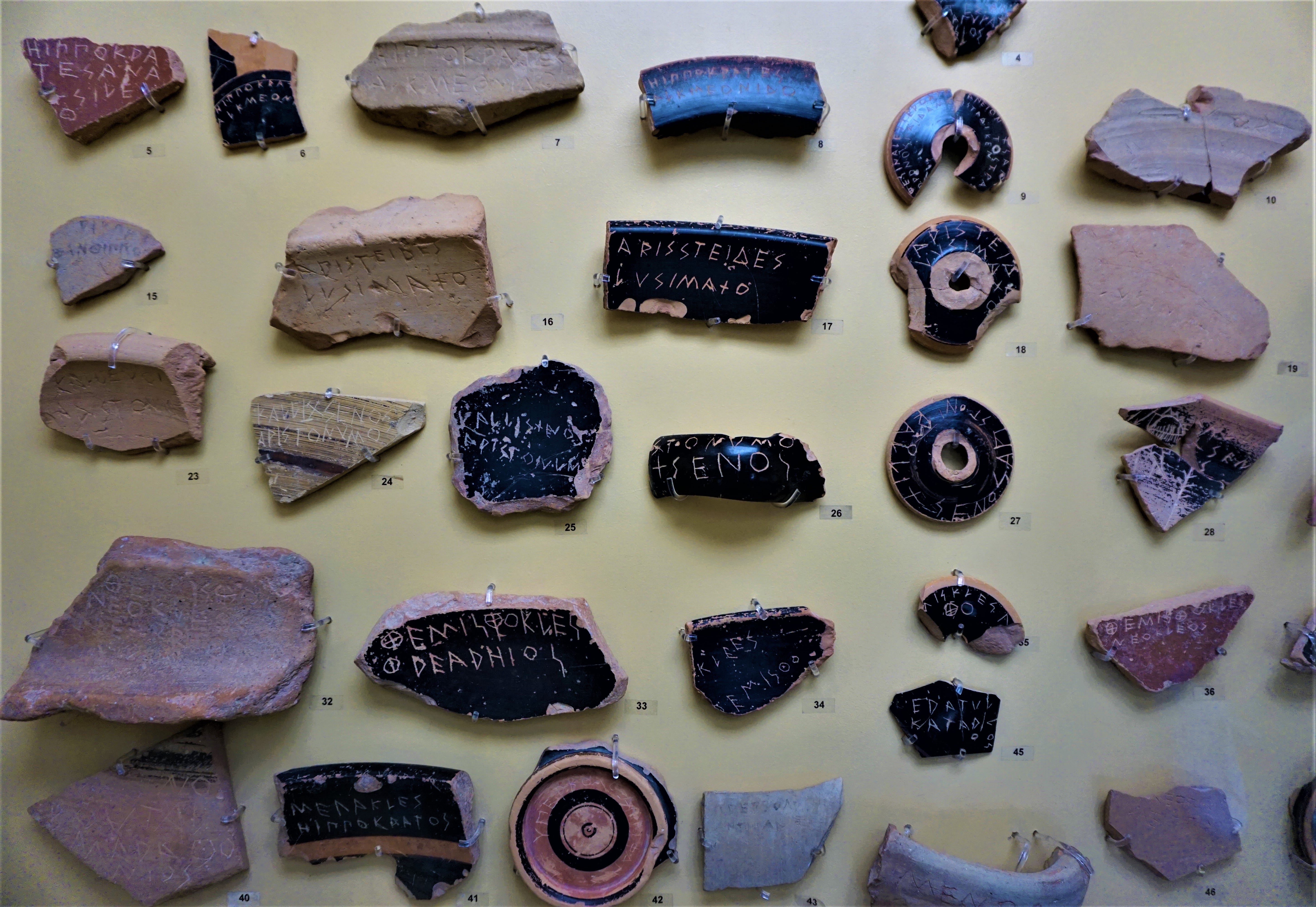
Curiously, a collection of Ostraka used to vote for Themistocles look as if they are standardized and custom made, though the shape is quite similar to the mouth of an amphorae. I have not discovered an explanation for this, though it stands to reason that people campaigning against a specific man might make and distribute ostraka.

When the Persians invaded in 480 all of the men who had been ostracized were recalled to the city, so it did not necessarily last the whole ten years.
“Thucydides, Son of Olorus, the author of this text.” The other famous Thucydides (son of Melasias,) believed to be a relative of the former, happens to be one of the 13 men known to have been ostracized.
How exile in Madagascar could possibly be better than exile in Tahiti is beyond me.
At some point we must, as a society, decide that there's more to life than being entertained. What's called MSM today, got it's cue from Fox News long ago. MSM was struggling to stay afloat reporting The News, but Fox News, with alien babies and conspiracies, stole the limelight and made millions. MSM just followed the crowd to stay alive. Who's fault is that (he asked knowingly)?
If there's one positive thing that's come out of the last 10 horrid years, it's that America has been forced to look at it's ugly self in the mirror. We'll see the outcome of that soon.
One of the arguments you hear again taxing the rich, is that they will leave. I've always thought, "good riddence".
So maybe we just pass a painful tax on billionaires that is collectible unless they give up their citizenship/passport. Self-exile, as you mentioned.
They will try to keep doing what they're doing somewhere else but will be a lot easier to manage as non-citizens.