

“Life’s but a walking shadow, a poor player /
That struts and frets his hour upon the stage /
And then is heard no more. It is a tale /
Told by an idiot, full of sound and fury, /
Signifying nothing.”
Macbeth, 5.5.27-31
Introduction: The Sudden Fame of Sacha Stavisky
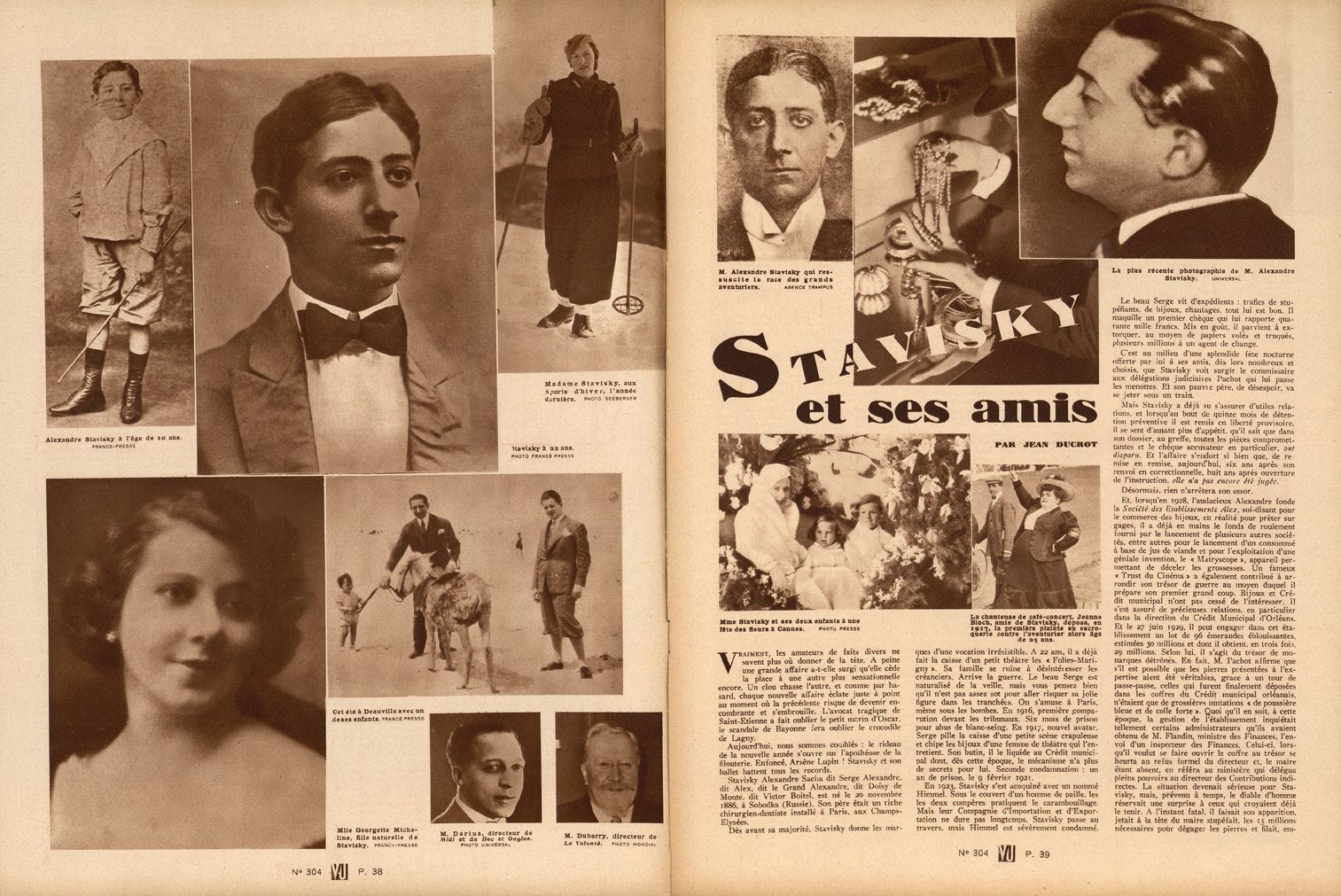
In 1934, the French Third Republic was rocked by one of history’s great political scandals. A “top hat” criminal named Serge Alexandre Stavisky was discovered to have issued fraudulent bonds from a municipal pawnshop in Bayonne, France. The bonds had been recommended by a Minister and were thought to be government-backed, and with the Great Depression making the whole country financially stressed the public mood of was as such that a fairly trivial financial scandal, primarily targeting insurance companies and others with money, rapidly became a matter of unprecedented public focus. It was discovered that Stavisky was “connected” and seemed to have been given a sweetheart deal on a prior charge. The public became rabid. Janet Flanner, an American journalist with a society column about Paris for The New Yorker, wrote at the time,
“Part of the public’s shock when the Stavisky scandal broke came from the fact that no one had ever heard of him before—except the judges, lawyers, political mandarins, and detectives who had been stretching the jailbird’s provisional liberty for the last six years.” [110]
With a new warrant out for his arrest, Stavisky fled to Chamonix in the French Alps and hid in a cabin as he was rapidly becoming the most notorious man in France. Police ultimately tracked him to this location, where he shot himself to avoid capture. However, the great majority of the French were sure that he was “suicided,” turned into a verb for the first time for the occasion, by the police to prevent him from testifying about his powerful friends. Following the firing of the Paris police chief, who was said to have a tangential connection to Stavisky, there were deadly riots on February 6th, 1934 which lead to the government resigning without being voted out. Stavisky-mania further grew among the public, who came to be convinced that their government was controlled by a mafia. French prosecutors spent two years and wasted vast resources investigating the case, ultimately only putting 20 people on trial for fairly minor crimes, 11 of whom were acquitted. It was this ridiculous affair that the French public were obsessed with as the Nazis consolidated power next door.
As you may have guessed by now, the reason I want to tell this story is because of its striking similarities to Epstein-mania. I will not, however, be mentioning that again, and will let you draw your own comparisons. My purpose is instead to show the dangers of a crime panic to common sense and good governance. The Third Republic never really recovered from Stavisky Affair, and among its effects were bringing the war hero Philippe Pétain back into political life as a rare figure who could unify the public.
For the following story my most important source is the 1934 text France in Ferment by Alexander Werth, a Russian émigré British journalist who spent the 1930s covering France. My other sources are the American journalist John Gunther’s Inside Europe1 and Paris Was Yesterday, a collection of pre-war writing by Janet Flanner (about whom I happen to have recently reviewed a book for the New York Post.) I will only be giving citations for direct quotes, but for the most part follow Werth, which I believe is the most thorough contemporary English-language account.2 The archives of both the New York Times and Time Magazine also both proved useful, in which case I have just used hyperlinks. I would add here that this case produced extraordinary amounts of rumor and contradictory reports, and I am almost exclusively using sources from 1934-1936, so I apologize if I repeat anything which was later determined to be inaccurate (on the off chance some Stavisky expert comes along to notice.)
Stavisky would not be remembered for his crimes alone if it did not cause a moral panic, and the real story is the impact of the scandal. Nevertheless, it is important to start with an outline of the man’s life.
A Biographical Sketch
Serge Alexandre “Sacha” Stavisky was born near Kiev, Russia in 1886. His father, an honest Jewish dentist, brought the family to France when he was a young child. Initially, he set up business in Paris’s Jewish quarter, but was successful and soon had a practice off the Champs-Élysées. Having become respectable Paris bourgeois, the elder Stavisky sent his son to some of Paris’s nicest schools, which seems to have helped him hobnob with the upper classes later in life, some of whom he had known since childhood. Over the course of his young life, Stavisky became a naturalized French citizen, converted to Catholicism, and spoke French nearly as a first language. However, despite his father’s ambitions, Stavisky was more interested in vice, and fell in with a bad crowd and started running around with older women. At this time he also developed an interest in theater, and actresses, but it seems most of his time was spent hanging around men involved in drug trafficking and white slavery. Some sources describe him as having been a gigolo, though the difference between that and sponging off of older women is hazy and there are few clear records of his life at this point. Janet Flanner described his early adulthood as follows,
“He began his humble career in 1906 by failing as a cafe singer. In succession, during the next nine years. He failed at managing a night club, illicit gambling dens, a nude revue, a tinned-soup company, an electric-icebox company, a shyster brokerage desk, and drug-running.” [110]
It must be noted this was written at the beginning of the public mania, and this should be more accurately considered what rumors purported him to have done. What we do know is that is that his father had to pay off a few bills from that “shyster brokerage desk” to keep him out of jail. He volunteered for military service during the war, but was discharged after not too long for reasons which are uncertain. By 1917, he was at least nominally a WWI veteran running a cabaret in “partnership” with an older woman, where besides loving her he seems to have primarily sold cocaine; the “partnership” ended when her money ran out.
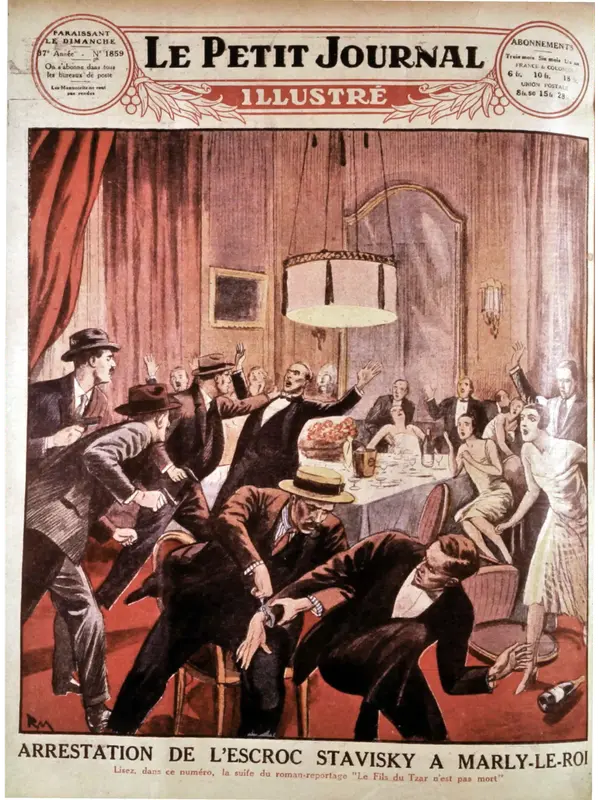
For the next 9 years little is known about Stavisky besides that he was still in an underworld milieu. The only clear piece of Stavisky’s history from this period is an affair in 1921 regarding a small forged check, which disappeared before the trial. It is rumored this is when he first became a police informant, though no evidence exists that he was an informant before 1926. He may have been involved in some affair relating to kiting a check from 20,000 to 60,000 francs in 1925 under an assumed name. In 1926 he suddenly became much more ambitious, and managed to defraud a stock broker of around 7.5 million francs, which is a little over $8 million today. An arrest warrant was issued, and he was arrested two months later while hosting a “sumptuous” dinner party. In attendance was his pregnant mistress and future wife, Arlette Simon, an actress and “Chanel’s most beautiful model,” to whom by all accounts he would remain genuinely devoted for the rest of his life. Here he was first called “King of the Crooks,” though seemingly primarily due to the picturesque circumstances under which he was apprehended.
In what is one of the saddest part of this whole story, following Stavisky’s arrest his honest old father, who had hoped his boy would outshine him and become a doctor, killed himself from shame.
Stavisky got four lawyer-deputies for his defense, which is to say lawyers who were also in Parliament, and one of whom was an ex-Minister. He was provisionally released without trial on medical grounds that were likely spurious, and left with a passport calling him M. Alexandre. Who among the police knew M. Alexandre and M. Stavisky were the same person and when they knew it was one of the most controversial aspects of the case. He is described by Flanner as having been released with an “immunity card” from the Sûreté Générale, or national police, but I found no evidence such a thing has ever existed and it appears to have just been a widespread rumor when the scandal took off. Stavisky’s court hearings and by extension his provisional release, were extended 19 times over a 6 year period. This was taken as clear evidence of corruption, though trials in France move at a glacial pace and even today we see high profile figures on trial for corruption at liberty for many years, perhaps having one hearing every few years before possibly going to jail. This doesn’t, however, explain how it is that Stavisky was said to be investigated by the Police Judicaire 45 times during the period which follows without having been re-arrested.
A Man of Confidence
From here, Stavisky’s activities become rapidly more impressive, though the majority of his connections remained to other top hat criminals and not to the actual upper crust of society. In France at the time pawnshops were semi-official institutions, called Crédits Municipaux, with the idea being that it was a good way to give the public access to small amounts of credit without putting them in debt to loan sharks. In short, this was supposed to make a naturally sketchy business somewhat more honest, which Stavisky was able to exploit. These were the foundation of a number of schemes out of which he was able to extract enormous sums over a number of years. Flanner wrote of his activities,
All of Stavisky’s recent schemes were marked by folie de grandeur and a patent inability to come off. To expand the credit of the hockshop at Orléans to float bonds, he put in pawn what he called the late German Empress’s crown emeralds, or fifteen million francs’ worth of spinach-colored glass. His Hungarian agrarian-bonds scheme got him in immediate trouble with the International Settlement Bank at Basel. His last idea, for an International Public Works Corporation was so idiotic that it even attracted the official patronage of the French ambassador to the Vatican. [110-111]
While it may seem hard to believe that he could find success with these schemes, I would note that the two largest American scammers of the modern era, Bernie Madoff and Sam Bankman-Fried, did nothing special, the former running a conventional Ponzi scheme with the money stored in one account and the latter having simply illegally transferred money from one account to another. Both operated for years while rubbing elbows with more prominent men than Stavisky ever did.
Like any successful con artist, Stavisky could tell a good story and kept up a lifestyle that seemed to prove success. He claimed to a Minister that through his financing scheme, which he did not detail, he had found the solution to unemployment in Europe. He began living large, wasting endless money gambling at the casino in Biarretz near Bayonne, despite that he was prohibited from entering casinos due to his status as a provisionally released man awaiting trial. He managed to take over the Empire Theatre in Paris, to which he devoted much of his time, having a genuine interest in the arts, and which did allow him to make some connections in the upper segments of society. He began founding companies with names like S.I.M.A. and S.A.P.I.E.N.S. which were meant to solve a variety of society’s problems, and more importantly which gave him a way of putting various important people on boards with promises of big future profits. He also got involved in racehorses (running under the name of an elderly Latin American diplomat with whom he became close) and some newspapers.
The Bayonne Bonds began to attract attention because the small municipality was doing substantially more business than much larger municipalities. Flanner memorably described his activities,
“The scheme which finally killed him, his political guests’ reputations, and the uninvited public’s peace of mind, was his emission of hundreds of millions of francs’ worth of false bonds on the city of Bayonne’s municipal pawnshop, which were bought up by life-insurance companies, counseled by the Minister of the Colonies, who was counseled by the Minister of Commerce, who was counseled by the Mayor of Bayonne, who was counseled by the little manager of the hockshop, who was counseled by Stavisky. Since the little manager was the only person involved who made nothing out of the fifteen-million-dollar scandal, he was the first to be clapped in jail, which should teach him.” [109-110]
Werth writes, “it is hardly credible that these insurance companies could have been taken in,” given the volume of the scam from such a small town, and it was suspected that they understood the racket and were motivated by outright corruption, or believed they were government guaranteed so didn’t care if the scheme collapsed [86.] One way or another, the wiser part of the finance industry certainly knew something was wrong, and there were periodic articles about the bonds being sketchy in smaller financial newspapers, though Stavisky sent people around to pay off or beat up the journalists in question, based on what proved necessary.
Authorities seem to have become properly aware of the situation with the Bayonne bonds by the end of November, 1933, though they were slow to act. On December 23rd, Tissier, the manager of the Bayonne pawnshop was arrested. On December 29th an arrest warrant was issued for Alexandre Stavisky, followed by the first mention of his name in the Paris press the following day.
The Scandal Erupts
John Gunther described Stavisky’s catapulting into the public consciousness as follows,
“Secrecy pent up in a hundred mouths for seven years burst forth in an angry, scandalous torrent. Stavisky’s connection with the bonds became known, and then his police record. He fled—having received a false passport from the police. He rested in Chamonix for a fortnight, hoping the storm would pass. Instead it blew to tornado violence. [201]
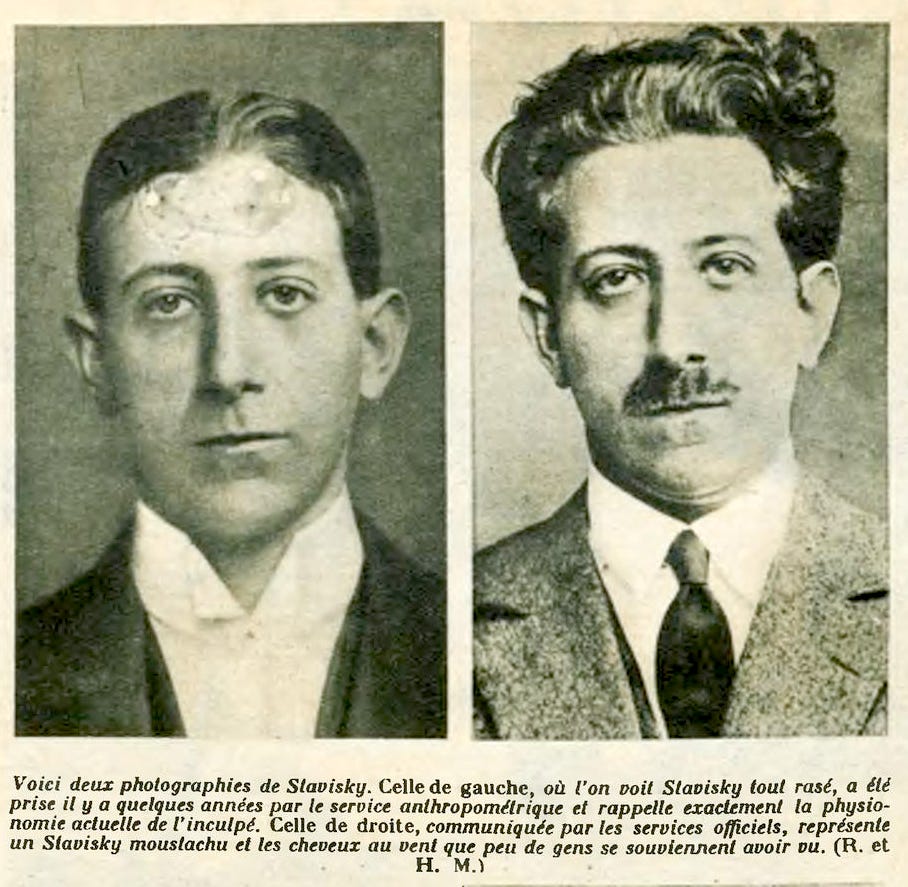
It should be noted here that nothing I have seen provides evidence that Stavisky was provided a third passport by the police on December 23rd, they all merely assert that and no one got to the bottom of the matter. The passport he was carrying had his picture and description but the name of a former boxer named Nieman whom he kept around as a tough. While contemporary sources all assert this fraudulent passport was delivered to Stavisky from the Sûreté Générale none provide proof to that effect, and it seems to me that given his extensive underworld connections it could have been forged.3
Why all of the above would become an incredible scandal was highly dependent on the time when it took place. As Werth notes before beginning the story, “In a time of prosperity, a big financial racket creates a smaller impression than it does in times of depression” [62.] France had initially weathered the Wall Street crash surprisingly well, but by 1934 was deep in depression, and everyone was suffering from salary cuts, decreased sales, high taxes to cover the national budget. The idea of a scammer living large off of dishonest investments antagonized the public, even if the victims were primarily insurance companies to such an extent the public speculated as to what drove Stavisky to spare “the little guy.”
On top of this, much attention was paid to the fact that it was an immigrant who had made this money off of France. The country had taken in an enormous amount of foreigners following the World War to help rebuild the country and replace all of the dead and disabled Frenchman in the work force. They were largely welcomed in France’s generally tolerant society. However, by the beginning of 1934, Jewish refugees from Germany were becoming an increasing concern- though they had initially been welcomed to show France’s liberal tolerance compared to Germany’s growing authoritarianism- and the country was less welcoming to foreigners generally. Flanner said at the time that the country had even become less friendly to its large American community that had been so celebrated in the 1920s. Most descriptions and profiles of Stavisky emphasized his Slavic name and appearance. It should be added here, however, that surprisingly little attention was paid to his Jewish origins. In French public life anti-Semitism was largely discredited due to seemingly interminable Dreyfus Affair- the country’s last ridiculous major “current thing,” and in fact the origin of the term “anti-Semitism”- finally ending around 30 years before in the total exoneration of Dreyfus. Still, the general feeling that a foreigner had come into the country to take advantage of their good nature was strong, even if Stavisky was a fully assimilated citizen who had lived in the country for perhaps 40 years.
During the first week of January the public at large became aware of the general details of Stavisky’s biography above. Public excitement was enormous, as everyone considered it obvious that protection by police and key politicians were the only reasons why he was able to remain at liberty and carry out these operations as the “King of Paris.” Nor, did they believe, he could have escaped if the police did not help him, which it must have been in their interest to do. Throughout France, the public shouted “Les Noms, Les Noms!”, demanding to know who else was involved in this scandal, beyond the few marginal figures who were already implicated.
Werth writes,
“Who was to blame? Parliament, whose authority was just then at a low ebb, was, naturally, suspected of being the chief culprit. What was still worse, a member of the Government was found to have been mixed up in the dirty business. “Les Noms, Les Noms!”—the public continued to clamour. Never in all the history of the Third Republic had the anti-Parliamentary and the anti-Government Press been given such an undreamed-of opportunity. All right, they would give the public enough names to make them sick of the Republic and of the Chamber of Deputies.” [88]
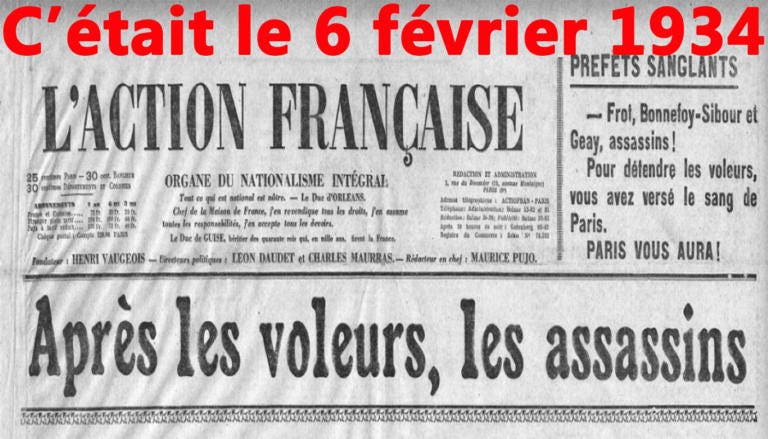
The journal of the right wing Royalist, anti-Parliamentary group Action Française, led by its main writer Léon Daudet, had spent the months preceding the Stavisky scandal accusing Parliament of being hopelessly corrupt and a “Masonic Gang.” As if by prophecy, he had chosen as particular targets Dalimier, Dubarry, and the Seine prosecutor Pressard, the brother-in-law of the Radical-Socialist Prime Minister Chautemps, all of whom would end up key figures in the Stavisky scandal. This Dubarry was not a politician but a shady influence peddling journalist of sorts, who was running a small newspaper called Volonté that was heavily subsidized by the government and also funded by Stavisky. Dubarry was indeed Stavisky’s point man with Parliament. Further, they had been accusing the Sûreté Générale of murder, or at least of covering up murders (Daudet’s own son had been murdered in 1923 in questionable circumstances which he blamed on the police.) They particularly honed in on the murder of Oscar Dufrenne, a notorious homosexual music hall director who was found wrapped in a carpet with his head smashed in earlier in the year; presumably the implication was that powerful figures were covering up their own homosexual escapades, but that is not clear in Werth.
The journal Action Française first started promoting the Bayonne Affair on December, 28th, before Stavisky’s name had been connected to it. As early as December 29th they had developed a clear enough picture of the crime to say, “The moving spirit in the swindle is said to be a nondescript alien, who is well-known in certain newspaper quarters, and who is said to have escaped” [89.] “Nondescript” was an ironically accurate description of Stavisky, of whom, according to Flanner, the novelist Collette, a resident of the same hotel as Stavisky, said “he excelled at having no face; at counting, when he chose to, only as a silhouette” [111.] Certainly, when the scandal broke most people claimed they had never seen him.
On January 3rd, they featured their first cover story on the topic. Maurice Pujo, the head of Camelots du Roi, a militant youth organization associated with Action Française, managed to obtain and publish the two letters from Dalimier, the Minister of the Colonies, recommending the Bayonne Bonds. As well as the “hard news,” he added his own postscript, saying,
“One can hardly imagine that the extraordinary favours which Stavisky enjoyed were merely the outcome of bribes paid merely to individuals. Is it true or not that, on the eve of the last General Election, Stavisky paid a very substantial sum into the election fund of the Radical Party?”4 [90]
Action Française had not only gotten the scoop, the narrative they had been promoting for months was proving accurate, “Unlike all the other papers, the Action Française of January was a direct continuation of the Action Française of December, of November, of October, of two, five, ten and twenty years ago” [88.] After the letters were published the media went into a frenzy, with only a few government-controlled papers urging moderation. The state’s authority was badly shaken among those who had believed in it previously. Action Française had to lead the pack and be more extreme, and on January 7th, the newspaper had the headline A BAS LES VOLEURS!, meaning “down with the thieves.” In a screed calling for protests, Pujo wrote,
“He [Dalimier] has been urged to resign; but he has refused to do so. He should be in prison together with his pals Stavisky and Dubarry; instead of which, he continues to be a member of the Government whose duty it is to inquire into this affair. Dalimier is not alone; we can see behind him a crowd of other ministers and influential Members of Parliament, all of whom have, in one way or another, favoured the adventurer’s rackets, especially by instructing the police to leave him alone…There is no law and no justice in a country where the magistrates and the police are accomplices of criminals.” [91]
Pujo then proceeds to say that the “honest people of France” are “forced to take the law into their own hands”, and tells the public to “clamour” in front of Parliament when it reassembles at the beginning of that week, ominously adding, “P.S.—Instructions will be sent to our friends in due course.”
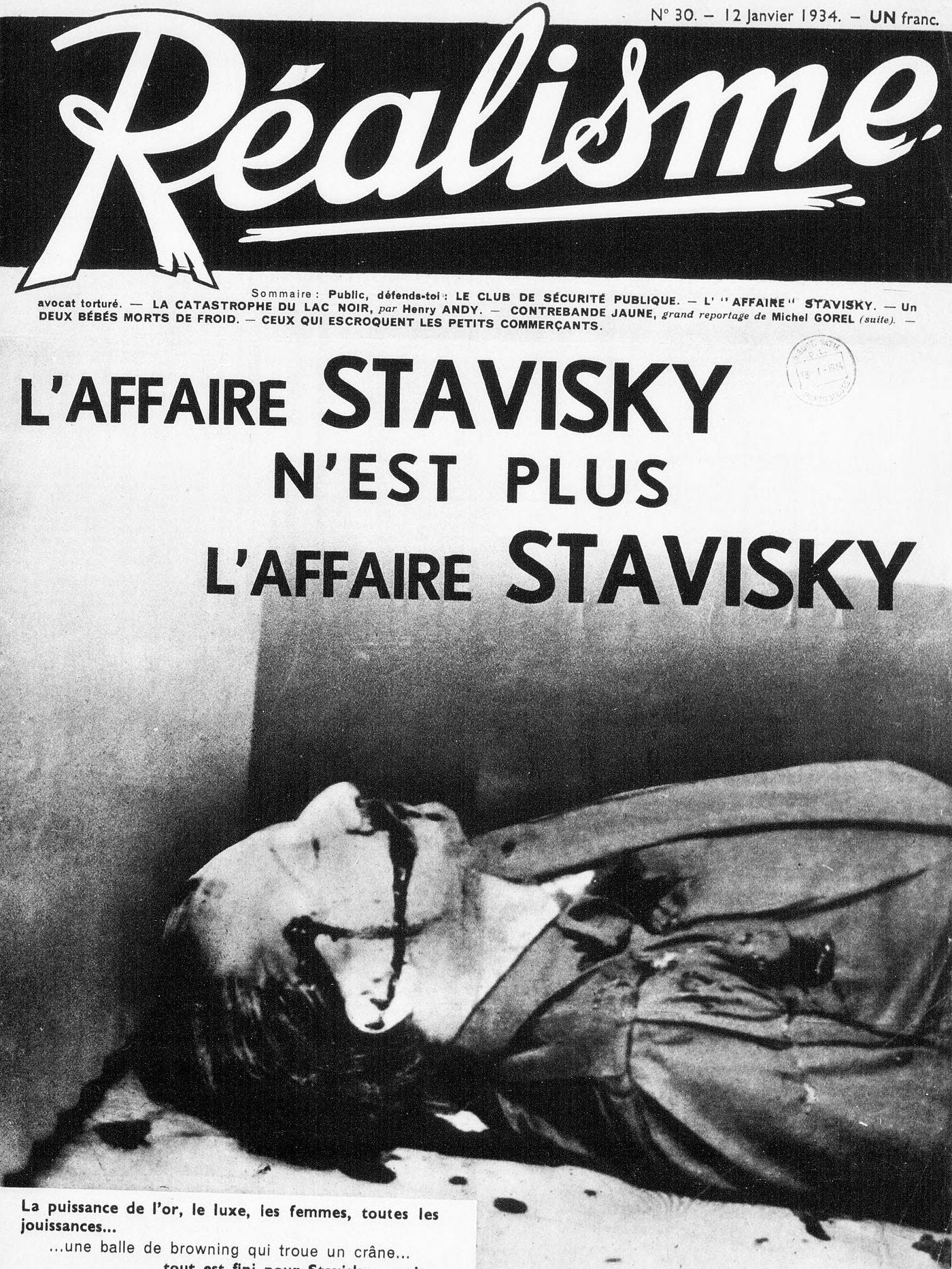
One day later, Alexandre Stavisky was in a coma following a single gunshot to the head.
“Alexandre Stavisky Didn’t Kill Himself”
This was the official story of Stavisky’s death:
Stavisky having become the most wanted man in the country, the police were on a nationwide manhunt. It was discovered that his passport was stamped at the Swiss border, though it is unclear why he would have returned to France or why the police would imagine he did. Regardless, they began search the area, and ultimately honed in on the Alpine resort town Chamonix- the home of the first Winter Olympics ten years prior- where he had holed up in a vacation cabin. Stavisky’s assistant Voix had rented the cabin under the assumed name Forgeat5, but the detective Charpentier was able to recognize his handwriting due to prior surveillance as well as the fact that it was an alias Voix had used previously. After observing the cabin and determining it was suspicious due to a “hermetically sealed room” (I don’t understand the significance of this, it seems they were heating only one room in the large cabin, which isn’t what vacationers would do) Charpentier called the Sûreté Générale for permission to see if anyone was there and to break the door down if necessary- which was later taken as evidence he requested a kill order. After some knocking a voice asked who was there, they identified themselves as police and a gun shot rang out. Charpentier broke a window and entered, finding Stavisky with a gunshot wound to the head but still alive, attempting to grab his gun and fire another shot. A doctor was called for, but Stavisky went into a coma and couldn’t be helped. He died the next day, aged 47, next to his wife who had arrived the day before.
Here is a British newsreel from the time:
The public was skeptical of this story, to put it mildly. From Werth,
“Nine out of ten people in Paris did not believe a word of the “official” version.
The word “suicide” made people smile, or made them angry. “The police have murdered him. He knew too much.” The official version was torn to shreds. Dozens of details were produced on all sides to disprove it. The conviction that Stavisky had not killed himself was shared by Communists and Socialists, Royalist and Reactionaries, and by the man in the street. The Communist Humanité declared that he was murdered; the Socialist Populaire declared that he was “suicided”. The Nationalist Jour and M. Hennessey’s Quotidien agreed; while the Action Française, which had made a hobby of police murders, simply howled with joy; even the respectable Echo de Paris enclosed the “Suicide” in inverted commas. It published a cartoon of Dubarry, Dalimier and many other politicians have a deep sigh of relief and the news of Stavisky’s death. [94-95]
Janet Flanner related the following news to her audience of American sophisticates,
“Of the twenty-two Paris papers relating the story of his police-tracked end in Chamonix, fourteen referred to Stavisky’s suicide as “suicide.” He is a corpse the police will never manage to bury because they supposedly shot him to keep him quiet.” [111]
Note that even in the above British newsreel it doesn’t take a stance on whether he was murdered, instead saying France is left to decide.
Telling this story, it is a challenge to continue giving new terms for the scandal’s perpetual growth. Regardless, suffice to say at this point the Stavisky case was a full-blown national obsession. The Action Française was in the street in front of Parliament having little riots every night. They did not yet try to storm the building, but their rowdiness led to the government cordoning off the building with security, creating the optics of a Parliament under siege and inaccessible to the public. This was brilliantly calculated, with Werth saying, “The man in the street began to wonder what sort of Parliament this was which had to place bayonets and revolvers between itself and its electors” [100.]
Parliament Convenes
It was on January 11th when the Deputies first assembled in their “fortress” to debate Stavisky. The press and public galleries were crowded like never before, and every Deputy was present except for Garat, the Bayonne Mayor, who was in jail for involvement with the bonds. A newspaperman named Darius had also been arrested. This man, described as “negroid,” ran a pro-Nazi paper that was allegedly subsidized by the German Government, the French Government, and Stavisky at the same time; Darius had been one of the men to critically report on the Bayonne Bonds but then accepted a bribe and promote them (he would later claim, when being prosecuted, that he was simply convinced of the legitimacy of the bonds after speaking with Stavisky’s agents.) Dalimier had, with much “coaxing” resigned two days before over his role in endorsing the Bayonne Bonds. However, what seemed to surprise the public the most was the arrest of Dubarry, the amiable backslapper who was friends with everyone in France and who seemed to use tutoye with all the Cabinet Ministers.6 Dalimier’s resignation and the arrests of these few unfortunate men notwithstanding, everyone in France wanted to know what the government was going to do about the corruption they believed was eating away at their state.
Before continuing, I need readers to allow a slight digression on two points for which I have not yet found a place. The first is that at the time Freemasons in France were quite powerful, but that French Freemasonry had broken with international Freemasonry by denying the religious aspects and becoming atheistic, a schism which continues to this day. The religious and clerical right such as Action Française detested French Freemasonry.7 The second thing which needs to be explained is that at this late point in the Third Republic, party names (with the exception of the Communists), weren’t just nonsense, they were generally the exact opposite of what the party was. Gunther quotes the following from an Albert Guerard,
“The nomenclature of parties is perverse. The ‘Liberals’ are dyed-in-the-wool conservatives. The ‘Conservatives’ are revolutionary in spirit, tone, and method’; the ‘Social and Radical Left’ belongs to the Right’ the ‘Radical Socialists’ are trimmers and time-servers; and the most reactionary statesman of recent years, Millerand, was a socialist. French parties are not even shadows. It would tax the subtlety of a Byzantine theologian to distinguish between the Democratic Alliance, the Republicans of the Left, and the Republican Union.” [182-183]
The point, most of all, is that this Radical Socialist party which was then in power was basically timid and non-ideological, I suppose something like a modern Eurocrat before they were driven mad by the invasion of Ukraine. The upshot of France’s irrational and unstable politics was that non-political institutions, such as those responsible for, for example, stopping a man from selling fraudulent bonds out of a pawnshop, had a great deal of power and were the source of what stability and credibility the Third Republic possessed.
To return to January 11th, it was these diverse and nonsensical parties left to sort out what had happened with this scandal which seemed tailor-made for the groups opposing Parliament. The lobbies were filled with men saying “Stavisky, Stavisky, Stavisky” and openly discussing his supposed murder. Again from Werth,
“Mr. Lagrange, a Socialist Deputy had the privilege of being the first man to utter from the tribune of the chamber of Deputies the name Stavisky. How many hundred times was that name going to be uttered during the parliamentary debates of the following fortnight; how many thousand-million times was it going to be uttered throughout France?” [102]
According to Werth, “it may be safely said” that only three at all objective speeches were made in the next two days,
“All other speeches were little more than a mudslinging contest. Tempers rose at times to unattained heights of fury; the task Parliament had set itself to inquire into the Stavisky Affair soon degenerated into a dog-fight; and soon it became clear that the opposition’s only aim was to bring down the Government.” [102]
The bulk of Lagrange’s speech is largely a summary of what has already been explained here, asking rhetorical questions such as how he was able to gamble away millions at casinos he was legally barred from entering, but his discussion of investigations provides some new information as well as being a sample of what the government was facing from the calmest and most reasonable Deputy,
“And yet we now learn from a Press interview that a high police official now in retirement, M. Pachot, had watched Stavisky all the time and that he had drawn up several reports. I ask you what happened to M. Pachot’s reports? Such are the questions, Mr. Prime Minister, which call for an answer…Chiappe, the Prefect of Police, on returning from Florence the other day, declared that he had been watching Stavisky for ten years, drawing up report upon report. If this is true, what were the influences which prevented the Authorities from acting? The day came when Stavisky’s arrest became inevitable. He escaped. Who is guilty of this final piece of negligence? At last he was about to be caught; but at that moment he committed suicide. That may be the most dramatic part of this whole affair.
Stavisky is dead. We are told that he committed suicide. And yet public opinion has known for years that the police are inevitably mixed up in all financial scandals…Public opinion has risen like one man and has cried: ‘Police murder’.” [104-105]
The hapless Chautemps had no idea how to get a handle on any of this- and it should be noted he only became Prime Minister in late November so, if anything, deserved credit for being the government that did finally try to shut down Stavisky (though it appears the police were acting without direction from his government.) Not knowing what to do about the endless personal abuse in the French press where “no man in Parliament seemed immune against the most fantastic charges” he proposed strengthening the libel law, which further infuriated the entire country. Everyone drew the conclusion he was trying to hush up the affair, and by extension his government’s involvement in it. M. Ybarnégaray, a Deputy of the Right and one of the three whom Werth says were being reasonable, proposed a committee of inquiry to get to the bottom of this. Werth writes,
“All the ‘revelations’ made by the speakers during the subsequent debates—except the “revelations” concerning members of the Government—were merely variations of the same them: here were the facts of the Stavisky case; but where were the culprits? The Press, the parliamentary Lobbies, every café and tramcar in France were full of wild and unconfirmed rumours; the country was acutely suspicious; and nobody knew exactly why Stavisky had done this or that; and even the “revelations” made by the Opposition against members of the Government were, nine times out of ten, unfounded. A Committee of Inquiry was an absolute necessity ; and yet, on the ground that it would poison the political atmosphere, and give rise to endless personal intrigues, M. Chautemps rejected it. In reality nothing would have had a more calming effect on the public than the establishment of such a committee.” [107]
He goes on to say, “Probably no politician of M. Chautemp’s standing ever misunderstood the political atmosphere as badly as he did.” Parliament continued going around in circles trying to blame each other while there were near daily riots in the streets,
“Without anybody knowing definitely who was to blame for the Stavisky Affair…the Left and the Right were ready to tear each other to pieces. The Right howled that the Left alone were responsible for the Stavisky Affair; the Left shouted that the Right were equally responsible and that, moreover, they had many scandals other than the Stavisky scandal, on their conscience. The Stavisky debates were, at times, no more than a mudslinging contest.
It was a childish but intensely irritating game: “Remember, it was in 1930—when M. Tardieu was in power—that Stavisky engineered the swindle at Orléans,” M. Monnet the Socialist said. “Remember it was under the Government of M. Steeg that Bayonne was authorized to open a Crédit Municipal.” [108]
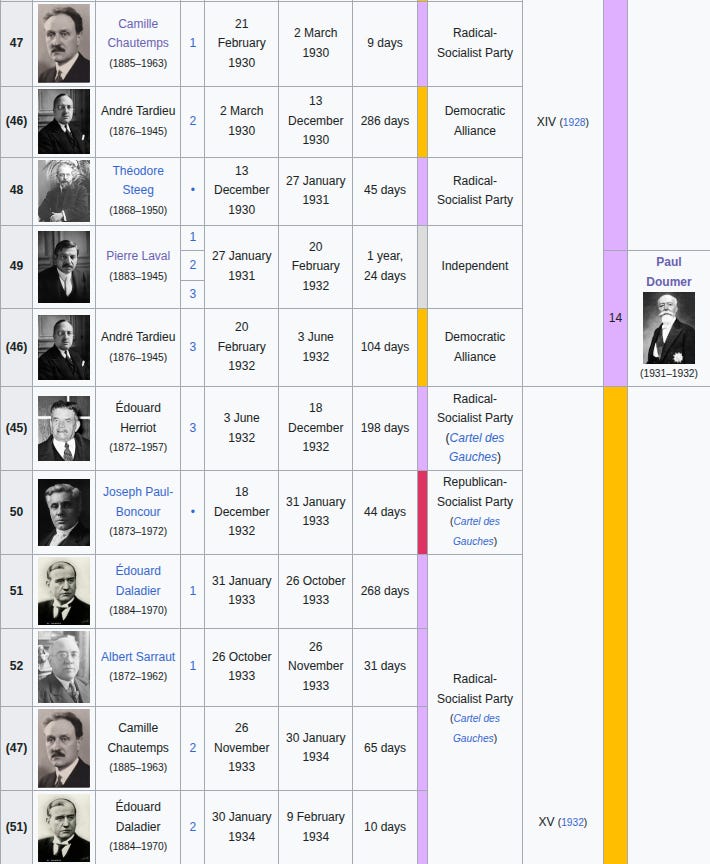
Sober observers in France- to the extent that any existed besides foreign journalists like Alexander Werth and Janet Flanner- would have found it obvious that no specific elected government was responsible for what had happened, particularly given the incredible political instability of the Third Republic in this era, as one can see from this table of the governments in the years leading up to and during the scandal:
On top of everything, it was said “several hundreds” of documents disappeared from the Stavisky dossier in the Law Courts. Of course, his lawyers who were also Deputies were suspected, despite that their erstwhile client was dead. By the end of January, Parliamentary debate had devolved to just saying things you claimed to have heard the other side say in the lobby, as no progress was made to getting to the bottom of the affair. This instead was Parliament:
“A Socialist Deputy declared that he had just heard a Deputy of the Right, Baron Roulleaux-Dugage, saying that “all Deputies should be chased out.” To which the Baron in question, rising to his feet, replied that he himself had just heard a prominent member of the Left declare in the lobby that there were “at least thirty or forty gangsters in this House”
At that time, a certain part of the Paris public continued to believe in the gangsterdom of parliamentary government; and there were some who thought thirty or forty gangsters to be an understatement.” [115]
As this was going on, the banks and other capital interests began to fear a Radical Socialist-Socialist alliance would form to hold the government together and be used against them, and moved hard against Chautemps.8 At the same time, an image of a Stavisky check showing 6,00,000 francs payable to the Radical Party Election Fund was copied and circulated all over the country, the creator of which later denied it was a forgery and claimed it was merely a “humorous propaganda device.”
Amidst all of this, Chautemps resigned his government, despite maintaining a majority and not having been voted out. The Stavisky Affair had become not just about Stavisky, but about everything in French political life.
The “Suicide Theory” Ascendant
As this was all spiraling out of control, the case that Stavisky did, in fact, kill himself had grown rapidly stronger. Any number of rumors about Stavisky’s death had spread from unknown sources and then were disproven. For one thing, there was the testimony of Voix, the assistant, and his mistress, who were both in the cabin and whom both said they had tried to talk Stavisky out of suicide over the preceding days. Voix said that Stavisky had wished to spare his family the disgrace of the Assises Court and of a long term of penal servitude, and had said repeatedly he would kill himself instead of being taken alive by the police. Of course, he could be a co-conspirator; many considered that Voix was a police informer so disregarded such testimony. What caused a great deal of excitement was that Petit Parisien claiming to have interviewed Mme. Stavisky and that she said she had seen two shell casings in the room where her husband was shot. However, the next day, she denied having said any such thing. Of course, the conspiracy theorists reacted to this with, “Who had persuaded her, and by what means, to deny her earlier story” [96.] Further, Mme. Stavisky said that her husband had talked about killing himself and she had been scared that he would.
The detective Charpentier gave a detailed account of Stavisky’s death, which also seemed to confirm the suicide. A second post-mortem was done, which confirmed that there was only one bullet in Stavisky’s body. However, to those who were set on police murder, the most they would admit was that the police had murdered him with only one bullet. Others told stories about how the police had supposedly delayed medical care so that he would bleed out. Some newspapers published a floor plan of the cabin showing how a murderer could have got in. However, they were all operating on wild speculation while no evidence pointed in this direction.
Then, after some time it was found that before he died Stavisky had sent white hyacinths to his wife and farewell letter to each of his three family members. The letter to the son, seen as particularly touching and pathetic, was signed “Your Unhappy Daddy.” He had also asked his wife to watch over the boy closely to make sure he didn’t turn bad at 15, the age when Stavisky had turned away from the good values with which his father tried to raise him. Even this they tried to poke holes in, thinking the quality of writing too great for a crook, despite that Stavisky had attended elite schools and had made his living charming people.
Following all of this, those who needed to believe Stavisky had been silenced moved on to a “suicide by persuasion” theory. This is more plausible, but also not really provable. The mistress of Voix did provide testimony saying it would have been easy to capture Stavisky, for example when they had been taking daily walks. According to her, he spent two hours in extreme stress watching the police set up their operation while they didn’t move on him. the thought was that if they would have moved faster he wouldn’t have killed himself, which doesn’t make sense to me. One thing which is bizarre is there were meant to be 4th and 5th residents of the cabin, a masseur named Robiglia and his girlfriend who are mentioned in one of the reports, but who were never heard about again, as if they never existed. The suicide or suicide by persuasion theory would never fully die. Look, for example, at this curious little news item the New York Times ran on July, 6th 1934 titled, “New Doubt is Cast on Stavisky Suicide.” During the hearings that summer a police officer, Le Gall, said that in his report he wrote the pistol was in Stavisky’s right hand, but now he believes it was in his left hand and that he wrote his report wrong (Stavisky was shot in the right temple.) Stranger still, he said, “I would have had ninety-nine chances out of a hundred to capture Stavisky alive if I had been allowed to.”
Werth writes of the turnaround,
“Whatever people may have thought of the Chamonix Affair after a few days or a few weeks of mature reflection—and most people, with the important exception of those who have police murders on the brain, ultimately accepted the suicide, or rather, suicide by persuasion theory—nine-tenths of Paris were convinced on January 9th—and for at least another week—that Stavisky had been murdered.” [100]
The novelist Colette, the one who lived in his building, said, in support of the suicide theory,
“He was a falsely young man; his delicate complexion, perhaps also his fragile mental equilibrium, demanded constant care. He was at an age which in women is called menopause—marked by neurasthenia, capricious weaknesses, doubts. Ten years ago he could have faced the law courts. But in 1934, he was, behind that extraordinary façade, a finished man.” [Flanner. 111.]
The Great Riot
Strangely enough this realization on the part of the public, that Stavisky probably wasn’t murdered, did nothing to calm the public mood. Riots continued and President Lebrun, a calm and composed man who had suddenly been made President after the prior one was assassinated, decided to appoint Daladier, who had just left the post on October 26th, as Prime Minister. The first four days after his appointment the rioting did abate and Paris was eerily calm as Daladier tried to cobble together a cabinet. He ultimately took the post of Foreign Minister for himself, not trusting anyone else to negotiate with Hitler, because of course that is what was actually going on in Europe as France was tearing itself apart over a somewhat banal fraud case.
However, a strange sequence of events relating to a tragedy performed on stage would end in real tragedy. At a highly successful performance of Shakespeare’s Coriolanus at the state theater the bourgeois got a little too enthusiastic about the anti-democratic lines spoken by the play’s hero. The left was upset, and the director of the Comédie Française was fired and replaced by, of all people, M. Thomé, the head of the Secret Police (who it seems was actually something of a theater lover.) In the midst of this shakeup, Daladier decided to go after the untouchable Chiappe, the Prefect of the Paris Police. This Chiappe was a dapper Corsican who was quite independent minded but a remarkably effective administrator. By all accounts he had done great things for quality of life in Paris. He was known to have met Stavisky socially because he kept some unsavory company, seemingly not out of corruption but out of a desire to have a window into the underworld. Chiappe was also a staunch anti-Communist said to have Royalist sympathies (or fascist sympathies, depending on who you ask.)9 He had used a light touch with the right wing rioters but was liberal with the use of clubs on communists, who he said were a different class of people. He had commonly arrested them preemptively when there was trouble in Paris (that said, he was proud of his record of never having fired on them.) Getting rid of him was a gamble, but was necessary for Daladier to gain support of the Left in Parliament, to whom Chiappe was an understandably hated figure. Daladier attempted to promote him out of the city, offering him the position of Resident-General of Morocco, perhaps the most important post in the French Empire at the time. Chiappe refused, saying he could not leave Paris in these circumstances.
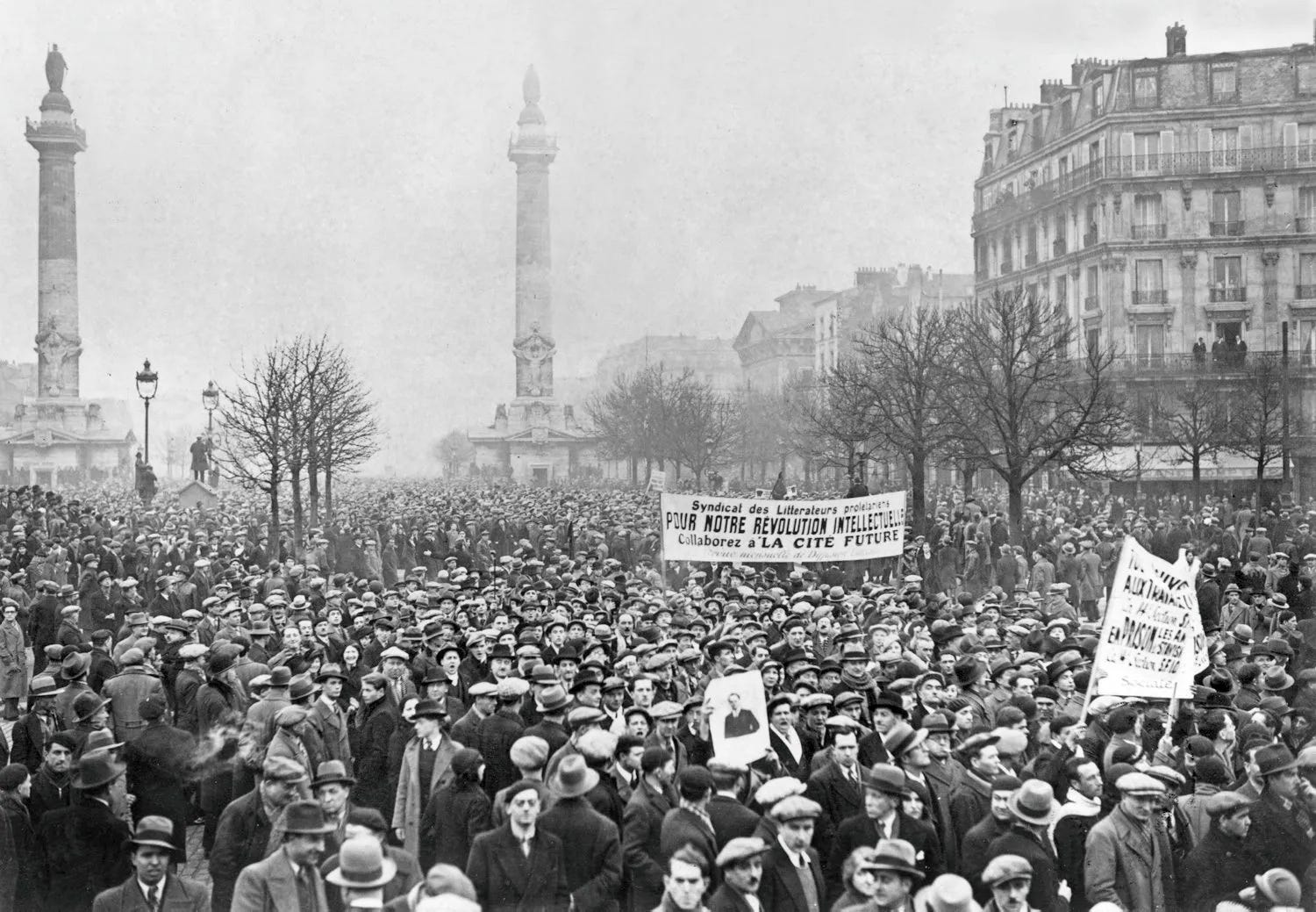
The facts of what happened next are contested. In a phone call between Daladier and Chiappe he either said “If you fire me, tonight you will see me…” à la rue or dans la rue. The first, “on the street,” means “homeless” or, in modern English parlance, “out on my ass.” The second, “in the street” means protesting, which in France generally means rioting, or for some reason can also mean “A Dictator” (I suppose “ruler of the streets.”) The claim that Chiappe threatened to start a riot was argued about endlessly, but one way or another on February 6th 1934, the day when Daladier was meant to make his first appearance before the chamber, riots did start, one of the most infamous riots in the history of this most riotous of cities. With an inexperienced new police chief and the loyalty of the Sûreté Générale in question, the Garde Mobile, (national guard) were brought in to to deal with with the riot. 17 people were killed when the Garde Mobile fired on rioters trying to storm Parliament, though no one ever agreed on how the shooting started.
This riot itself is too complex to go into, though I must share John Gunther’s brief and picturesque description,
“A riot in France is one of the most remarkable things in the world. The frenzied combatants maintain perfect discipline. Seventeen people were barbarously killed, and several thousand injured, but there was no fighting at all between 7:30 and 9 P.M. when everyone took time out for dinner. When it started, no one thought of a revolution; it was just a nice big riot. Communists, royalists, Fascists, socialists, fought shoulder to shoulder under both red flag and tricolor against the police and Garde Mobile. The fighting stopped at the stroke of twelve, because the Paris Metro (underground) stops running at twelve-thirty, and no one wanted to walk all the way home. Bloody, bandaged, fighters and police jostled their way into the trains together. Promptly at seven-thirty next morning the fighting started again.”10 [202-203]
By some accounts this was an attempted coup but that is still not entirely agreed on: in fact, just this week people have been arguing about this riot after a rightest was killed by a left wing mob in Paris. The evidence overall seems in favor of the Right not trying to take power by force and that it was just an old-fashioned French riot of particular ferocity, though certainly primarily driven by a myriad of right wing groups.
Regardless, the new Daladier government fell before it began. His resignation came on February 9th. Shortly before this the former President Doumergue, one of the only major political figures in France not touched by scandal, had broken three years of silence in retirement to write an editorial about the political situation. This Cincinnatus was brought in to try and save the Republic and was made Prime Minister shortly after his return to Paris. Among his most consequential decisions were bringing Philip Pétain out of retirement to serve as the Minister of War, which is what brought the Hero of Verdun, who would later be convicted of treason, back into French politics despite his advanced age. Further, on February 12th there was a general strike of great magnitude in opposition to fascism, with Socialists carrying signs which read “We will not allow the Republic to be ‘suicided’” [183.]
The Prince Affair
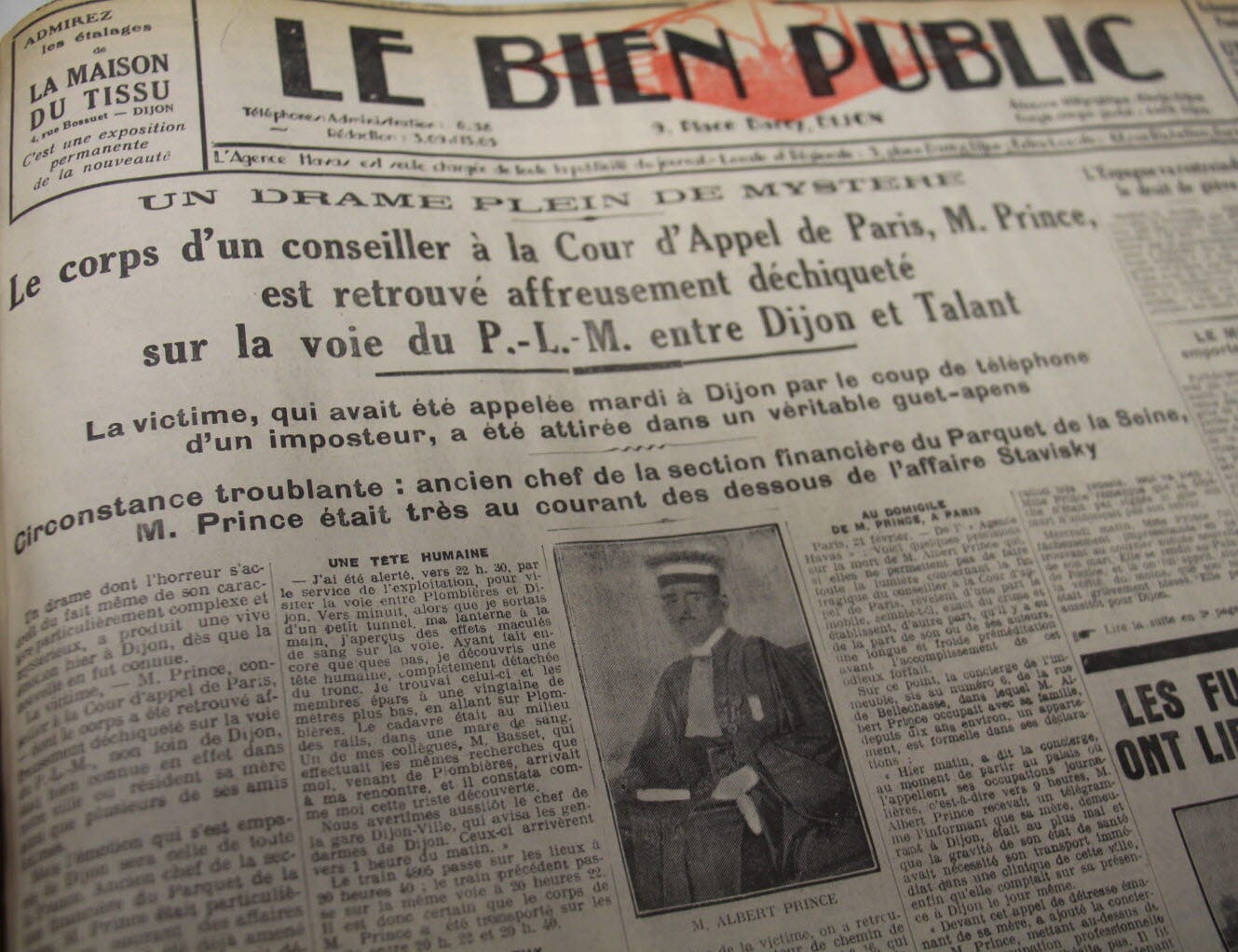
One might think this was the scandal blowing out, the public having exploded with rage and two governments falling, followed by a general strike in support of the Republic. However, the scandal was only going to further intensify. The next week, the body of Albert Prince, a judge working on a report on the Stavisky case, was found dismembered on train tracks in Dijon. The death of Prince, into which the investigation ended in 1937 without reaching a satisfactory conclusion, remains a famous “unsolved mystery” in France.
M. Albert Prince, 52, was a conseiller, or junior judge at the Paris Court of Appeal at the time of his death. Until 1931, he had been the head of the financial section of the Paris Parquet, or Prosecutor’s Office. The judiciary has greater investigative powers in Napoleonic Code systems than in the United States, but for our purposes here was matters is it was this Parquet which had to approve all 19 extensions of Stavisky’s provisional freedom, allowing him the liberty to conduct his main crime spree.
The official version, as told by Prince’s wife is this: On February 20th, when he was on his way to the court, she received a call saying her mother-in-law was terribly ill and he needed to go Dijon immediately to decide on an operation, but that he should go alone. Prince happened to return home having forgotten a document. He called into the office to say he wasn’t going to make it to work, and went to catch the first train to Dijon. At the Paris station called his wife to apologize for not bringing her and mentioned he had forgot the document he meant to bring to work on, which she believed related to Stavisky. He was meant to contact a Dr. Hallinger at the phone number Dijon 147. He telegraphed his wife from Dijon saying he had spoke to Hallinger and his mother was as satisfactory as possible and he was on his way to the nursing home. At 8:51 the driver of a cargo train noticed the front of it had arrived at it the station covered in blood. After a search of a few hours, his body was found cut in three, and it seemed he had a piece of string around his ankle which may have tied him to the tracks, though from damage it isn’t entirely clear. Among various objects found were a bloody knife, but his briefcase was empty besides a basic note from his boss asking for a report on Stavisky. The autopsy showed he was under the influence of a drug at the time of his death. The only other solid evidence was that he had checked into a hotel, his name having been found on the register. A witness claimed that he got in a car with someone. The assumption was that he was coaxed into the car on the pretense of going to see his mother and then was drugged, driven around for some time, and left on the tracks. It was never discovered who placed the phone call drawing him to Dijon, but 147 was the phone number of a grocer, and yet the telegram, which he was seen sending, said he had spoke to the doctor.
You can imagine the reaction in Paris. Everyone speculated that Prince “knew too much” about the Stavisky Affair and that people as such needed him “removed,” and that the whole Parquet must be compromised. Werth write, “That Prince was a terror to all criminals was somehow taken for granted from the start,” mystically promoted in death to the one honest French prosecutor [201.] It seems that in reality Prince was little more than an unimpressive bureaucrat who through incompetence, corruption, or simply that the Parquet was terribly overworked, had badly dropped the ball on what would turn out to have been the most important case of his career. A variety of stories were told about the process by which this investigation and the documents got passed around without progress but all of them drive to the same general point that far from anyone seeking to protect Stavisky, the office simply never found time to deal with it, and then were later all scared of the consequences of their own complacency. Prince in particular seemed to have spent his last days going around trying to collect documents which would exonerate himself and incriminate Pressard, though if any such proof existed it was never brought to light.
From the Government, the night of the murder, before any information had come in, M. Albert Sarraut, the Minister of the Interior, said the murder pointed to the existence of a “maffia.” This “mafia” claim, which was just irresponsible speculation, sent newspapers running in every direction with journalists looking for proof of its existence. The “usual suspects” were rounded up, particularly from a sketchy bar Stavisky had frequented called the Frolic’s Club.11 The usual suspects included, of all people, a man named Simanovitch who was the son of Rasputin’s secretary and who happened to have been on the same train as Prince on the way to Dijon. Another woman claimed to have seen Jo-la-Terreur, a by-then notorious lackey of Stavisky’s, in Dijon.
With the entire country far past behaving responsibly, there was no restraint on the mafia story,
Neither the Action Française nor the Liberté, nor half a dozen other papers had any doubt that the murder was perpetrated by the maffia, a gang of murderers in the hire of the Sûreté Générale; and as the Sûreté Générale was in Léon Daudet’s phrase, “the marching wing of Freemasonry,” the Prince murder was a Masonic murder. And as Chautemps was a Freemason, he and his brother-in-law Pressard were the real instigators of the Prince murder. It was, indeed, a most harmonious theory.” [202]
Several private investigations into this matter were started and then stopped suddenly, including some former Scotland Yard detectives who had came to lend a hand. France’s most important satirical newspaper, Le Canard Enchaîné, began a series of sketches about China’s two greatest detectives, Ki-san-fou and Ki-Mo-No coming to investigate and the first “report” published in the original Chinese said “Getting on splendidly” read downwards but “send more cash” if read upwards. At least some of the public was beginning to find this absurd.
The government, scared to pursue the possibility that Prince committed suicide, lest it provoke further riots, let the story of a mafia run wild. However, the Left did believe that Prince had killed himself. The Republic was in the curious situation of just having dealt with a suicide that might be a murder and now had a murder that might be a suicide. Janet Flanner wrote that to accept the suicide theory meant, “The judge sent himself a bogus message, went to Dijon, anaesthetized himself in a strange automobile, and while unconscious tied himself on a lonely railway track and allowed a train to run over him” [qtd, Gunther, 202.] And yet, the more which came out, the more likely that seemed, though the phone call remains the biggest mystery.
Regardless of what happened, Prince had spent his final days in some sort of panic trying to save himself and put the blame on Pressard. Yet, he never copied the documents he was intending to copy nor presented them to Lescouvé, the highest magistrate in France, who was the one to show such evidence. Further, though there is some argument for the benefit of a brutal scene, how exactly would this murder have been planned? It requires that he happened to come home or get the message to go to Dijon, where he wasn’t carrying the documents murderers would have wanted and they had no reason to believe he would be, and then someone perhaps drugged him and drove him around for hours- when he could clearly later identify captors if rescued- only to tie him to train tracks fairly close to town where anyone could have found him (a track inspector employed to make sure nothing is on the railroad had only missed him by perhaps half an hour.) Going through all of this instead of just paying a thug to shoot him on the street and snatch his briefcase doesn’t make any sense. Further, the most compelling piece of evidence of external violence, the bloody knife, was found to have only lightly cut flesh, and not to have been used to stab anyone and thus was probably not even relevant to his death. Werth wrote, “While the mystery still remains a mystery, the suicide version, for all its psychological complexity, hangs fairly well together, while the murder version leaves room for numerous questions” [209.] As brutal as it sounds, I don’t think taking a dose of a tranquilizer to put you to sleep and then laying on a train track is worse than any other form of suicide. It is a grim irony that throwing himself in front of a train is in fact how the elder Stavisky killed himself.
I would posit two more possibilities here that don’t seem to have been examined in 1934, though which were probably looked into by the time they closed the case in 1937. The first is that generally life insurance policies don’t pay out in the case of a suicide. Now, if you’re going to kill yourself from shame, one would generally want it to be known one’s death was an act of contrition, not something which would throw gasoline on an inferno as this was sure to do. Nevertheless, it should be considered that he engineered the entire thing to look like a murder, particularly as it’s plausible that he expected to be imprisoned when everything came out. Secondly, it is possible that someone lured him to threaten him and to make it clear his plans for exoneration could not work, and he then killed himself, though that could just as easily be done in Paris. Regardless, this is the most genuinely sketchy part of this entire affair.
The Stavisky Inquiry
On February 24th, three days after the body of Prince was discovered, committees were formed to look into all of this. The first, the Stavisky Committee, was popularly known as the “Thieves’ Committee,” while the second, the Riots Committee, was known as the “Murderers’ Committee.” These non-partisan committees of 44 men were apportioned based on Parliamentary representation. They did some good work, but there wasn’t nearly as much “there” as people believed, and some of the most potentially damning things, such as how Stavisky got the false passport shortly before his death, they never got to the bottom of. As to the 19 extensions, always seen as one of the most incriminating aspects, the truth was more likely just that the Parquet was overworked, one of Stavisky’s lawyers came around every 4 months and asked for an extension, he was a non-violent criminal and they had other cases they were currently working on. Plus, they kept showing up with legitimate medical certificates saying he couldn’t appear in court for various reasons; Stavisky was said to be something of a hypochondriac and of a fragile constitution, but presumably he could have appeared in court at any time and he just paid doctors to produce the notes. How he was looked into so many times and not arrested is another question, but he was a generally sketchy person engaged in financial crimes which are more easily suspected than proven, particularly as he was using new scams to pay off prior scams, so in a way they weren’t scams at all…no one files a police complaint about a bond scheme which pays out the promised amount. Further, as to how he was not “under surveillance,” it came out in testimony that 3,000 people in Paris were on provisional release, so quite obviously the standard was not to employ someone to surveil them.
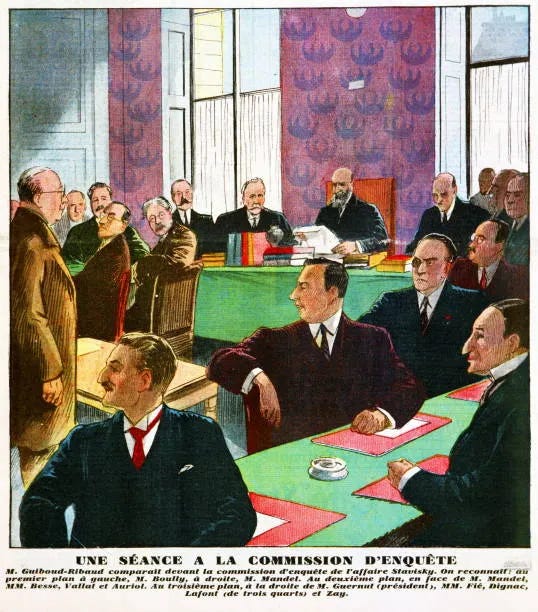
It should have been obvious by this point that the scandal would reflect poorly on the French state, but for much more mundane reasons than anyone was prepared to accept. Nevertheless, they got to work on getting to the bottom of this “mafia,” primarily constituting Stavisky, a few strongmen he employed, some various scammers, and a couple of bought off journalists. As Werth describes it, “Many Parisians discovered that they were living not in Paris, but Chicago, and the Stavisky Affair was not so much a political scandal as a gangster story” [212.] Flanner is even more colorful,
“To keep up with the Stavisky scandal—i.e., the French government—anyone would have to read the newspapers three hours a day, which is what everyone does. It is curious to be living in a land where the government is busy not governing but sucking pencils over the scenario of a super-production, thirty-million dollar gangster film on which it will not get a penny back—if it can help it. Daily, the concocted plot arrives at a peak of ingenuity, complication, villainy, and breathless surprise which simply cannot be beat—until the next day’s new twists beat it hollow…
Everywhere one turns here, past, present, future, theater, police, weekly magazines, casinos, bordels, parliament, government-backed bonds, senators, magistracy, one sees the triumph of the criminal mind…
In the midst of the latest Stavisky government investigations, some senator or other proposed some law or other about the price of wheat, on which the French farmer’s next summer crop, and city folks’ next winter’s bread, depend. But nobody paid any attention.” [ 114-116]
It should be noted yet again that the timeline here is after the Nazis took power but before the June 30th murders (now known as The Night of the Long Knives) and the price of wheat was also not the most pressing issue facing France that was being neglected in the deranged political climate which had arisen.
For weeks, the public and the law courts themselves were going crazy. Some people actually lost their minds from the stress, such as a Barrister who burst into the chamber where Romagnino, one of Stavisky’s associates, was being interviewed and having some sort of psychotic episode where he broke all sorts of things, shouted about a mafia, and ultimately tried to strip his clothes off; after great effort he was tied up and taken to an asylum on a stretcher.
He was not the only case. Werth tells of others,
“About the same time Maître Raymond Hubert, who was Romagnino’s counsel, jumped one day into the Seine. He was fished out and sent to a nursing-home. M. Hurlaux, a Paris magistrate, on being told of his dismissal—he had some personal dealings with Stavisky—attempted to poison himself right there, in the Public Prosecutor’s office. He was also sent to a nursing-home. M. Blanchard, a high official of the Ministry of Agriculture, who was dismissed from public service following the discovery that he had held a directorial post on one of the Stavisky’s companies, was found in the Forest of Fountainebleu, two days late, with his throat cut.
The cases of Hurlaux and Blanchard were particularly sad. Blanchard, though holding a high government post, had been tempted to join one of the Stavisky’s companies for the sake of £15 a month. As for Hurlaux, he received nothing at all; but a good friend of his…had one day introduced him in the street to Stavisky. Hurlaux was greatly impressed by Stavisky’s big talk.” [214-215]
Hurlaux, it seems, was quite excited by Stavisky claiming he was trying to fund a literary prize for “literature works on a non-pornographic basis” which seems to imply that most literary awards in France at the time were for pornographic literature. He got to thinking Stavisky was important and wrote Stavisky asking for career help- which was not forthcoming- and when it was discovered that was the end of Hurlaux’s career.
This having become something of a witchhunt, there was a lot of this going on. Anyone whom it could be shown had met Stavisky was at risk of losing his job. To the extent that important men were implicated, it was primarily because Stavisky had made all of these different companies, and each one tries to sell subscriptions showing off their board of directors. This is, in any country where private capital is a significant factor, a common enough scheme, which is why you are always seeing important people on the board of this or that even though you imagine they don’t do any actual work. The former Prime Minister Tardieu testified that 17 Deputies were in some way or another connected to Stavisky, which was out of 610 Deputies and 305 Senators [237.] Of these, four were his defense lawyers, who had a perfectly good justification for their association with a criminal, though of course the appearance of impropriety makes it obvious why they shouldn’t be allowed to act as defense attorneys. It does seem at least one of them was more or less extorting Stavisky, which was about as deep as Parliament’s guilt went. Regardless, the penetration of Stavisky’s influence in Parliament was not at all what the public believed when this mania was becoming an unstoppable force.
Even Dalimier was just irresponsible and made no money off of the Bayonne Bonds. He had recommended them on Dubarry’s request, which is an unforgivable dereliction of duty given Dubarry’s well-known sketchy nature and the fact that such a thing shouldn’t be done as a private favor. It seems he just signed his name and didn’t think more about it, though he had an excuse about having been distracted at the time. The perverse thing here is that anyone seriously guilty, if such a man existed within the government, knew how to protect himself and avoid discovery. Others were crooks anyway so some jail time was not a huge deal. As Werth writes,
“In a scandal like the Stavisky scandal it is the “damned fools: rather than the rogues who suffer most. Men like Romagnino and Dubarry, when they get out of jail, will no doubt carry on as usual; Hurlaux’s career is finished and Blanchard is dead.” [215]
As to the premise that Stavisky was under police protection, a variety of testimony was given but none was definitive. Chiappe said both that he had been “hot on his trail” for ten years and also that it wasn’t his job to arrest him. The latter is true insofar as it doesn’t seem any of Stavisky’s crimes took place in Paris, at least not in the sense that it would be the responsibility of the Paris police. Another policeman claimed to have a file on him going back to 1909. As to the Parquet, the ones actually responsible for financial crimes, the division meant to be in charge of him had 21,000 cases in 1933 under one magistrate, and it seems they really just didn’t get around to it.
The most interesting police testimony came from a man named Bayard, who had been using Stavisky as an informer since his arrest in 1926 and was greatly maligned for having done so. He said he never rewarded him anything and mostly received information on dope fiends, thieves, and forgers. One wonders if Stavisky was using him to get rid of inconvenient people. Here is some of his testimony.
Bayard: “Perhaps he thought I would take care of him in a moment of need.”
M. Mandel: “And you never gave him anything in return for his services?”
Bayard: “No, nothing. I don’t know what he expected me to do.”
M. Mandel: “And you really expect us to believe that during the time he worked for you, you never did him the slightest service? Was he your dupe then?”
Bayard: “Perhaps he was.”
…
M. Lagrange: “Between 1928 and 1931 the Police Judiciare inquired forty-five times into the Stavisky affair, and yet no action was taken against him. Was it because you were covering for him?”
Bayard: “No, if the Police Judiciaire had known him to be my informer, they would certainly have arrested him, considering the rivalry existing between the two services.”Bayard also declared that the whole police had known ever since 1928 that Serge Alexandre and Stavisky were one and the same person. In conclusion he complained of having been dismissed simply because he had employed Stavisky as his informer; and of being treated in the Press every day as a gangster. It was no good employing archbishops as informers, was it?” [227-228]
Another inspector at the Sûreté Générale, Simon, said that Stavisky had been “sacred and untouchable” and “There can be no doubt that we were not wanted to interfere with him. Everybody at the Sûreté knows what a farce the whole Stavisky Affair was.” And yet, he couldn’t name anyone who had given such an order.
The Holy Grail of this whole investigation was supposed to be the book of checks and counterfoils which were going to show everyone who was guilty of profiting off of the Bayonne Bonds. Ultimately, these were turned over by Jo-la-Terreur. However, they did not prove illuminating. The great majority of them were made out to “bearer” or “self,” while others were made out to a small number of Stavisky’s close associates. Others were in some sort of code. Everyone looked for any name they could recognize and wildly accused each other. The only one tracked to anyone important was one titled “Queuille, Agriculture” though with how fast governments changed Queuille was no longer the Minister of Agriculture at the time it was cashed, and it had instead been cashed by M. Blanchard, who is said to have killed himself a few days after this discovery (it is unclear to me why being found in the forest with his throat cut was assumed to be a suicide.)
Looking at the counterfoils, it was thought that perhaps as much as 300 million francs were missing. Stavisky had been found with around 30,000 francs on him, whereas it was said that his poor wife was left only 500 after his death. Modern sources tend to refer to the money as never having been recovered. However, contemporary sources emphasize that the reason things collapsed is because his money ran out. He was living an extravagant lifestyle, renting basically an entire hotel floor, gambling, keeping up appearances to fool investors, and dealing with investments in newspapers, lawyers, bribes to politicians, sponging friends, and the like. Ironically enough, all of the money he stole was probably put straight back into the economy in one way or another.
It needs to be said though, in one important regard, the French government did better than it was given credit for. What brought Stavisky’s empire crashing down was actually this Hungarian agricultural bonds scheme, from which he was hoping to make perhaps half a billion francs in profit to cover the Bayonne scheme and move onto his next thing. His lobbying and other efforts did not get him what he needed in this instance,
“Not only did the Ministry of Finance disapprove of the scheme, but, in conjunction with the Ministry of Foreign Affairs, it published a circular warning everybody against the Hungarian bonds swindle. Without the 500 million of fresh money which would have enabled him to repay the Bayonne Bonds, and still keep a balance of some 300 million francs, Stavisky was ruined; and that circular marked, indeed, the end of his financial career.” [225]
As Lagrange said in the initial Stavisky debate, if he had been successful with the Hungarian bonds, the swindle would have been big enough that “The Stavisky Affair would no longer have been a ‘scandal’ but a ‘financial crisis’—a krach” [103.] So, in the end, the government did stop this in time, or at least would have, if not for the scandal taking on a ludicrous life of its own.
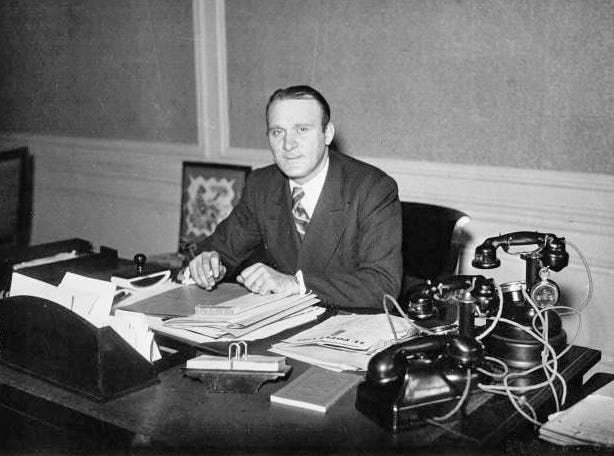
While it was never shown that there was a mafia, or even that the French government was suffering from any sort of conspiracy of corruption, the Stavisky case shook the state to its foundations. Werth writes,
“The Stavisky Affair, as the very thorough inquiry by the Parliamentary Committee revealed, was not merely one scandal, but a whole series of scandals. It was a legal scandal, a police scandal, a Press scandal, an administrative scandal and a parliamentary scandal. But apart from the revelations of corruption and the negligence of these various departments of French public life, the Stavisky Affair also showed up—and this was in the long run more important than the individual, and not very numerous, cases of proved corruption—a number of inherent vices in the administration of public services, which facilitated the corruption and often accounted for negligence.” [217]
Three main “inherent vices” seem to have been identified, and not one of them interesting enough to make a good newspaper headline.
The first was the rivalry between the different police organizations and the unclear delineation of responsibilities. Paris was covered by multiple police services and none actually provided a good answer about how Stavisky was allowed to operate freely for so long. It is notable that this is broadly the line of excuses Americans were given following 9/11.
The second was, of all things, the tendency of French politicians to be overly polite. In any government you get all sorts of petty crooks hanging around lobbies looking for favors or an opportunity to snatch some official letterhead to use in a scam and the like. There was no good answer to how Dubarry, a third rate journalist publishing a tiny newspaper, came to be one of the most influential power brokers in the country besides that he was simply so friendly no one could “cut him dead” if he approached them. At the time many believed that Dubarry was running a massive blackmail operation, but this was never proven beyond that he might attack you in the press, which is a risk with any publisher. Regarding the menace of corruption, it is perhaps illustrative to think of the scene in The Wire when Clay Davis ambushes “the rainmaker” at the Federal building to convince Stringer Bell he is working for the money which Bell pays him. There was a lot of this sort of thing going on, except the “rainmaker” was wise to the grift. Once Stavisky was managing the Empire Theatre, he did have some answer for his general place in society that would justify speaking to him. Regardless, there were not clear laws on lobbying, the lobbies were full of graspers, and the Deputies had reached such a level of informality that many of them were using tu with the old ladies behind the cigarette counter. It all created a situation where there weren’t sufficiently clear guidelines- formal or informal- on when it was appropriate to receive or give a favor.
The last, and most important thing, was that the French state was simply too centralized. No one was accountable because everything could be blamed enough on some other aspect of the system until the blame is so diluted as to be meaningless. This is particularly true due to the instability of the governments and the lack of a strong Head of State. There were 15 governments in the 5 years preceding Stavisky’s death, and since they could be thrown out at any time, even your government falling hardly seemed like a serious consequence. Now, not that modern France doesn’t have problems, but the entire thing would have happened under at most two Presidents and anger could at least be directed somewhere specific and since it is a disgrace to not finish a Presidential term it would matter. Even with the benefit of hindsight it is nearly impossible to make heads of tails of anyone in an official position who bears formal responsibility. Werth quotes a 1914 text on French government, which seems to cover this as well as anything could:
“If a terrible scandal breaks out, it is impossible discover in the case of those responsible for it anything more than a mere shadow of guilt or a mere appearance of error. The whole trouble must consequently be attributed to some evil divinity.”
- Robert de Jouvenel [Le République des Camarades]
Conclusion: An Affair to Remember
Alexander Werth, in introducing Stavisky the man, wrote the following,
“It may be safely said that few of Stavisky’s friends and acquaintances during his last years were completely disinterested: for every friendship he had to pay. That is the tragic aspect of Stavisky’s life; and he probably realised it. Conscious of being a law-breaker, he perhaps felt that he could mix only among the people whom he had more or less bought.” [79-80]
Of those people he had more or less bought, charmed, or manipulated, nineteen of them, plus his wife, would face criminal charges in a trial which concluded early in 1936.
Mme. Stavisky, the widowed mother, spent 14 months in prison awaiting trial. Left destitute and certainly unable to find support from her husband’s “friends,” it was their governess who took care of her children, supporting them out of her own savings. When they went to visit, she was moved to a hospital and put in a false cast to shield the children as much as possible from the sad new reality of their lives. She was finally provisionally released in May, 1935, some months before the trial.
Janet Flanner described the opening day in court,
“At first sitting in the Paris Assises de Justice, there weren’t chairs enough for all the accused. the two hundred and seventy witnesses, the thirty-six defense lawyers and their gowned clerks, the eighteen jurors (six in reserve, in case half of the first dozen crack up, which would otherwise mean a retrial)…Only those accused of fraud got to sit up in the criminals’ dock; lesser lights, merely charged with the illegal reception of millions, were down on the benches usually reserved for the public…There was hardly room for the safe containing the twelve-hundred-page Act of Accusation…in the prisoners’ dock, there also, apparently, was no room for the many ex-government officials and other big men formerly, according to rumor, implicated in the government-backed Stavisky swindling.” [154-155]
The most important public figure accused was a retired General who had merely lent his good name to one of Stavisky’s many schemes. Only two deputies faced charges, Garat, the Bayonne Mayor, and Bonnaure, who had been involved in some of Stavisky’s international bond operations. Mme. Stavisky claimed that she believed her husband when he told her he went straight after the 1926 arrest, though she was most likely willfully ignorant. Throughout the trial most people felt that he wouldn’t have made his gorgeous model of a wife privy to any of his wrongdoing. All of the rest argued similarly that the confidence man had simply taken them into his confidence, and with his charm and lavish lifestyle they assumed he was successful and everything was above board.
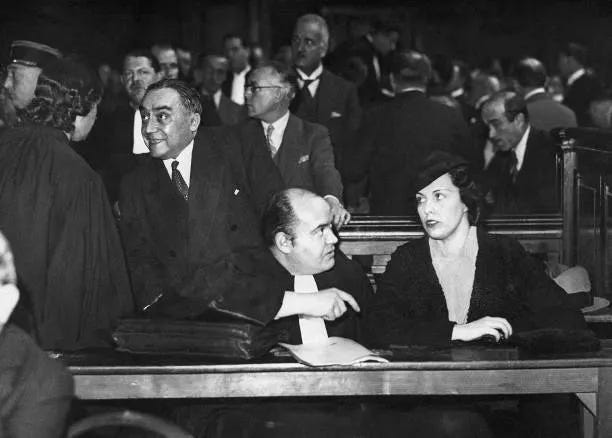
Of the 20 people on trial, 10 men and Mme. Stavisky were acquitted. Among the acquitted were Dubarry, widely considered to be Stavisky’s fixer and perhaps the most guilty among them. The 9 men found guilty were fined a nominal $6.60 each.12 Tissier, the Bayonne Pawn Shop manager and Hayotte, the manager of the Empire Theatre both got 7 year sentences. Three others, insignificant crooks, got 5 each. The General was sentenced to 2 years. The two Deputies both received one year suspended sentences, in effect, time served.
The roaring scandal which had occupied two years of French life and taken the lives of 20 men (including Stavisky himself) and cost God knows how much to prosecute ended with a whimper, with 9 men splitting perhaps 40 years in jail. No conspiracy was discovered, there was no mafia, and there is no evidence the Freemasons had anything to do with it. The Third Republic was left greatly internally weakened as the world outside its borders was becoming rapidly more dangerous. While Stavisky was a crook who deserved to be prosecuted, there is no argument to be made that it wouldn’t have been better if the public simply didn’t notice. It’s a curious note that in the abstract Chautemps was right that giving the matter as little attention was possible was best for France, he just made the fatal mistake of not understanding the public mood in a free state.
Historians looking back on this generally agree that this would have been a typical scandal if not for political forces primed to exploit it. That is largely true, and in many ways it was simply an unfortunate coincidence that everything happened as Action Française had been describing for months. Daudet wasn’t prophetic, he was simply lucky and got an inside report on Stavisky a little bit earlier than everyone else. It makes me think twice about all the times I have made quips like, “the problem with this being proven is it makes the conspiracy theory seem true,” because as much as it pains me to say it, that take from the political and media establishment is not always incorrect. The thing is though, besides that Dubarry was a crook, none of their conspiracy theories were actually proven true. It seems most likely that Stavisky killed himself, Prince killed himself, and there wasn’t any sort of organized widespread corruption allowing Stavisky to keep operating. However, there was certainly no shortage of state failures, for which the Third Republic and the French people would soon enough pay a deadly price.
For a few years, this ridiculous scandal faded into memory. Then, both the occupying Nazis and the Vichy government separately found it useful. The Nazis made it a key propaganda point about the machinations of Jews having weakened the Third Republic, even producing a film called Forces Occultes which portrayed Stavisky Affair as a Jewish-Masonic plot. The Vichy government also used the memory of Stavisky to hold show trials against former political leaders and to blame them for France’s inability to defend itself (it needs to be remembered that Vichy France and Nazi Germany were technically at war for a number of years, in a carefully managed fiction.) There is something curious about the fact that the whole scandal played out with xenophobia, but not anti-Semitism, as a factor, only for the latter to be picked up five years after it ended. I suppose what makes that poignant is that everyone used the scandal to attack whomever they wished to attack the whole time, something which the Nazis merely continued.
Throughout this essay, I have only used contemporary sources from 1936 or earlier. However, to provide an epilogue I must look to the 2002 text Stavisky: A Confidence Man in the Republic of Virtue by Paul F. Jankowski.
Mme. Stavisky left France after the trial, seeking to make a living as a performer in America. She returned shortly after, selling her jewelry and working as an unlicensed dressmaker to survive. During the occupation, facing homelessness, for a time she lived with Darius, the “negroid” Nazi propagandist whom her husband had bought off around a decade earlier. After the war she married a US military officer and spent most of the rest of her life in Puerto Rico in comfortable obscurity.
Their son, Claude Stavisky, never recovered from the events of 1934, with his luxurious young life being upended by his father’s suicide, eviction from their hotel, and his mother’s period in “the hospital.” Of course, that was all followed by the Nazi occupation neatly matching up with his formative teenage years. He spent the rest of his life in and out of asylums, otherwise working as a carnival magician, where owners would try to use his notorious name to draw in crowds. It seems that he had inherited his father’s love of deception.
I can find nothing whatsoever about the Stavisky daughter, Michelle. I prefer to imagine that if she possessed her mother’s beauty and her father’s charm perhaps she left this all behind her and made a good marriage and got a new name. It seems more likely that she disappeared onto the streets of Paris.
Late in life Arlette, the former Mme. Stavisky, returned to France permanently to try and take care of her troubled son. She had done everything she could to put the painful past behind her. In 1988, at age 85, she did finally break her silence, telling a journalist from France-Soir, “Understand that my husband alone was more intelligent than all of the journalists in the world put together.”
And with that, the once-fabulous Arlette, Chanel’s most beautiful model, had said the final word on the Stavisky Affair.
Thank you for reading! The Wayward Rabbler is written by Brad Pearce. If you enjoyed this content please subscribe and share. My main articles are free but paid subscriptions help me a huge amount. I also have a tip jar at Ko-Fi. My Facebook page is The Wayward Rabbler. You can see my shitposting and serious commentary on Twitter @WaywardRabbler.
Page numbers are from the 1940 “War Edition,” which is expanded but which left prior content from 1936 unmodified.
It could be argued that at times I follow this text too close without providing a citation, however being as it is 90 years old, fairly rare, and has thus far not been digitized, I am not going to worry about it. Should some plucky individual come along years from now and try to accuse me of plagiarism, I will consider this to constitute a sort of bulk citation.
To be clear, this is not really like the kind of passport you would get from the State Department. France long had some internal movement controls. It is more like the passport Jean Valjean was meant to carry showing he was a convict on parole. That said, it was stamped at the Swiss border, so must have been good for international travel…and yet, he stayed in France.
In the 1974 film Stavisky by Alain Raisnais, which is fairly historically accurate as far as movies go, the police chief in sitting on such information with the plan that if the government wins the next election he will blackmail them with it and if the opposition wins he will ingratiate himself with them by providing this information about their opponents.
This name means “blacksmith” in French, though sounds like a comically bad alias in English. “I’m Mr. Forget…You never saw me here.”
That is to say, the informal mode of address, a concept which doesn’t exist in modern English because thee/thou are obsolete. A very rough equivalency is “a first name basis.”
By contrast, Italian Freemasons were more or less right wing terrorists during the Years of Lead.
I don’t think this was due to those parties being particularly “anti-capitalist” so much as the fact that the central bank- privately controlled by six families- was immensely overpowered in the Third Republic and wanted political disunity.
It is not entirely clear to me why Action Française, enemies of the Sûreté Générale, should riot over their Paris Prefect being fired, but he was certainly the most sympathetic to them of anyone who might fill that role, and they were also opportunistic.
French riots are still more or less like this, though the police usually avoid firing on anyone. Riot police and rioters in France are something like Wile E. Coyote and the sheep dog who are friends after they clock out.
This just is grammatically incorrect, being an English business name in Paris. Werth includes a footnote to that effect.
I find this impossible to believe, but it is what Time Magazine published on January, 27th, 1936 and none of the text appears in any way garbled. That was presumably an even number in francs. It is roughly $150 currently.