

“It is an undertaking of some degree of delicacy to examine into the cause of public disorders. If a man happens to not succeed in such an enquiry, he will be thought weak and visionary; if he touches the true grievance, there is a danger that he may come near to persons of weight and consequence, who will rather be exasperated at the discovery of their errors, than thankful for the occasion of correcting them.”
- Edmund Burke [Thoughts on the Cause of the Present Discontents, 1770.]
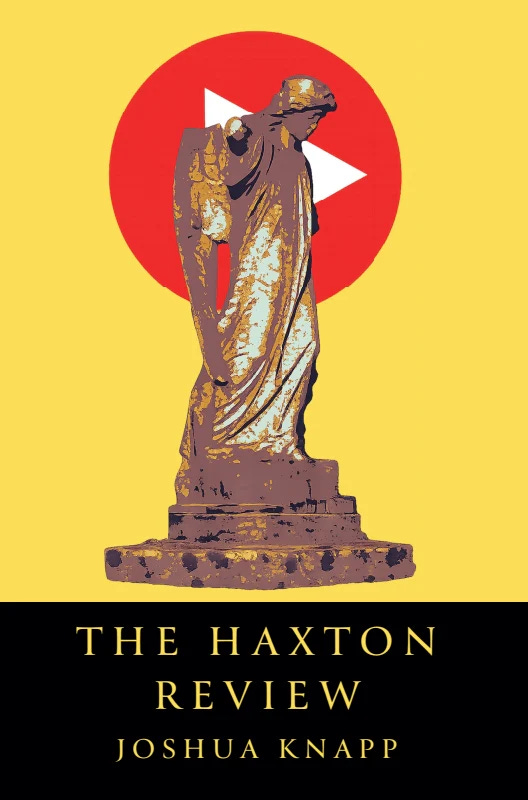
A number of weeks ago I was contacted by Ethan Rundell of Vauban Books, the translator and publisher of the new version of The Camp of the Saints, asking if I would take a review copy of a new novel from their British publishing imprint, The Maldon Press. With some hesitation I accepted, not exactly as a favor but to help out with the difficult and important endeavor of publishing the sort of fiction which is not given a chance by corporate publishers. I am glad I did, because this is a remarkable novel.
What follows is not exactly a traditional review, but more of a commentary on this moment in the life of what was once called Great Britain that the novel portrays. Though it is not the sort of novel with big plot twists, I will still only be describing the plot in broad strokes, since it seems unlikely that any readers of this essay but the author and the publisher will have read the text.
Joshua Knapp’s The Haxton Review is an impressive novel of our time. I realized upon starting it that as someone who doesn’t read contemporary fiction, I had never before read a novel where the main character has a smart phone and social media; the only contemporary novel to which I am truly devoted is Denis Johnson’s Tree of Smoke, an epic of the Vietnam War that has its epilogue still before my birth and Johnson, born in 1949, was not close to my age. The main character in The Haxton Review, Adam, has many experiences I recognize and relate to, and unlike older fiction, I am not ever left wondering how accurate of a reflection the text is of its era. As a self-described honorary member of the British online right, I am quite familiar with their society and I know that there are incredible things going on in that space, but it almost entirely relies on anonymity due to the circumstances described in this novel (Nina Power, one of the few prominent, public figures of the British New Right was bankrupted from nonsense legal matters related to her political views, for example.) The British as a whole are not nearly as cucked as many Americans believe, but the good ones do commonly have to rely on stealth to survive in their society.
This book is itself published pseudonymously by an American publisher, which kind of gets to the point, particularly as it should not be that controversial. Perhaps the most stunning thing about the novel is in fact that it is a dystopian novel that is not set in a fictional world: the author did not think of the “soft totalitarian” Yookay, but instead had it forced upon him in real life. As regards to the plot, I generally make an allowance for one large coincidence per story before writing it off as too improbable, because one really improbable thing tends to lead to a story worth telling, but Knapp does not even use the one large coincidence I allow: if anything the story line is somewhat mundane, which helps to make the novel’s point.
I should add as a comment for my primarily American audience that while Trump has been awful in a variety of ways, the “vibe shift” has been genuine and immensely liberating. Britain is potentially only one election away from the same thing happening, though Farage’s Reform Party would have most of Trump’s greatest faults, IE slavish devotion to Israel, strict “hate crime” and “hate speech” enforcement only for Jews, and endless South Asians lecturing you about what it means to be British1, a topic which the text gets into at some depth. Like me, the character has no particular issue with Islam itself but just thinks there has been too much immigration and not enough assimilation, unlike people who are so fanatically anti-Islamic that they believe they are in “one struggle” with Israel, Hindus, and Nigerian Christians against Islam. While it never got quite as bad in America, much of what is described in the story is not substantially different from American life in 2024, though it feels a thousand years away now. I would encourage any Americans who should choose to read this text to remember that this is indeed the society that the Democrats want for us.
Overall, this text is wonderful for its nuance, though I must admit the character thinks so much like myself that to me personally I was provided with no new ideas; I do not think that experience would be typical for other readers. The character, and presumably the author, gives the uneasy description of “Old Labour.” He is in short, a man of the conservative left, who would be a BSW voter were he in Germany (basically an anti-immigration, law and order, economic left party.) This is, as I am always saying, the growth ideology throughout the West. It is my view that the milquetoast libertarians of the world had it wrong with “fiscal conservative, social liberal” and in reality “fiscal liberal, social conservative” is the much better position. As the narrator notes, Labour was always an uneasy alliance between middle class intellectuals and the working class but has gone insane,
“Labour’s drift into emoting, intolerant wokeness…First of all the drift baffled me, then it amused me, and then, when I finally realised it was deadly serious, it terrified me and angered me in equal measure…the pendulum has swung much too far towards the middle-class intellectuals recently, just as they were turning absolutely bonkers.” [88]
This, of course, also describes America’s Democrats. It should be added that it is these middle class intellectuals who run the corporate publishing industry, which is why this book is from a small specialty publisher and is being written about on this substack instead of for a major magazine (to be fair, I didn’t try too hard to find a publisher for a review, as I don’t generally review fiction.) I was left wondering how much I have missed not reading contemporary fiction, and have been told very little, because books like this which actually relate to my life experience and worldview do not get picked up by the over-educated middle-aged women who generally make such decisions. That this would be considered a right wing book at all is ridiculous, because the character is very much the proverbial “normal person from 1995” in a world gone mad.

At it’s heart, The Haxton Review is a Do The Right Thing sort of story, which is to say, it is about the tensions which inevitably arise when a neighborhood’s demography rapidly changes and a former majority finds itself suddenly surrounded by people of a different type. Of course, what we call “white flight” in America is written off as merely the racism of whites not wanting to live around blacks, but is a much more universal concept. In East LA there are neighborhoods where, incredibly, just in 100 years, well-to-do WASPs were replaced by Okies, who were replaced by blacks, who were replaced by Mexicans, who were replaced by various smaller immigrant groups in more fragmented enclaves, giving each group about 20 years of dominance in that period. That is an extreme example, but in many neighborhoods of the American Northeast the founding stock was replaced by Catholic immigrants, who were replaced by blacks or Puerto Ricans, who have now been again replaced by various mass immigrant communities or are now fragmented and dysfunctional places lacking a majority. This history is, of course, brought up in the text with the standard, “this place was never uniform, the Irish used to live here!” from a liberal, as if that didn’t bring with it a variety of social challenges. Except for a small number of genuinely cosmopolitan people, almost everyone prefers to live around those like themselves if it is reasonable to do so. It has been noted that the ultra-liberal cities on the West Coast and Minneapolis were once the socially acceptable form of white separatism, but of course the Boomer libs could not ideologically justify keeping the Third World out and they’ve largely lost control of their cities.
The story being set in post-industrial northern England in 2024, the overwhelming migrant community are Pakistanis, who have fully taken over a Haxton, a suburb of the fictional city of Coxthorpe, except for one poor white enclave called Lantyrn Royd. It should be noted here, though it should go without saying, that a big difference between England and America is that while the United States is genuinely historically a “nation of immigrants” (though there has been too much immigration), an Englishman’s ancestors may have lived nearby for thousands of years, and it is not uncommon to be able to date one’s family back to the Norman Conquest, when decent records were first kept. In Britain, the ruling class simply decided to make up the premise that the United Kingdom is a “nation of immigrants” and now the liberals want to treat the arrival of the Windrush, a ship bearing West Indian migrants, as the new founding date of one of the world’s oldest continuous polities to exist in a recognizable form (the initial wave of migrants following WW2 are called “The Windrush Generation” and are celebrated in the Yookay civil religion though half the time when you hear about one of them he appears to have been on government assistance for 60 years.)
The main character in this novel, Adam, reminds me quite a lot of myself except that, mercifully, I have been married since my mid-20’s. Adam is a bachelor in his 40’s who is the sort of person to over think things and make himself unhappy- he spent years studying to be a Priest only to flee at the last minute due to lack of belief, and is a lapsed Catholic convert at the time the book takes place. He is a warehouse worker who is quite valuable there as he is overqualified for the job but doesn’t expect to do anything else. He drinks a lot because he doesn’t have anything else going on but also doesn’t seem to struggle with alcoholism in the sense that it is not a compulsion. He spends a lot of his free time meeting random old and unattractive women on the internet and engaging in mutual masturbation with them (it is unclear to me how common this is in real life, I don’t believe he views normal pornography at any point in the novel.) He doesn’t appear to be bad with women but it seems he has given up on making a relationship work. Adam’s only real social life is going to his widowed mother’s for dinner every Sunday- tea, they call dinner in northeast England apparently- and then getting drunk with her. I see men like this around, who don’t appear to have social lives and I do wonder about their internal lives. There have always been bachelors of course (not just in the euphemistic sense) but I think with modern technology and entertainment they are compartmentalized in a way they never were before. As is noted at several points in the text, the Asians have managed to maintain a stronger value system which helps them navigate the world, and it doesn’t seem many of them become lost souls like this, surely in large part because no Pakistani makes it past 30 as a bachelor without relentless and constant hounding by a bunch of Aunties trying to get him married.
I should add here a few words about Adam’s brother Ben, who is a writer of op-eds about democratic norms for a major newspaper. I found this particularly amusing because my older brother is also much more successful than I am and left home to go to an elite university after high school and has never moved back, though my older brother is a nice person and not a douchebag like Adam’s older brother- nevertheless we are not close and almost never speak except when he should happen to visit home. It is Ben and his media friends that lead to the sequence of events where Adam gets noticed because they are so interested in an articulate “genuine” voice from “forgotten England.” I found this line about his brother’s op-ed on the events particularly amusing,
“He’s not quite lying, no. But the bit about him going south in search of work gets pretty close. He left Coxthorpe to go to Cambridge for God’s sake…It’s more than overstated, mum. It makes him sound like some Irish famine-victim getting on a coffin ship to America. It’s fucking weird.” [55]
This comes as no surprise to me though, as his media friends are absolutely the sort of people who periodically go out to “forgotten” areas to find out what is wrong with them, and people who left “forgotten” areas are generally the worst about this. If they are going to send someone out to Tennessee to ask why it’s how it is you would get far better work from a journalist born and raised in New York than you would from a native Tennessean who moved to New York, but they will choose the latter every time.2
As to the actual plot of the novel, it starts like any good adventure: with the character opting to get day drunk. In short, while wandering around some Muslim group gives him a pamphlet about this “Rush Bearing” event to which they are feigning offense, which is basically just a revival of an old tradition where you do a march ending at a church (rushes were placed for worshipers to kneel upon.) Drawing on his background in religious instruction, he notices that the pamphlet seems to have three authors, a Muslim voice, a white liberal voice, and a left wing voice existing in tension with each other. It is particularly noteworthy that they simultaneously call Haxton a ‘diverse, multi-cultural community,’ and a ‘Muslim area,’ because of course “diverse” just means “non-white” [10.] This works as a subtle way to introduce the obvious tensions between what Muslims actually believe and the liberal or left wing “pro-diversity” whites who support them.
Adam then goes to the bar where the event is being planned to talk to the people there, and later decides to start an “OyTube” channel3 with videos about the event, the titular Haxton Review. The reason the Muslims are so upset is because the procession, being planned by people “not even originally from Haxton,” will include a crusader, though as is said, it’s not even a real fake knight, it is just going to be a kid with a pot on his head. Jason, a surly bar patron Adam ultimately befriends, argues that they aren’t actually offended, “They aren’t offended by shit like that, believe me. They pretend they are so that everyone feels fucking sorry for them, but they in’t. It in’t about that” [18.] This is surely the case, because beyond the Crusades being in the context of history always being full of wars, Pakistanis are not even the people the Crusades were against and we can be sure the vast majority of their peasant ancestors were largely unaware the Crusades were happening and certainly weren’t impacted by them. I don’t recall this being brought up in the text, and don’t know if that is an oversight or intentional, but it kind of works better going unsaid, because it is about what Jean Raspail called “Big Other,” not about any specific cultural traits of the people in question (and, of course, the pro-”diversity” white liberals in the novel entirely ignore the Nigerian Church in the community, because they are anti-Muslim and side with the whites.) Regardless, these immigrant groups have also generally faced real hardship and are not a bunch of pussies, they just rapidly learn how to play white people and that feigning offense is a totem in a country where mandated diversity is the civic religion.
The first on-camera interview Adam gets with the group is one of the most informative sections of the book. Of course, we have all heard endless nonsense like, “What is an English person” or “What is English culture” (or American, as the case may be.) This is seen as effective because it is a broad concept that is difficult to define but that any normal person intuitively understands, and thus the nihilists and sophists have a field day watching people twist in the wind trying to put it into simple language. It is as with the famous Tweet:

As said by Brenda, the bar proprietor of the novel, after listing some famed things from English culture,
“I in’t saying that being English is exactly the same now as it were, say, two hundred years ago, because obviously it in’t. It’s changed, just like everything changes. But just because something changes dun’t mean that it in’t real, and that it in’t worth looking after. And just cos different people list different things in what being English means, that dun’t mean it in’t real either.” [78]
This provides a clear response to the argument “because things change nothing is ever worth conserving.” Of course English culture changes. We all change over the course of our lives but “I’m not the man I used to be” is figurative it isn’t literally true, you are obviously the same individual person throughout your life. There is clear continuity in English culture and a shared history, it is not some sort of Ship of Theseus where every part has been replaced and we are left wondering if it is still the same thing. There are major British highways that still use pre-Roman cart trails!
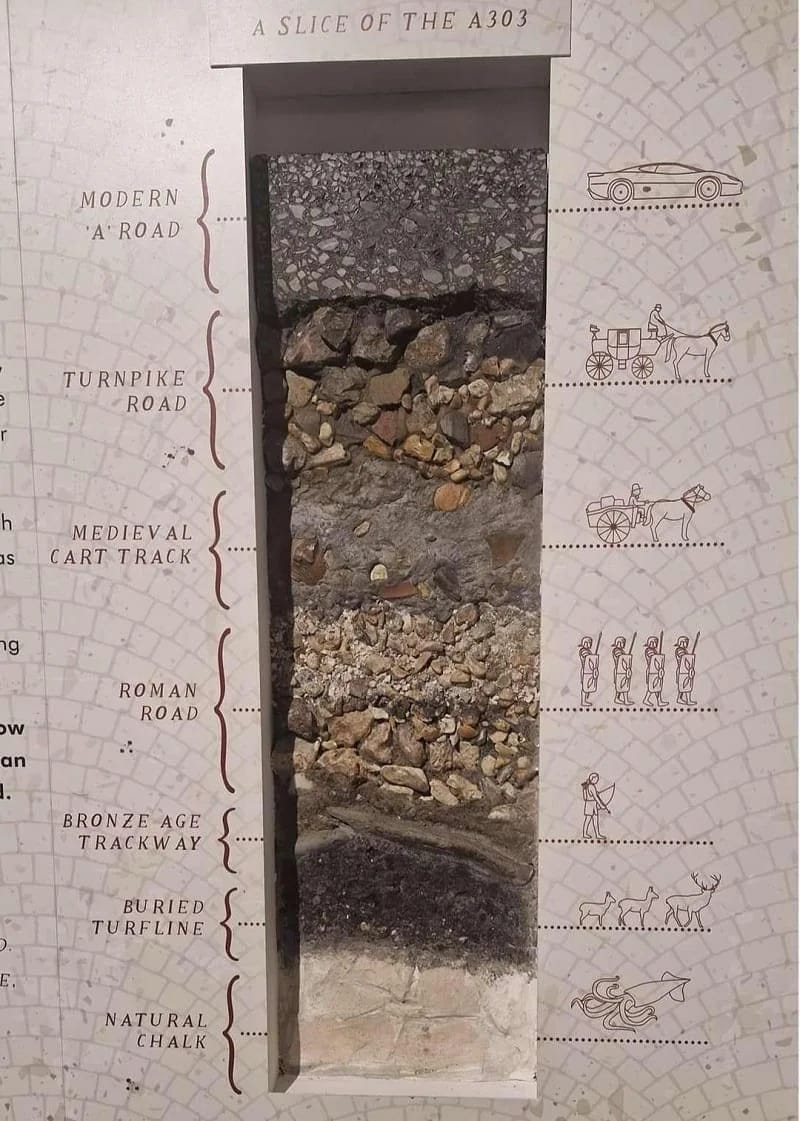
You don’t just suddenly become as English as people whose ancestors carried bronze spears on the same road you are driving on and no one earnestly doesn’t know what it means to be English. This is similar to race as a concept where if you sperg out in either direction you eventually look ridiculous because it is not possible to minutely classify races with perfect accuracy but on the other side people will claim that the difference between a Japanese man and a Fulani is so minute we don’t need a word for it and yet everyone in between understands the concept just fine.
Of course, the other argument that they like is because various major events went into the making of the English they must therefore accept infinity immigration. This is obvious nonsense, particularly given the brutality of the Norman Invasion which really made modern England and the fact that the native population was reduced to serfdom. More telling though is the introduction of the Angles, Saxons, and Jutes, who were invited by the elites in the belief that it was necessary to protect post-Roman Britain. The longstanding view that a sort of sexual apartheid wiped out the previous British male line (which would have required an even more extreme ancient “grooming gang” type of situation) is apparently discredited, but regardless what was considered necessary immigration led to elite assimilation which changed the country forever. Writers of the time talked of “rivers of blood” and the like. The point is the lessons from this history is not “such things always go on,” it is “don’t let them happen to you.” This is all essentially the English version of American Indians saying “you didn’t have greencards when you came here, no one is illegal on stolen land!” as if what happened is not that we wiped them out and took their country and thus this argument justifies the most extreme fears of immigration restrictionists.
Brenda continues,
“If that journalist fella wants to say that being proud of being English is a way of giving yourself a bit of comfort, well maybe he’s right. But there nothing wrong with that, because there’s damn all else round here to comfort you, most of the time. And also, just because being English is comforting, that dun’t make Englishness a lie.” [79]
The term has somewhat fallen out of favor due to it causing nothing misunderstandings, but it is instructive here to think about the beloved wokist phrase “social construct.” This meant something totally different to the left than to the right, because in the academic sense it just means “a way we have organized society” but to the right understood it as “this is fake and should be ignored.” Of course, the left does commonly want to tear downs the things that organize society, but basically meant it as a pseudo-intellectual way to say “this is not a natural law it’s a system of organization.” Marriage, for example, is clearly both a social construct and real. My point is that obviously Englishness is real and is comforting- life is hard and every society is filled with various social conventions to make people feel comfortable and understand their place within society. It is only this awful class of post-modernists who want to rapidly change society in ways that would make any normal person feel alarmed and uncomfortable and then tell them they shouldn’t worry about it because all of the things which made society make sense for hundreds or thousands of years were actually fake and can be ignored. Regarding this, Adam describes why liberals are so egregiously frustrating as succinctly as anyone has,
“It’s the absolute bullet-proof certainty of the modern liberal that gets on my nerves, together with their unshakable conviction that they represent the uniquely virtuous position in any debate. The liberal’s opponents are not just incorrect, they are also, always, utterly morally bankrupt. Add to this, the fact that people like my brother are paid so handsomely for crapping their liberal virtue all over much less well-off people like the Rush Bearers, and it becomes almost impossible to retain any objectivity or distance when one engages with them.” [88]
This is, of course, made all the more frustrating by the fact that they are often both morally and practically wrong, and that their intellectual foundations, such as they are, are nonsense that seem “counter-intuitive” because they are untrue. And yet, their world view is that their position is morally unassailable and they look out for the common good while minorities must “vote in their own interests” (good) but poor whites “vote against their own interests” because of racism while any affluent whites who happen to be conservative “vote in their own interests” (bad.) It goes unsaid that the dreadful managerial technocracy their politics mandate is absolutely in the economic interests of this class of liberals who staff it.
Another interesting thing from the interview is that the Rush Bearers are of course trying to come off as reasonable, non-racist people. When asked if she has social contact with the Muslim community, Brenda says they go to their shops sometimes, but have little other contact.
“I mean, where would we go to meet them for starters? There in’t really anywhere, is there. We dun’t really have much in common with them I suppose. Oh God, does that sound awful?” [71]
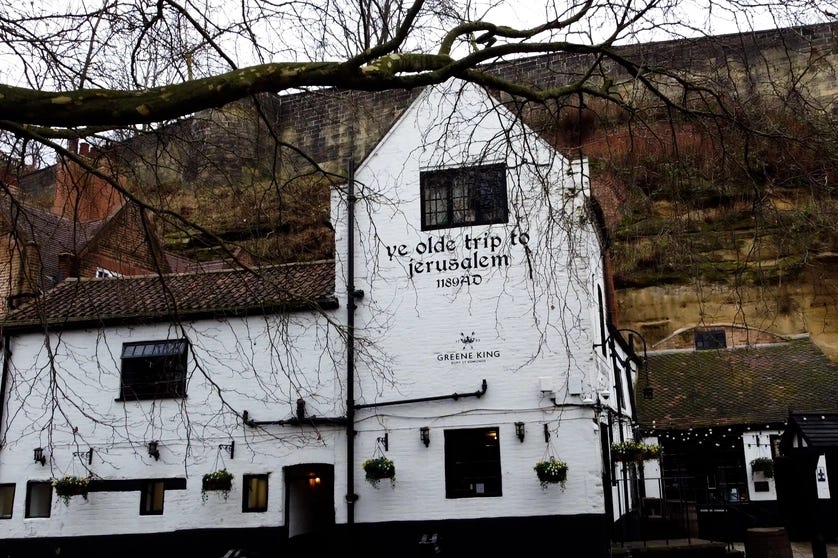
I don’t believe that “Islam is incompatible with the West,” and in fact, I think that phrase is strong sounding but largely meaningless. Islamism, the ideological belief in Islamic government, is incompatible with the government structure of European countries but Westerners are very clearly capable of living in the Gulf and doing fine and tons of West African Muslims have fully integrated into French society (others haven’t, though.) What I find interesting- and this theme is strong but fairly subtle in the text- is how do people who don’t drink integrate into a culture where the pub has been the center of communal life for over 1000 years? (I actually remember reading some Middle English poem in college lamenting the destruction of his Mead Hall, I believe about the village being destroyed by the Danes.) The French love their wine shops but also have iconic street cafes where social mixing without alcohol regularly occurs. I am sure there are tea shops you hang out at in Britain but I don’t remember seeing them as gathering places in British media. The pub is and always has been the center of British community life, and it’s hard to imagine this changing- and certainly the English don’t want it to- so where are they supposed to meet the Muslims besides when they see them milling around on the streets?
After recording the interview, Jason, the angry bar patron, offers to help Adam edit and post his video. It turns out, he is a natural history enthusiast and runs his own video channel on the topic. It’s stated plainly that this “a rebuke to snobby middle class assumptions,” as Adam describes it [94.] Indeed, the usual argument would be that these whites have been left behind due to a lack of interest in science and technology, but though we don’t learn his background and why he is some sort of laborer, he is interested in and talented at both things. More importantly though, he is anchored to his ancestral homeland. He says,
“The moors are the best thing about Coxthorpe. They’re ours, aren’t they? They belong to all of us, we should respect them...
You don’t get any Asian’s up on the moors, neither. Or hardly any.”
“For fuck’s sake, Jason.”
“It’s true. It in’t their land is it? Not really. So they dun’t care for it like we do. They dun’t belong to it. They’re all dreaming of the mountains in Kashmir, or whatever, not the moors round Coxthorpe.” [94-95]
It is a consistent feature that Adam isn’t racist and is just trying to understand everyone, but of course there is little room for such nuance in modern British life. At the same time, Adam doesn’t live in the Asian part of the metropolitan area, and is not besieged like the white holdout community he is following in Lantyrn Royd. Regardless, Jason enjoying a break from Asians is only a minor point, the larger point is that genuine attachment to the land is something that takes time, because humans are meant to be from somewhere (the famed “somewheres vs anywheres” debate is discussed at a different point in the text.) It really is as Livy says that, “Love for the soil-- a love that takes a long time to develop" [II.1.] Another more subtle aspect of this, that I am not sure was intentional on the part of the author, is simply that there is a “noble savage” view of “normies” on the internet, that assumes people are online a lot less than they really are. Jason is highly technology literate, though only recently learning more about politics. While obscure internet topics do exist, you’ll hear things like, “no one is talking about Jeffrey Epstein!” or “No one cares about trans in sports!” claiming these are “terminally online-only” when if you use Facebook you see elderly women from around town talking about these things (the trans issue, discussed to death, is mercifully mostly dismissed by the narrator as “bonkers” in a few places and not delved into.)
Upon release, the video is viewed by a surprising amount of people, most of all because a gossip columnist at his brother’s newspaper writes about it to stick it to Ben, who is apparently considered a pretentious douchebag even among the other members of the liberal media elite.
What Adam says that bothers everyone so much is his willingness to discuss Englishness and its relation to being white. This isn’t his intention, but since “indigenous” just means “anthropologists were not impressed with your civilization when they showed up” there isn’t really another term besides white to use for the native English as opposed to recent migrants when discussing the issue of minorities in England (though the French use autochthonous, a synonym of indigenous, which they have decided is less problematic for some reason that I don’t remember.) Anyhow, he says,
“Perhaps we have to say that while Englishness is not defined by ethnicity and descent, it is not completely unrelated to it either. On the one hand, we must avoid a bleak, biologically determined, racial nationalism, on the other we must avoid the magic dirt theory, that people become English simply by arriving on our soil, with the intention to stay. To say that anyone becomes English by virtue of getting here is to undermine the bonds of mutual commitment and reciprocal belonging that come from shared history and membership of the same descent group.” [84-85]
Indeed, this is so reasonable it should be a thought crime. It is obviously the case that if you immigrate somewhere and intend to stay there your family becomes more of that nationality over time, as much as recent immigrants who constantly reference their foreign background may like to deny it. He then goes on to say that the analogy of the family is helpful, as one is born into a family but can also be married or adopted into a family or come to be considered family other ways, but that it involves work on both sides for the bonds to become strong. He ends with the self-evident point that while the English can be welcoming, the newcomers (even in the third generation) have an obligation themselves to try to become English.
His brother said of this, “That stuff about white people being like an extended family is somewhat hair curling!” [100] while “Reverend” Lavinia Shaw, a lady priest who is a major character says, “I couldn’t stomach your image of the white English functioning as a family, I just couldn’t” [114.] Of course both of these characters consider themselves better educated than Adam, but in reality they have been corrupted by nonsense whereas he has a fairly deep political mind with a much better understanding of classical thought. My memory was that as some point someone said it sounded “like Nazi stuff” but I’m not finding the quote- regardless, it is the obvious implication. This focus on it being “problematic” to call the English nation “like a family” is absurd. If you go back 1000 years you would find presumably every single white English person has at least one common ancestor with every single other white English person, something that very obviously isn’t true of 20th and 21st century immigrants. I am more English than Rishi Sunak could ever be and my family has not lived there for 175 years. This is not at all some sort of nationalist ideology it’s just obviously true.
If you’ll allow a digression, the nation as a “socially constructed” extended family would be “Political Science 101” if not for the fact that discipline exists to brain rot you into believing liberal internationalist nonsense. This is what pretty much every political theorist who has examined the rise of the state says a state is- many of them the Englishman who created modernity! Take, for example, Thomas Hobbes in Leviathan, “as small families did then; so now do cities and kingdoms which are but greater families” [2.XVII.2.] Bear in mind that in this text Hobbes painstakingly analyzes the minutia of human life and yet this particular thing he appears to consider self-evident. In John Locke’s Two Treatises on Government he talks about political authority deriving from the paternal authority which God granted Adam at such incredible length that it is hard to find any short and clear quote on the matter (it is more or less the thesis of his entire argument), but nevertheless, “Whether a family by degrees grew up into a commonwealth…or whether several families, or the descendants of several families, whom chance, neighbourhood, or business brought together, uniting into a society...” [Second Treatise, 8.110.] The Romans called the Senators “conscript fathers” which is to say they had been put into the role to act as the fathers of the nation. In the United States, a substantially less descent-based country than Britain, I don’t remember even at “peak woke” anyone saying the concept of “Founding Fathers” is “problematic” because it implies the nation is like a family.4 Fraternité is in the motto of the French Republic, of course it is meant as a concept but Adam also said family was an “analogy” for a nation.
More important than any of the above, however, the British Monarch is the living patriarch of the family that is the British nations. The English and Scottish Crowns are held in personal union because of the literal combining and families and mixing of blood of those royal houses into one family. The King may be completely cucked and consider Islam to be equally British to the Church of England that he ostensibly leads, but nevertheless his meaning as their Head of State is that his people are an extended family. When Adam’s brother calls this analogy “hair curling” or Lavinia Shaw- who is a priest in the King’s religion!- says she can’t “stomach it” they are rejecting the United Kingdom entirely, and they don’t seem to even realize it. However, this is what one should expect, because the entire past of the human experience and the English people must melt away to appease the new God of “diversity,” which is considered some sort of inherent moral good for reasons which no one can explain in compelling terms.
The popularity of the completely sensible and nuanced video that shook the diversity cultists to its core gets Adam involved with modern Britain’s most celebrated institution: the diversity police. His boss, who is clearly what you or I would call a normal person, calls Adam into his office about a strange phone call he has received. It’s common to, and the text does, reference 1984, but this makes me think more of the Atlas Shrugged bureaucrat, with the “We’re not saying Reardon Metal is unsafe, we’re saying we don’t know if it’s safe.” I’m going to quote the conversation with his boss at some length, though still substantially shortened, as it is a remarkable picture of modern Britain.
[Boss:] “I got a call this lunchtime. From a copper.”
[Adam:] “From a policeman? About me?”
“Yes.”
“But I haven’t broken any laws.”
“I know you han’t. He were very particular about that, was the cop. It’s about a non-crime incident, apparently. He actually said that: a non-crime incident…He was from something called the Communities Cohesion Team…”
“…What’s the Community Cohesion Team?”
“Not community, communities. He were right particular about that when I were noting it down…He said he were just checking in. That were the phrase he used…that you’d been putting some stuff online that ‘sailed a bit close to the wind about racism and suchlike, and he were just checking in about your thinking.” [192]
The boss unsuccessfully tries to convince the cop that as far as he knows Adam is not a Nazi, and the cop gives him the number of Prevent, and says to contact them if he notices anything. Prevent, originally to prevent the Muslims from embracing radical Islamic terrorism, has been turned on anyone who opposes unlimited immigration (Alex Jones said 20 years ago that the entire anti-terrorism apparatus would be turned on the white right wing!) Prevent are the people who funded the widely lampooned interactive novel game Pathways, and gave us the new right wing avatar, Amelia.
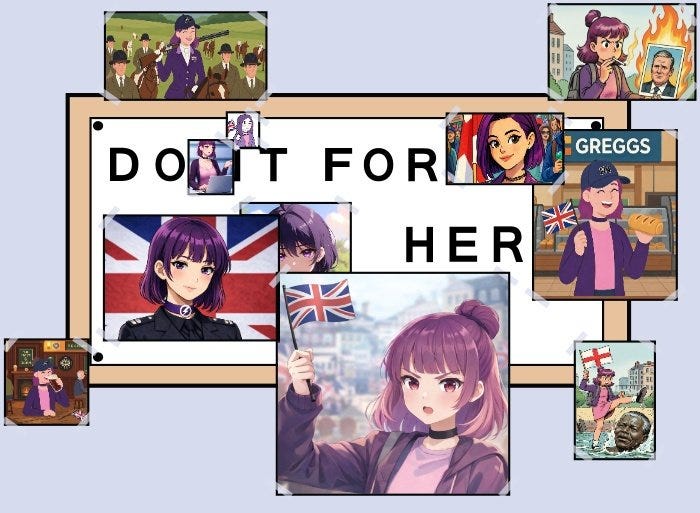
The conversation continues,
“He said that his role were to be supportive of the company as we managed our DEI journey, and that would include helping us negotiate a spectrum of deliverables, going forward, regardless of what decisions we ended up making.”
“Did he really talk like that?”
“Yeah, I made a note of it cos it were so weird.” [193]
Bear in mind there is no evidence here that the company is on a “DEI journey,” the cop just assumes that, but it is portrayed as a diverse workplace where people get along fine, because it’s a labor job in a low-income, high-immigration region. As to what the hell a “spectrum of deliverables” that the police could help them negotiate is, or with whom they would be negotiating it, the boss has no more of a clue than you or I, but the implication is of course that the government will reward them for firing Adam. He ends with the obvious takeaway of any reasonable person,
“I think I preferred coppers when they used to give you a clip for being pissed up and causing a bother on the weekend…
I in’t quite sure where the rules are these days. That’s the trouble, in’t it.” [194]
Modern Britain has began focusing on this ridiculous “Five Values” slogan now that they have immigrants to attempt to assimilate, a premise which as far as I know was made up whole cloth fairly recently. It is a grand irony that actually none of these things are followed when it comes to cracking down on anyone who opposes mass immigration:
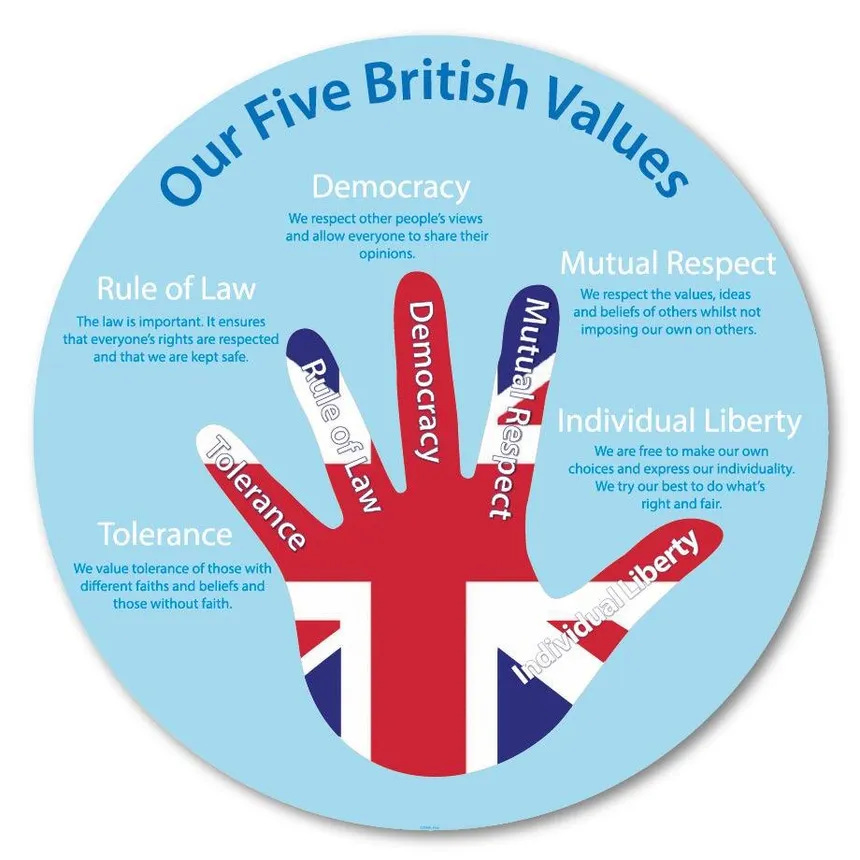
It’s profoundly alien to British tradition to “not be sure of the rules these days” particularly when interacting with the government. I’ve been reading Thomas Hardy’s novels, written at at time of tremendous change brought on by the Second Industrial Revolution, and I do not remember any situation where a character lacked a clear understanding of the rules of the society and country they live in because Great Britain is historically an incredibly orderly country of clear rules. The British taught the Pakistanis cricket5 specifically to teach them how to be rule followers, but with Pakistani mass immigration it is now the British who don’t know the rules in their own country. It is all quite inverted. This has been a trend everywhere with mass immigration, that the government has to curb the traditional liberties of the native populace to force or manipulate them into being nice to immigrants.
As the situation in Haxton gets increasingly tense the city is visited by activists from both sides of the political spectrum. Roger, a friendly academic fascist who is behind reviving the Rush Bearing, gives a remarkable description of what is wrong with this segment of the European right, and I must say I deal with this shit all the time- both recognizing the problem in Europe and with a segment of the American right. In this case, he is explaining a group which is named, “English Solidarity.”
“The first thing about them is that they will be pro-Israel. Unquestionably pro-Israel in the ‘shared struggle against Islam’…while they will be ferociously anti-Islamic, they will also be pro-immigration. They will be nationalists in the civic sense of the term and will talk about British values and citizenship and so on until they’re blue in the bloody face. But they won’t be nationalists in the true sense of caring for their own ethnic inheritance, their own kin, and worry about their people’s replacement in their own bloody country.” [225]
In short, they will be Dinesh D’Souza but white. He continues,
“They turn our folk into little bloody Zionists, which makes it easier for politicians to send our young men to die in shitty little wars for a foreign power.” [226]
Adam then encounters these people, to find that Roger is of course correct. He asks one the question, “If you’re all about English solidarity, why the Israeli flags? Coxthorpe’s a long way from Tel Aviv.” He gets the response, “It’s obvious mate. It’s cos they stand up to Muslims too.” Another member says, “It’s global, though, isn’t it? The struggle. If anyone’s standing up to Muslims and Jihadis and all that, anywhere in the world, we’ve got to show solidarity” [249.] He seems nonplussed by Adam’s comment that perhaps a better name would be Global Solidarity.
It is also noticed that both sides are flying rainbow flags, one side being the over-discussed “Queers for Palestine” types while the anti-Muslim right is sure that Muslims routinely throw gays off buildings and gays must thus be a key part of the global anti-Islamic struggle. When Adam returns to his narration he says the following,
“English Solidarity, it seems, are first and foremost anti-Islam, or anti-radical Islam. Beyond that they are Zionists, multi-culturalists, and violent defenders of sexual and gender diversity…the strangest thing about ES, for me, is how similar they are to the people they are protesting against. And, I suppose, the image of the rainbow flags on both sides of today’s police lines is the most obvious expression of that. At some level, the clash between English Solidarity and Respect Haxton looks very much like a civil war within the diversity cult.” [253]
This exact thing drives me crazy, and it is under-discussed. The (non-Evangelical) Zionist right has decided that sodomy is a core Western value despite that they almost universally thought homosexuality was wrong 20 years ago. Here in America, home of the famous “God Hates Fags” church (whatever happened to those people?) it is somehow assumed that only Muslims might oppose homosexuality on religious grounds. This is all profoundly frustrating as someone who strongly opposes immigration on practical and theoretical grounds but who has no particular animus against Islam and does not believe we’re locked in some civilizational struggle. I mean, here is some content I just happened to see on Twitter in the time I was planning this article:
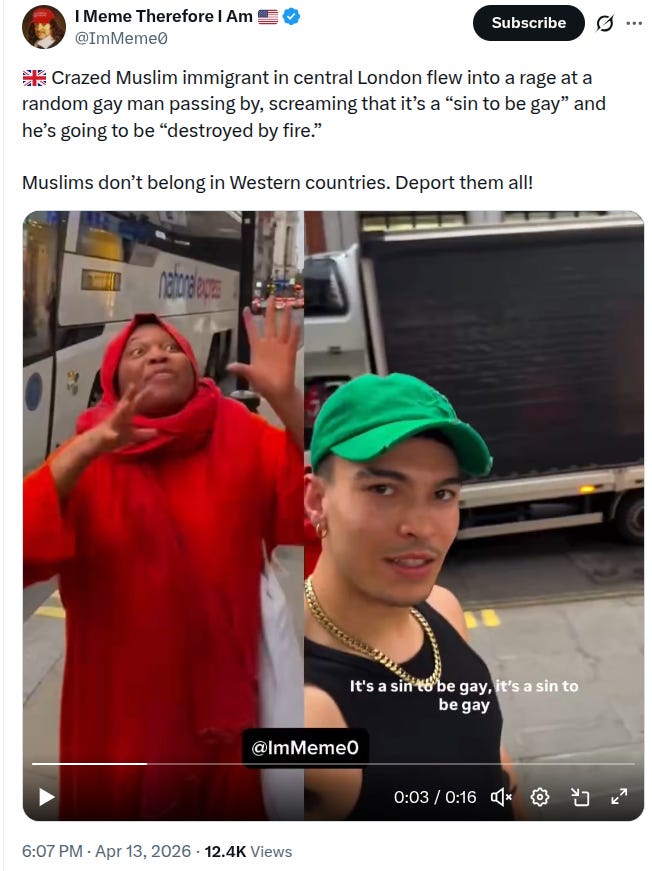
The other side has a group come to town called Resistance Media. As is the case with the American left during the woke era, somehow the “Resistance” is in complete solidarity with the police, government, and capital (and in this story, it is later implied, are also spooked up.) As Adam says,
“Resistance Media: the anti-capitalist, anarchist media company that makes a common cause with The Salamanca Banking Group and West Yorkshire Police. Brave street-fighting revolutionaries to a man. Sorry, not to a man, to a person.” [242]
I’ve never heard anyone on the left have a good explanation for how they are the “resistance” if they are allied with all of society’s major power centers against some of the most marginalized people in society, though mildly complaining Pride Parades were overly corporatized or whatever wasn’t that uncommon. I am reminded of my friend and mentor Daniel McCarthy once saying on a podcast something along the lines of, “I mean, the fucking CIA is woke on transgenderism!” Clearly the “powers that be” like all of this and consider it to help them. Knapp overall does an impressive job of seeking to explain the role of capital, particularly given that almost anyone on the modern right is abysmal on this topic because they exist in a reaction to Marx that largely denies class interest as a significant factor in society (I know of no serious thinker before Marx who denied class conflict was an important part of history but now even the Pope referencing poverty gets him called a communist.)
One person interviewed suggests that perhaps this Salamanca Banking Group just doesn’t like racism and that is the reason for their sponsorship of the diversity festival. A more plausible but still basic, explanation would be that they need good PR. Regardless, as Adam points out, they have done nothing else which would imply that they’ve found a conscience. Instead, he narrates the following,
“Capital is completely unconcerned with nations. In fact, it’s completely unconcerned with everything apart from its own increase. It doesn’t care about peoples, or belonging, or home, or beauty, or goodness, or meaning…Maybe the bank, and international capital generally, want people to be rootless, secular and interchangeable, and without earthly loyalties or metaphysical commitments which would impede their final commodification, and the commodification of the world around them.” [263-264]
That is pretty close, though how I describe this is that financial interests always benefit from instability and the more that they break down social connections and community the more you are left to rely on banks loans and other services should you run into any problems. Of course, it is also the banks that benefit the most from “line go up” regardless of if that “economic growth” is actually good for the public or merely more total people being in the country. What is important to note is that while the left fallaciously holds an almost religious certainty that “wealth is conservative,” in reality landed interests are conservative but financial interests are not at all, at least not in the social sense (they generally aren’t in the economic sense either, being able to benefit from most regulations and government spending.) In my view, by a wide margin the best pre-Marx conservative discourse on how this all functions in reality is from Edmund Burke’s Reflections on the Revolution in France, history’s first major instance of “woke capital.” Burke writes,
“In the state of real, though not always perceived warfare between the noble ancient landed interest, and the new monied interest, the greatest because the most applicable strength was in the hands of the latter. The monied interest is in its nature more ready for any adventure; and its possessors more disposed to new enterprizes of any kind. Being a recent acquisition, it falls in more naturally with any novelties. It is therefore the kind of wealth which will be resorted to by all who wish for change…
The literary cabal had some years ago formed something like a regular plan for the destruction of the Christian religion. This object they pursued with a degree of zeal which hitherto had been discovered only in the propagators of some system of piety…To this system of literary monopoly was joined an unremitting industry to blacken and discredit in every way, and by every means, all those who did not hold to their faction…
Writers, especially when they act in a body, and with one direction, have great influence on the publick mind; the alliance therefore of these writers with the monied interest had no small effect in removing the popular odium and envy which attended that species of wealth. These writers, like the propagators of all novelties, pretended to a great zeal for the poor, and the lower orders…They served as a link to unite, in favour of one object, obnoxious wealth to restless and desperate poverty.” [110-1136]
This basically describes the struggle of the entire novel and why it is that an immigrant lumpenproletariat, the media liberal elites, and the big bank are all on the same side against normal people whose happiness and well-being are genuinely threatened by rapid change. Modern conservatives, in general, have no workable theory for “woke capital” (outside of those who simply blame it on a Jewish conspiracy, I suppose) because a steady stream of Marx-reactors have trained them to not understand class conflict, but it is all laid out perfectly in Burke’s description of Revolutionary France.
As The Haxton Review comes to its end, it becomes apparent that for unclear reasons the hands of the government have probably been all over this affair from the start, possibly even instigating it for the opportunity to shut it down, more or less. When in a conversation with Lavinia Shaw, the woke female priest specializing in “interfaith issues,” Adam asks the purpose of the whole thing, she merely replies, “If I were you, Adam, I’d try not to think about the ends very much. In my experience, it doesn’t do one much good. It gets rather uncomfortable” [437.] This is, of course, the maddening thing about mass immigration. There is no clear answer to the question “What is this for? Why do we need to do this?”
The socially acceptable answer to why governments want this is low birth rates make it is necessary to fund Europe’s welfare state and old-age pensions, but the actual data shows mass immigration costs an enormous amount of money. The claim “Diversity is our strength” is just a meaningless bit of liturgy of the diversity religion that isn’t considered to require proving. I must admit to not having read Renaud Camus and not knowing more about “The Great Replacement Theory” besides the broad concept that mass immigration is changing the population. I am, however, skeptical of Camus because he is a gay man with an Israeli flag in his Twitter handle (as well as an EU flag and a Ukraine flag, incredibly enough) and thus it’s hard to imagine he doesn’t meet Roger’s description of the wrong kind of rightist. I would say about that, ignoring that the rulers seem to be entirely incompetent so could just be stupid and operating from an idiotic principle, it isn’t obvious to me that it is easier or more profitable to rule over a mass of Third Worlders than Europeans. Further, the migrants, in sufficient numbers, will never accept the rule of pantsuit lady Eurocrats but will more likely overthrow and possibly kill them. I think that most likely it is the matter from The Camp of the Saints that it is “cowardice in the face of weakness” and misplaced historic guilt. In blunt terms, that we may lose our countries because the alternative was being mean.
However, while the EU simply being too paralyzed and weak is plausible, how it is that after British voters left the EU largely over immigration it increased even more with the “Boriswave” is unclear. I think that it may just be the case that the British Empire trained an entire class of people who have no marketable skills but to try to make South Asians, West Indians, and Africans more British, and now they are the Luddites of post-Imperial Britain, unwilling to lose their obsolete but economically lucrative positions managing those population groups. What is clear though is that the English people never said “yes” to this, and in fact said “no” in the monumental Brexit vote, and now they are somehow seen as the ones who are bad or ignorant for opposing a complete population change in their communities for reasons no one can understand or explain. It’s little more than what Kunley calls a “Really obviously bad idea.”
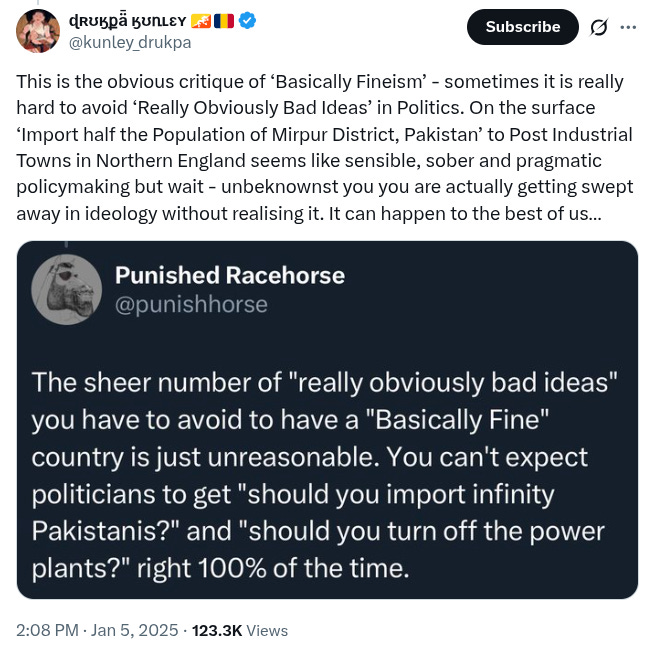
Overall. The Haxton Review is a worthy contemporary novel. It is well written with a strong sense of place, local culture, and idiom. It tells a story that I know to be entirely realistic. At the same time, I can’t vouch for how persuasive it is, because I have the same political views as the narrator- and one assumes, by extension, the author- to an absolutely stunning degree, particularly as it relates to the major themes of the novel. It didn’t, for me, open up any new frontiers or cause me to look at any substantial issues in a new way, because the novel is so thoroughly where I already was. Still, through fiction it has managed to explain how things are and perhaps how they should be in a way that is accessible to a much broader audience than any work of political theory one could write- should a broader audience somehow manage to find this book. Having done my part here to discuss and promote it, I am going to end with a final quote of Adam describing his world view that I did not thus far work in,
“I believe in defending settled communities where the individual may grow and flourish. I believe that the state should be a moral agent to protect a generously defined account of the good, rather than claiming (falsely) to be a morally neutral arbiter which ‘holds the ring’ and prevents any one conception of the good from squashing others. The morally active state that I would like to see, would ensure that all people have the material and cultural resources that will enable them to thrive…Most of all I loathe the idea that social life is all about identity, oppression, and self-assertion, with all the tasteless and narcissistic intersectional crap that goes with it. I hate the implication of this view, that common life is nothing but the play of contesting powers without any shared and binding notions of goodness and truth.” [174-175]
Indeed, but sadly, your government, and mine until recently, have decided that “diversity” is the key moral good that it is the most important thing for the state to promote. That is why Great Britain is now the Yookay.
Thank you for reading! The Wayward Rabbler is written by Brad Pearce. If you enjoyed this content please subscribe and share. I am available for freelance work and can be contacted here, on Twitter, or by emailing me at pearcebrad@hotmail.com. My main articles are free but paid subscriptions help me a huge amount. I also have a tip jar at Ko-Fi. My Facebook page is The Wayward Rabbler. You can see my shitposting and serious commentary on Twitter @WaywardRabbler.
This seems to be a specific Indian sub-continent cultural trait, feeling compelled to constantly lecture the public about the meaning of their own country. South Asians seem to call things “un-American” at 10x the rate of anyone else. I am not sure why. The Chinese and the Mexicans are certainly not like that.
It’s actually been remarkable freelancing how interested in anything related to my living in my home region is to the East Coast editors.
It’s strange the book chooses not to say “Youtube” when several social media services are mentioned by name and is is referenced as belonging to Google, but I assume a lawyer had some good reason.
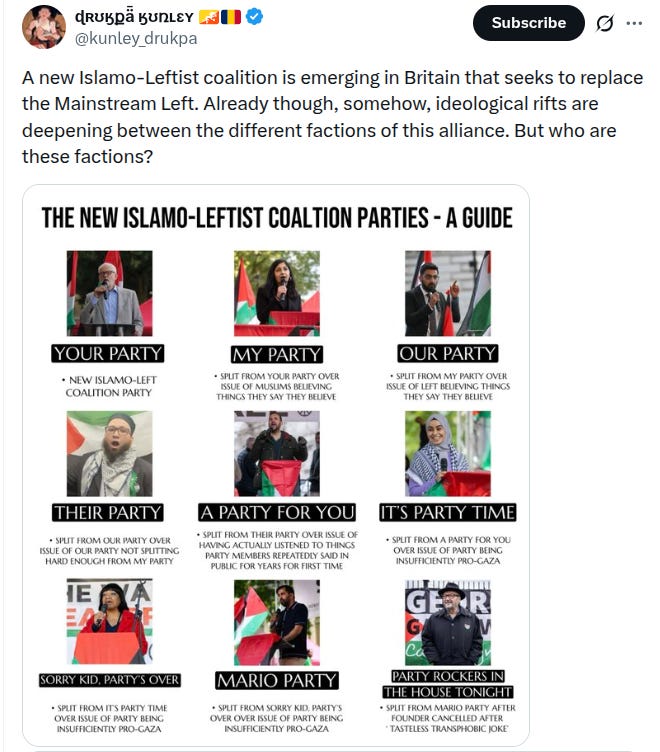
But there is a principle I don’t believe there is a name for, similar to Rule 34, that if you can imagine a deranged political view, there is a Tweet where at least one person has expressed it.
This is discussed at some length in the excellent book Tournament of Shadows: The Great Game and the Race for Empire in Central Asia. As an aside, I have no idea at all how cricket works and once saw a clipshow of former Pakistani Prime Minister Imran Khan playing- considered by some to be the best all-around cricket player of all time- and it looked so ridiculous if you put some silent film music to it I would have thought it was a comedy bit.
Burke’s work is, maddeningly, not internally organized for any sort of citation. These are the page numbers from the 1999 Oxford World’s Classics edition.
Brad, your writing and articles deserve 100s of likes. Just excellent