

“A prince must never, therefore, allow his dignity to be diminished and must never give up anything willingly, if he wishes to give it up honourably….because the person to whom you have conceded this possession through obvious cowardice will not stand still but will want to deprive you of other possessions, and, esteeming you less, he will be incited to act against you, and among those who support you, you will find your defenders lukewarm, since they feel that you are either weak or cowardly.”
- Machiavelli [Discourses, II.14]
A note to readers: I apologize for my low output, which I am trying hard to increase. My one year old is going through a phase where he spends half the day standing in front of me crying with his arms held up and then when I pick him up he squirms off my lap to do it again. He does this even when mom’s home and at night when she tries to take him to bed, which are the main times I am usually free to write. If he sits on my lap he slaps the keyboard. Suffice to say, it is extremely challenging to get work done. Thank you for your patience during this trying time.
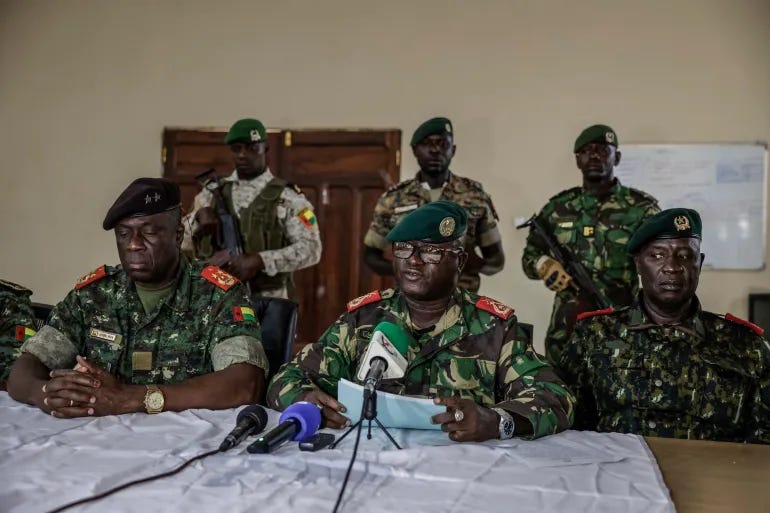
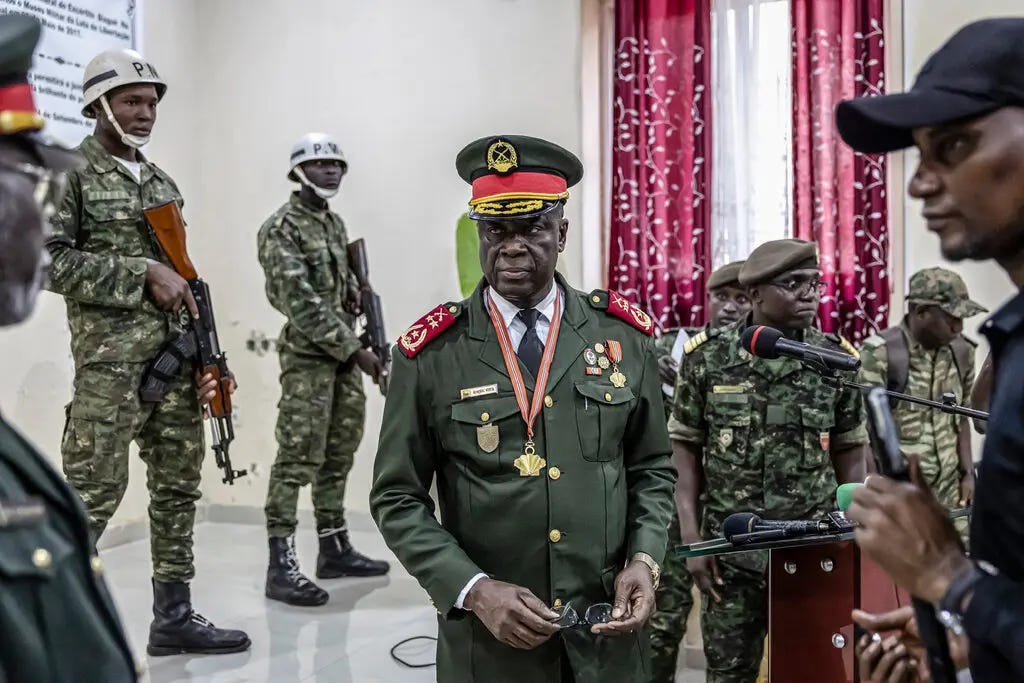
On Wednesday, November 26th the small, severely troubled West African nation of Guinea-Bissau, labeled by the UN as “Africa’s first narco-state,” experienced an event simultaneously typical and extremely bizarre. The typical part is a military taking power and going on TV to give themselves some innocuous sounding name- this time the “High Military Command for the Restoration of Order”- and announcing a suspension of the constitution, the closure of the borders, and the like. Dutifully, they blamed corruption and a conspiracy for the necessity of the coup, with coup spokesman Dinis N’Tchama saying they had discovered an “ongoing plan” to “manipulate election results” and that the “scheme was set up by some national politicians with the participation of a well-known drug lord, and domestic and foreign nationals.” He, of course, did not provide evidence for this claim. A man named General Horta N’Ta was named the new leader of the country. Many such cases.
Coups are common in this region, particularly in Guinea-Bissau where in 50 years of independence this is only the second time an elected President remained alive and in office at the end of his term and was able to run for re-election [the prior guy to do so lost, by the way.] But the bizarre thing is this: the coup took place shortly after an election but before the results were announced when both sides were claiming victory, and figures from both sides were arrested. Even more bizarre, the President, Umaro Sissoco Embalo, called France24 and said “I have been deposed.” He wouldn’t speak more, claiming the risk of his phone taken away, but this seems to be unprecedented, as in such a situation the deposed is usually denied communication and then if allowed to speak pontificates about the importance of democracy and the rule of law despite it generally being the case that he has shown no fidelity to either. Instead of remaining detained, a Senegalese military plane went into the country to fetch him and he was released. The “legitimacy,” if you will, of the coup was immediately thrown into question. Nigeria’s former President Goodluck Jonathon- one of West Africa’s only former Heads of State to have lost an election and left office peacefully, and thus a major senior statesman of the region- was observing the election for his NGO associated with the regional bloc ECOWAS and called the coup “ceremonial” and said it “wasn’t a coup.” Neighboring Senegal’s Prime Minister Ousmane Sonko called the coup “a sham,” after it was his country which sprung him from Guinea-Bissau.1 For reasons that are still not clear, Embalo soon left for Congo-Brazzaville.
The assumption held by many is that knowing he would lose, Embalo orchestrated this coup himself, as The People’s Dispatch suggested, “to protect the neo-colonial order.” The strange thing about it all though is that this is seemingly the worst and least reliable way Embalo could have avoided recognizing election results. The man had already dissolved Parliament twice and left it dissolved for years, forced a resignation out of the Supreme Court President by putting his house under siege, banned the party which won the last Parliamentary elections from running, and put off the election so long that his Presidency lost all constitutional legitimacy back in February. For all of that, it appears the actual vote counting was meant to be fair. Still, if a man is willing to do these things to run a country of 2 million+ people as a personal fiefdom with no real legislature or proper court, he could have just rigged the election, lied about the results, made up an excuse for why they were invalid, or otherwise refused to leave power. Now, having pulled this gambit, if a gambit it is, he will have the tricky problem of getting the military to give him back power after their “one year transition”- or at least to hold an election someone bothers to rig- which is all easier said than done when you’re abroad and don’t appear to provide anything that couldn’t be gained from any other warm suit. Strangely, ECOWAS, which suspended Guinea-Bissau following the coup, is calling for his reinstatement despite that his term ended many months ago and it would be more sensible to call for the junta to produce the election results and inaugurate the winner, which one assumes is his opponent. Given the strange events which we are watching and the immense power of drug cartels over this tiny impoverished country, we must assume that to a great extent we are watching some sort of coked-out puppet theater directed from Sinaloa, Mexico. Even so, one can’t easily understand why they would manage events in this fashion.
How then, did it come to this? My intention here today is to tell the story of Guinea-Bissau which led to this absurd situation.
Guinea-Bissau is one of Africa’s least known and most troubled states, on an enormous continent with a lot of problems that few outsiders know much about. Starting from the beginning of the written record, the country first had known contacts with Europeans in the mid-15th century when the Portuguese were exploring Africa, with Alvise Codomosto, a Venetian in Portuguese employment, being the first to reach the region. However, there is reason to believe it would have had at least semi-regular trade with the Mediterranean in Antiquity, since the Carthaginians are known to have traded at the mouth of the Senegal River, a trade which may have been continued by the Romans; the Romans also had at least one land expedition that is believed to have reached the Senegal River, which at the very least is a geographic feature that crops up a few places in the ancient texts. Regardless, after mapping the area the Portuguese set up a trade post on an island, but did not establish control over any meaningful amount of the mainland until the 19th century. This was one of the first regions to be impacted by the Atlantic Slave trade, when the Portuguese began to take slaves to Cabo Verde and the Azores Islands, which were uninhabited when the Portuguese discovered them. On Atlantic slave trade maps such as you might have seen in school, this region is listed under “Senegambia,” and was a significant source of slaves, though still in a much lower volume than the Gulf of Guinea and West Central Africa.
I should give a brief history of the Portuguese Empire, as I don’t think it has previously came up in my work. The initial Portuguese contacts with Africa, which came decades or centuries before the larger states in Europe, were largely positive. The more sophisticated African states, such as the Kingdom of Kongo, were treated as something like equals, forming treaties and exchanging ambassadors and the like. As one can see from the journals they kept, the Portuguese were often impressed with what they found in Africa. Many regions, particularly in the Gulf of Guinea and on the Swahili Coast, were of a roughly comparable level of social, economic, and political development to Portugal, which it must be said was an impoverished little corner of Europe. However, Portugal developed the caravel, a small ship famous for its ability to sail into the wind, and decided to set out on these long coastal voyages, changing the course of history and becoming one of the world’s great empires. Over time, due to increased European competition, the insatiable demand for slaves, and a variety of complex factors not worth going into here, Portugal’s relations with Africa became more predatory over time. The upshot of all of this is that while the material conditions of much of Western Europe and much of Africa were not substantially different in the mid-15th century, the Age of Exploration led to rapid growth in Europe but massively destabilized and harmed Africa, which in many places regressed during that period. Like Spain, the loot of empire greatly solidified Portugal’s upper class, propping up a rigid feudal system that prevented genuine economic growth for the public. Even in 1850 the average Portuguese person was living a life of ignorance and squalor in a hovel built out of local materials and engaging in subsistence farming, herding, or fishing. His material conditions and education were little better than the average African who had avoided slavery. In many ways his life was probably less free and less pleasant.
It is this Portugal which then claimed large swathes of land in Southern Africa during the 19th century, making Guinea-Bissau’s primary importance a stopover point on the way to Angola and Mozambique. Besides building beautiful capitals for their own people to inhabit, Portugal put very little into developing Africa and even less into developing Africans. It must be mentioned for completeness that it happened to be the case that those capitals were [and still are] the ends of Africa’s only transcontinental railroad, but this had little to do with Portugal wanting to build infrastructure in their territories and much more to do with connecting the Belgian Congo’s lucrative “copper belt” to sea trade. While Mozambique was somewhat more international trade oriented, in Angola Portugal sent the dregs of its society: criminals, debtors, beggars, and the like. Portugal being a small country, their numbers were not great, and they received little support from home. Unsurprisingly, these criminal and paupers did little to “civilize” Africans. The American journalist David Lamb, in his book 1984 The Africans, which is the most popular survey of the country a generation into the independence era, describes it as follows,
“Most of the white settlement before this century was comprised of degredadas—criminals sentenced to Angola rather than to jail in Portugal…Angola became a dumping ground for illiterate European peasants. And a miserable lot they were. Unable to find suitable work in the cities, many drifted into villages, took up with African peasant women and “went native,” living as bare as subsistence existence as the poorest black farmer.” [176]
The Portuguese Empire under the dictator Salazar ultimately claimed in 1951 to fully incorporate its colonies as essential parts of its state, such as the current status of French Guiana.2 There was no “color bar,” which is to say official racial discrimination, but Africans were separated into “assimilated” and “indigenous.” People of mixed race were considered to be white, but of course only if they were culturally Portuguese, and who knows how many descendants of Portuguese were considered indigenous because their great grandpa was a Portuguese convict who didn’t know no book learnin’ and just disappeared into the bush. Regardless, any African man could apply to become assimilated, but he had to be fluently literate in Portuguese and have an economic status unattainable to the vast majority of Africans. It should be mentioned that Portugal itself had shockingly high illiteracy rates into the mid-20th century, having only reached a majority-literate population in 1950 after extensive education efforts. Education was even worse among white Angolans, so most Portuguese adults could not have met this requirement. Were an African to become “assimilated,” he would be governed by different laws, including a mandatory military service requirement, but then would be eligible for a Portuguese passport. As Portugal was a dictatorship anyway and everything was directly administered from Lisbon, his political rights would be little changed. According to John Gunther, as of the 1950’s there were about 35,000 assimilados between Angola and Mozambique, out of a total population of over 9 million Africans [Inside Africa, 590.] No businesses in Portuguese Africa were officially segregated, but dress codes served the same function while allowing an African to dream he could one day afford nice clothing and a drink at a fancy bar- never underestimate what governments can accomplish with the illusion that it is possible for you to improve your economic status.
It was for this empire that Portugal was willing to go to war, the only European power which tried to sail against the winds of history like their famed caravels and keep their empire by brute military force instead of attempting to mold it into friendly independent states. For the Portuguese regime, now led by Salazar’s successor Caetano, this policy proved disastrous. In 1963 the African Party for the Independence of Guinea and Cabo Verde [PAIGC] launched a guerrilla war against the Portuguese. In this small neglected colony the guerrillas saw substantial success, ultimately driving the Portuguese into limited fortified areas, and nearly scoring a genuine total victory through territorial control, the only African rebel movement I know of to have such success against the European power. Caetano’s stance was that it was better to face outright defeat in Guinea-Bissau than to make any negotiation which would set a precedent for the larger colonies. It didn’t come to that, because in 1974 the government, stressed by endless colonial wars, as well as the usual problems of a long-standing decrepit dictatorship, was overthrown in a military coup known as “the Carnation Revolution.” They immediately announced an end to the African wars and Guinea-Bissau was recognized as independent later that year. The Portuguese Empire had collapsed, dooming white minority rule in Africa, though it would take another two decades for the last chip to fall when Apartheid ended in South Africa.3
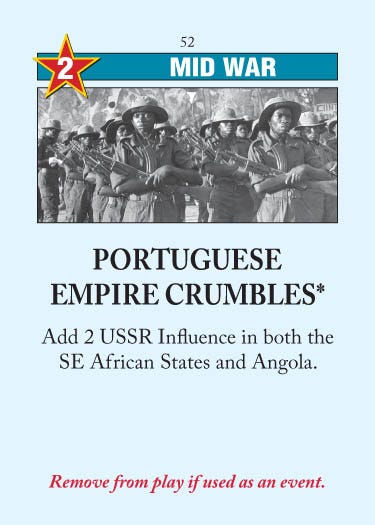
With the fall of the empire, white Portuguese fled Africa en masse, taking everything they could. The Portuguese were objectively the worst colonial empire in Africa, extracting everything they could while contributing as little as possible. In Guinea-Bissau, which had never been a settler colony, there were only 2,500 Portuguese in the country, a number which dropped to 350 within a few weeks. At the time the country had a life expectancy at birth of 35 years, and 45% of children died before age 5. There was a total of 24,000 jobs4 in the country of 800,000 people, and 82% of them were in the public sector, which is to say the salaries were previously paid by Lisbon. Lamb describes the rest of the country’s situation as follows:
“What they left as a legacy of three hundred years of colonial rule was pitifully little: fourteen university graduates, an illiteracy rate of 97 percent, and only 265 miles of paved roads in an area twice the size of New Jersey. There was only one modern plant in Guinea-Bissau in 1974—it produced beer for Portuguese troops—and as a final gesture before leaving, the Portuguese destroyed the national archives.” [5]
The country did not have a single African doctor, lawyer, or accountant [139.] Even compared to other African nations, at the time of independence Guinea-Bissau simply did not stand a chance.
Since independence, the people of Guinea-Bissau have known little but poverty and repression. In 1973 the founder of PAIGC, Amilcar Cabral, one of the heroes of Africa’s independence movements, had been assassinated in Conakry. His half-brother Luis Cabral became Guinea-Bissau’s first President. He was a repressive leader who made some attempts towards improving public services, but with no money and no doctors or other professionals there was very little to work with. He was overthrown in 1980 by Prime Minister Joao Bernardo Vieira, who established military rule for four years, then created a new constitution, and 10 years later held a multiparty election which he won. Four years later there was a civil war lasting a year which led to his deposition and exile in 1999. He later returned to the country, which was still wracked with instability, and won the 2005 election before being assassinated in 2009. Vieira had little success in improving Guinea-Bissau but did produce the only relative stability the country has known. Reuters has made a convenient list of coups and political violence in Guinea-Bissau, which now includes 4 successful coups, one civil war, the assassination of one President, and endless other instances of coup attempts or violent political strife, all in about 50 years.
It was into this that cartels arrived 20 years ago, according to The Economist, possibly invited by Vieira to fund his 2005 election campaign. Suffice to say the country was wide open for them, with the majority of the public living on under $2 a day and police who lacked fuel to chase them down even if they were inclined to do so instead of taking a bribe. A new Twitter account called Sahel Chronicles produced a wonderful 20 minute video on how Guinea-Bissau was taken over by narcos starting in 2005, but I don’t want to take away from their traffic by uploading it here [it is clearly a funded project started by talented people and I wish them the best.] It seems to partially follow a 2008 story which was originally in The Observer about how rapidly this all hit the country. I will just tell the story myself, largely going from those two sources.
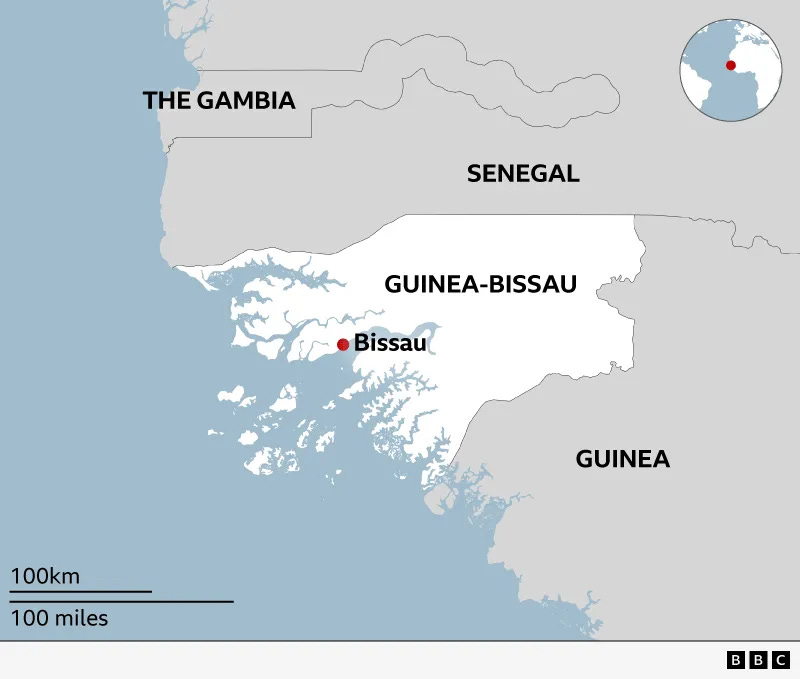
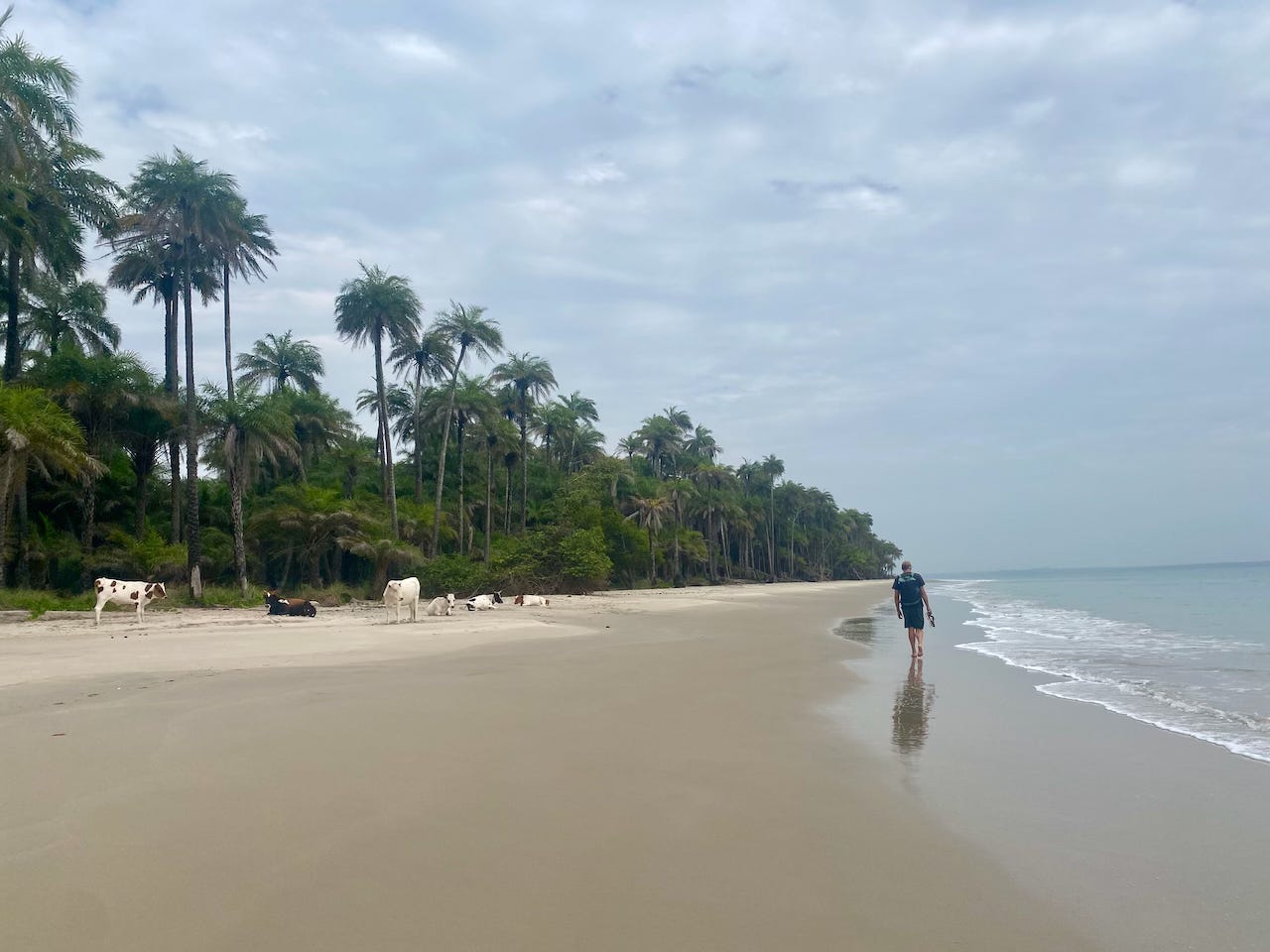
As you can see in the map above, Guinea-Bissau is a country of island and mangroves with a lot of coastline for its size. The Bijagos Islands, of which there are 88, are largely undeveloped with only one city of any size. Many of them which are inhabited have a few traditional villages scattered about. They are absolutely beautiful and would be one of the world’s great tourist destinations if in the sort of country that had ever been able to develop them. As it is, it can at least be said they are mostly unspoiled. Still, the islands are a paradise for more adventurous tourists, and also a paradise for drug traffickers. It turns out a Substacker named Paula Dear who keeps an African travel blog [which I have now subscribed to, of course] was there recently and took many pictures, which give a great idea of what the islands are like:

Since that doesn’t want to embed with a picture, I hope she won’t mind me sharing a picture she took:
I for some reason cannot find any satisfying maps, so also want to show you Google Maps satellite to get a better idea:
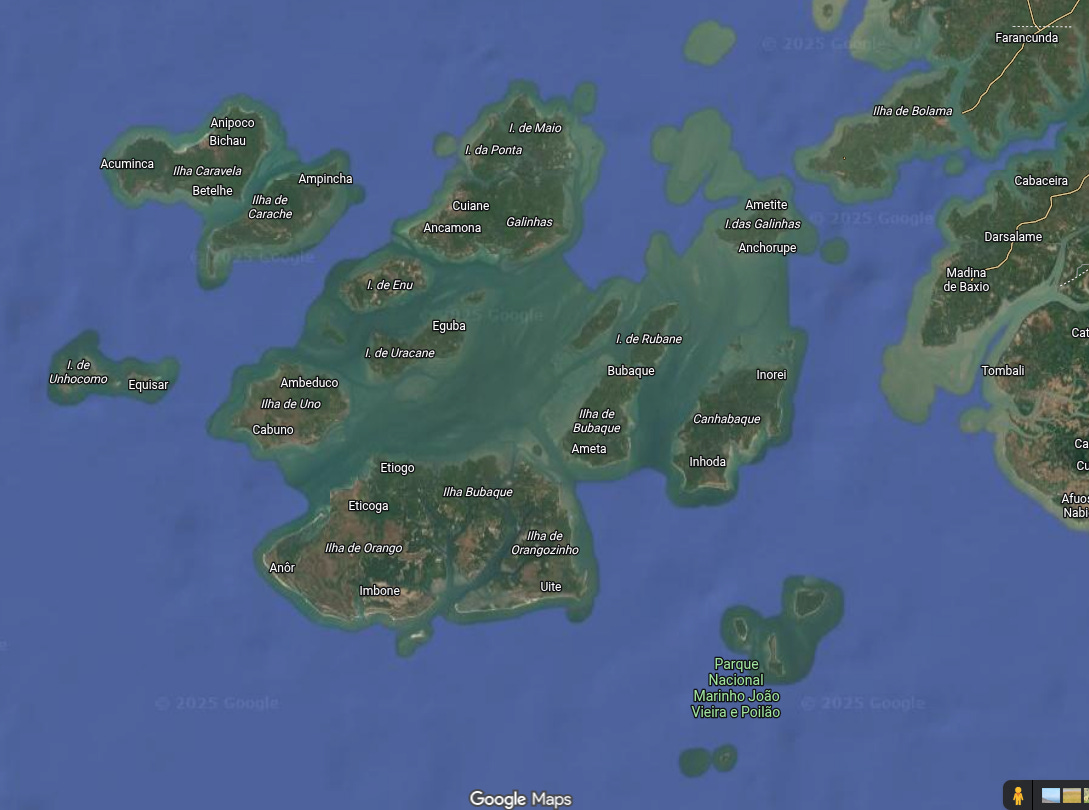
It just happens to be the case that these lovely sparsely inhabited islands are at about the nearest point between South American and Africa. The voyage is around 1,750 miles if one launches from Natal, Brazil and can be made in about 5 days in a speedboat while taking precautions to avoid detection such as only travelling at night while hiding under a blue tarp during the day. 20 years ago most of these islands had no government presence whatsoever, and now there are a couple of anti-aircraft guns but I didn’t find evidence they’ve shot anything down. When this all started, Guinea-Bissau had only one navy ship to patrol the entire country, and as we will see an admiral of that proud fleet seems to be a drug trafficker.
Anyway, 20 years ago, as you have perhaps heard of happening in Central America or elsewhere, bags of white powder started washing up. The local fishermen, who presumably had little contact with the outside world besides perhaps some shared radios, missionaries, and occasional adventure tourists, did not know what they were. It seems they did not know what cocaine was in general. According to The Observer, they used some of it as chalk to mark their soccer fields and a woman tried to fertilize her crops with it, which all died. Imagine their surprise when two Latin American men show up on a charter plane carrying one million dollars in cash and seeking to buy back any bags that had been collected. Either they did not realize the poverty and ignorance of world affairs of the people they were dealing with, or were just wanting to be generous and build goodwill, but either way they paid out enough for their cocaine that fisherman were moving out of their huts into nice properly constructed homes and buying cars with the proceeds from random bags of white powder that washed up on the beach.
The article from The Observer is particularly fascinating because it is written a mere three years after cocaine arrived, and already the country is full of Colombians living in spacious haciendas with pools and armed guards they have constructed. They are driving Porsches over entirely broken roads to go to clubs where they buy $80 bottles of imported whiskey [in 2008 money, it should be noted] in a country where most don’t make that much money in a month. The statistics are incredible:
“Since 2003, 99 per cent of all drugs seized in Africa have been found in West Africa. Between 1998 and 2003, the total quantity of cocaine seized each year in Africa was around 600kg. But by 2006, the figure had risen five-fold and during the first nine months of last year had already reached 5.6 tonnes. The latest seizure, from a Liberian ship - Blue Atlantic - intercepted by the French navy last month, was 2.4 tonnes of pure cocaine.”
Once again, this is only 3 years in, they have now had 20 to get established, though there was a lull in the mid-2010s where there were no seizures, that I suspect was just avoiding detection. In 2008 one ton of cocaine was leaving the country a day. It is now said that more value in cocaine moves through the country annually than the total GDP of Guinea-Bissau’s legal economy, where everyone works for peanuts [I mean that literally, though cashew production has expanded.]
When this started the country did not even have a working prison, and prisoners were just kept in the basement of a colonial manor. Of course, when narcos are arrested by local police they are ultimately allowed to walk away. The country had no drug education whatsoever, and locals are paid in cocaine and leftover cocaine gets traded within the country, so cocaine addiction has become an increasing problem even among the very poor. The reporters even spoke to an addict who seemed somewhat proud of his worldliness, since he knew what the cocaine was when it first showed up and he claims to have been the first person in the country to smoke crack; they spoke to him at what passed for the country’s only rehab clinic, and he shared the message that it is very difficult to stop smoking crack.
From the islands, where if narcos don’t escape detection entirely there is almost no government presence and they can buy off a whole village cheaply, they can move drugs to the mainland and its endless swampy inlets in smaller crafts. There are a myriad of routes to Europe, as shown on this map:
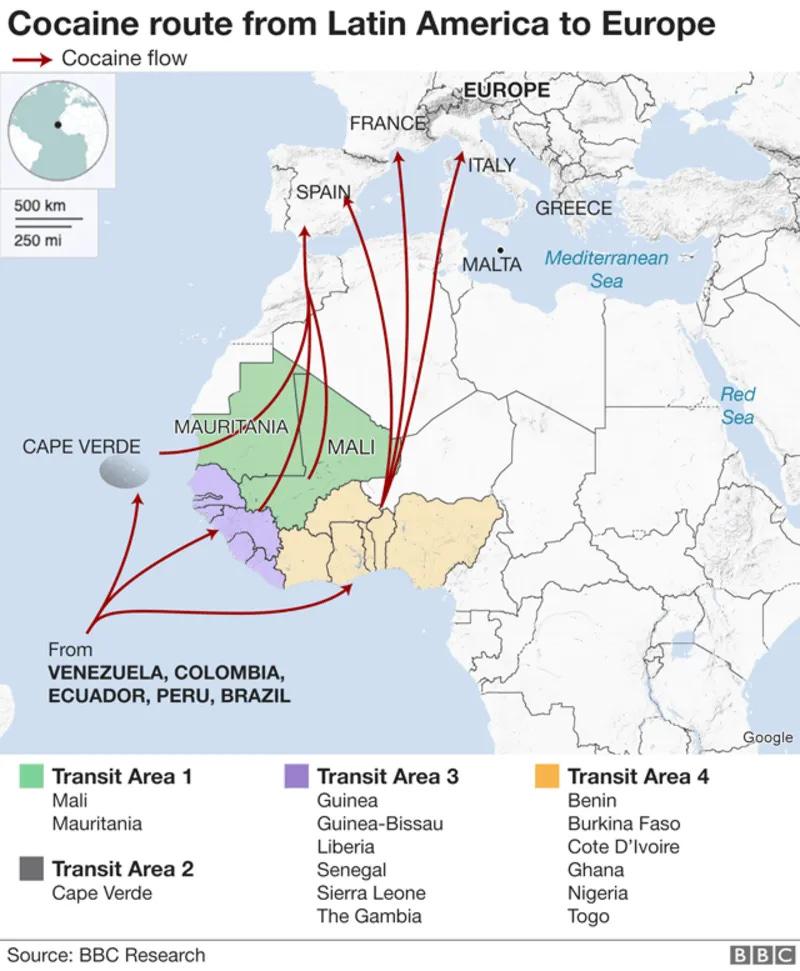
One option it doesn’t show is simply hiding the drugs in legal goods going out of Dakar, though this is not a terribly helpful map generally and those lines don’t represent actual routes they are just region to region. The rest of North and West Africa is racked with weak states and conflict and thus little interest in or ability to stop smuggling. It can be driven across the Sahara. It can be flown to any number of small airstrips- planes actually disappear from flight trackers going over the Sahara because there are no stations to connect with, and that is commercial planes that want to be seen. One must admit this is a situation where that Agadez Drone Base must have been handy. I wouldn’t be surprised if there is cocaine moving by actual camel caravan, being as it is the most valuable thing one can carry and there are no cops on desert trails. Of course once it is in North Africa it is just a quick hop over to Europe however you want to carry it.
Whether or not Vieira was responsible for inviting them as was said, the entire state was almost instantly corrupted, or more accurately the corrupt state was bought off by a new outside party. Every politician claims to be fighting cocaine and also seems to be living off of the drug trade. Every time an important figure gets caught with cocaine some weak excuse is provided. The 2012 coup where General Indjai took power was called “the cocaine coup” in the media, since the military was already seen as involved in drug trafficking and then there was a huge increase of small planes landing on the islands. The world tried to get involved soon after this started since the situation is Guinea-Bissau was now impacting wealthier countries but attempts at supporting the state’s efforts went nowhere. The US Drug Enforcement Administration began using the spurious grounds that the drugs were going to be trafficked to the United States to expand its global War on Drugs to this small West African country. In 2013 they attempted to entrap General Indjai but he seemed to have sensed something was wrong and sent to subordinate Rear Admiral Jose Americo Bubo Na Tchuto and two associates. Tchuto was arrested and ultimately spent four years in an American prison. According to the Sahel Chronicles video, he received a “hero’s welcome” upon returning home and was pictured with major political figures, though the BBC said in 2020 that up to that time he had kept a low profile since returning to the country.
Meanwhile, Guinea-Bissau continues to have enormous drug seizures, such as two tonnes seized last year. It also seems the country is about to get caught up in some good old fashioned war propaganda, after a widely panned Wall Street Journal article pushed the connection between Venezuelan trafficking and al Qaeda.
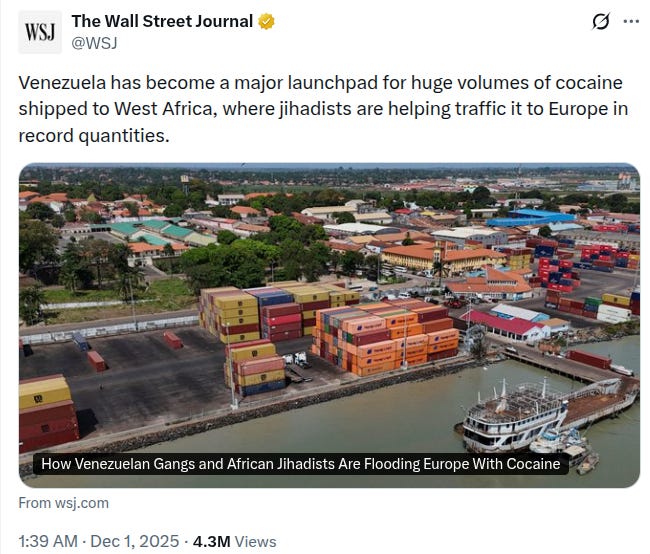
It pains me to say this, but as far as I know this isn’t really a lie. None of the people who are arrested ever seem to be Venezuelan- in fact it is said Mexico’s Sinaloa Cartel controls this trade- but the “launch pad” aspect is correct, for example the plane in the above seizure had came from Venezuela. As to jihadists, smuggling via the ground routes shown above more or less necessitates dealing with them in some capacity, though it may only be in the form of bribes to pass through unmolested. Guinea-Bissau’s former Justice Minister Ruth Monteiro told the BBC in 2020, of an 800kg seized shipment, “After our investigations, we were convinced the drugs were on the way to al-Qaeda in the Islamic Maghreb.” She easily could have been blowing smoke up their asses to get outside assistance fighting drugs, but regardless the claim has been made well before this current round of war mania. Further, I distinctly remember reading when I was working on my UAE article that Latin American cartels were buying gold with cash in Bamako, Mali to take to the UAE and turn back into legal money; unfortunately I can’t find that source now, but it all fits together when one combines readily available information about cocaine trafficking, Sahelian gold, and the Emirates. What is clear, one way or another, is that Bamako is a place where a transnational criminal trade network spanning four continents is meeting, which raises serious questions about the mouthpieces of Western financial interests recently pushing a narrative that it is in imminent danger of falling to terrorists.5 None of this would be improved by the US attacking Venezuela but the premise that Venezuela and African jihadists are links in the chain of cocaine getting to Europe appears to be at least broadly true and Guinea-Bissau is at the heart of the whole thing. The country has avoided jihadist insurgents in its own territory thus far, and it is not that big of a leap to imagine it is because they are bought off by their involvement in the cocaine business, though I have no evidence to that effect.
No one in the country seems immune to the money and power of the cartels, and it few knew what to make of Embalo when he took power. There were concerns about his closeness to the military and specifically Indjai. Embalo, however, claimed that Guinea-Bissau’s days of being a corrupt narcostate were over. Then, when there was a coup attempt in 2022 he claimed it was done by drug trafficker and to have seen two of the men from the 2013 sting attacking the palace and said it was directed by the third, Tchuto. All three were arrested. When directly asked how he squared this with his claim that the days of drug trafficking and its related corruption were over, he did not answer. Since then, he ruled without a legislature, held the Supreme Court President under siege until he resigned due to his inability to go to the court, and barred the PAIGC from participating in the election on frivolous grounds, despite that they’ve been the country’s “main” party since the time of independence. All of this was seemingly done in the name of fighting drug trafficking. And now, after perhaps losing an election that was delayed so much longer than the allowed delays that it was held 9 months after his legal mandate ended, they again have a coup, in the name of fighting drug trafficking.
In general, I am a skeptical of stories of a shadowy puppet master behind the scenes of events, thinking that the story of human affairs is more often a shitstorm of interests and incompetence over which no one man has control. In this instance, however, this country has hardly had a government for many years, and there is no good explanation for any of this behavior and it’s objectively true that the Sinaloa Cartel is more powerful than the Guinea-Bissau state. Perhaps the Mexicans have some innovation in political theory that I am not familiar with which would make sense of this. I certainly don’t believe the new junta’s story that their plot was to avoid a different plot, I can tell you that much. They would all be dead already if Sinaloa wanted them dead, so if they are actually fighting a plot by one crime lord it is in the service of another; cartels are more decentralized than is commonly imagined and Sinaloa’s guys in West Africa could be fighting it out, though I think for something this big the main boss probably makes the decisions and leaves as little as possible to chance.
One way or another, Embalo is out for now and it is strange. There are many ways African Heads of State stay in office past the point they are supposed to. Most change the constitution to allow more terms in office. Along with that, some suspend elections by declaring a state of emergency, some have coups they lead, some rig the vote, some don’t even rig the vote they just straight lie about results, some allow only token opposition. There is also my favorite, which is encouraging endless opposition parties and then having “fair” elections where you are against 10 parties who aren’t able to run as a coalition. What they don’t do is stage a fake coup and get themselves driven out of the country with a plan to have the military give power back to them, and yet, quite a lot of people think that is what Embalo has done.
I wish I had an answer for you, dear reader, but I suspect that whoever came up with this farcical plot has been getting high on his own supply…and of course I mean that literally.
Thank you for reading! The Wayward Rabbler is written by Brad Pearce. If you enjoyed this content please subscribe and share. My main articles are free but paid subscriptions help me a huge amount. I also have a tip jar at Ko-Fi. My Facebook page is The Wayward Rabbler. You can see my shitposting and serious commentary on Twitter @WaywardRabbler.
It doesn’t bear going into here but it is said that Senegal’s President Faye and PM Sonko had something of a falling out, so this perhaps represents conflict between them about how this should have been handled.
To be clear, in French Guiana this status isn’t a fiction and the people there do have full rights as citizens of the French Republic.
It was, moreso than opposition from “the international community,” the fall Portuguese Mozambique which doomed Rhodesia. This was not simply because it had been Rhodesia’s land connection both to the sea and to South Africa, but because South Africa’s policy of supporting white buffer states to keep it separate from black-ruled states had failed and thus Rhodesia’s use to them was largely symbolic.
This means “wage earners,” as you would call it. Some percentage of the population must have worked in specific trades which we would call “jobs” if they had occupational licenses and paid taxes, which they did not. Regardless the vast majority lived on subsistence farming, fishing, gathering, or other informal work, and of course what charity might be available.
I will try to write an article about this in the future, as I realize it combines all of my major interests.
Good piece but I think you could argue France was similar to Portugal in the way it fought for its empire at least in Algeria
I spoke to someone I know well who recently spent time in Bissau for work, and they are skeptical of the cartel narrative. The cartels have other routes into Europe (e.g. Antwerp, Marseille ports), and with all the unwanted attention their presence in Bissau has garnered, it’s possible they have moved on by now. This person doesn't have a good explanation for Embalo's actions either, however.
> For reasons that are still not clear, Embalo soon left for Congo-Brazzaville.
This person says Senegal kicked Embalo out, because they like to present themselves as a stronghold of democracy in the region (compared to their neighbors at least), and Embalo’s presence tarnished that image.