

“Moderation will be stigmatized as the virtue of cowards; and compromise as the prudence of traitors; until, in hopes of preserving the credit which may enable him to temper and moderate on some occasions, the popular leader is obliged to become active in propagating doctrines, and establishing powers, that will afterwards defeat any sober purpose at which he ultimately might have aimed.”
- Edmund Burke, Reflections on the Revolution in France
Table of Contents
Challenges to Basically Fineism
The Limits of Basically Fineism
Basically Fineist Public Policies
Denmark: Basically Fineism with Autistic Nordic Excellence Characteristics
Canada (Historic): Basically Fineism with Apologetic Extractivist Characteristics
Costa Rica: Basically Fineism with Nothing Ever Happens Here Central American Characteristics
Panama: Basically Fineism with Giant Tax Haven Characteristics
Uruguay: Basically Fineism with Latino Denmark Characteristics
Rwanda: Basically Fineism with Esoteric Kagameist Characteristics
Singapore: Basically Fineism with Chinese Mostly Competent Pragmatism Characteristics
Conclusion: For a Mostly Competent Pragmatism
Preface
Many have asked for a more thorough explanation of Basically Fineism, a utilitarian non-ideological political philosophy expounded by the pseudonymous British political theorist and anthropologist who goes by the name Drukpa Kunley. Having become a firm adherent, it is my hope that with what limited faculties the Creator has blessed me, my efforts will not be too inadequate in writing down some of the principles of Basically Fineism in the hopes that it should help humanity move past the problems we face in this troubled world.
I would like to make clear first of all that except where a direct quotation is given, all of the thoughts contained herein are my own. My intention is to introduce how I came to this philosophy, give a deeper political background, illustrate the concept, explain its challenges and limitations, show its application to specific policies, and give real world examples of a smattering of states that have practiced Basically Fineism. Readers should know that though Basically Fineism is to some extent inherently conservative insofar as it requires realism, prudence, and moderate government, it can improve upon most existing political settlements or viewpoints. In a sense, it makes an entire belief system out of not “letting the perfect be the enemy of the good” and one will find that most sober political theorists throughout history have in one way or another embraced a Basically Fineist viewpoint, particularly as the ideal goal of statecraft is the creation of a stable state where the material and social conditions are good enough that men do not seek revolution. I would further add that while the language of the online right may at times come off as silly, the humor serves to make political theory, which is seen as dismal and uninteresting to many, accessible to the masses. Further, I merely write in the language of my times, as have those who came before me.
A great deal of credit is due to Mr. Kunley, as well as to those proud few leaders throughout the world who have avoided the pitfalls of ideological and polarized times to make Basically Fineism a reality in those places where it has been attempted. All errors, however, are my own. Unless otherwise noted, all infographics included below (for they go farther than being “memes”) are the work of Drukpa Kunley, a true sage of our era. It may be the case that I do not always go all the way back to the beginning of a concept or the origin of a phrase, but what matters more is that they are now in the contemporary parlance. Further, while it is my habit to avoid continuous revision of my pieces after publishing, in this circumstance I will make an exception should comments, discourse, or the further development in Basically Fineism merit doing so. Basically Fineism only having been defined and given its name in late 2024, there is much work to be done in understanding and studying the most important contribution to political theory of our era.

I hope that those who devote the time to reading this treatise will find it valuable. I should note the degree of focus on America which follows merely reflects that being my own country, and thus the one I know the most about and have the most concern for.
Introduction
I spent much of my adult life as a libertarian, having always been one to distrust authority and not insensibly becoming disgusted when looking upon the American state, particularly having come of age in the Total Mess times of Post-9/11 and the Financial Crisis. Like many, I found the libertarian theorist Murray Rothbard highly compelling, though also like many I did not myself examine his source material. I don’t mean to restate the introduction I wrote for this substack itself but nevertheless need to explain how I came to be where I am.
I long thought, “well, wouldn’t it be nice if the government worked well enough that I didn’t need to focus on it,” particularly as I am one of these people who struggles to fit into society and my constant rage at the government doesn’t help anything nor does my general desire to not contribute to their activities via taxes. That is not, though, an inherent trait of government, merely of bad government. It is certainly possible for a government to just take 10% or so of your income and stop you from being invaded and keep the roads in workable condition without entering every area of your life and bothering you all the time. With American politicians, over time I adopted the viewpoint that I would more or less support any who isn’t obviously evil, insane, or idiotic; in modern America that means there are vanishingly few politicians I can support in good conscience. Still, while I always had a good deal of pragmatism and was never a purist, I was long an anarchist, believing it is impossible to make a state work, and that private businesses can handle anything of importance.
Like many, what started changing this viewpoint was covidmania, which demonstrated two key things to me, among many lessons. Firstly, it demonstrated that people fundamentally don’t understand the limits of public policy but are very scared once you gin up a panic. What I mean here is we started at “Two weeks to slow the spread” and the claim was “for whatever reason our hospitals are not equipped to deal with a pandemic (?) so we need to try to put this off a bit while we prepare.” This was fairly stupid and pointless, and it doesn’t appear they did much to prepare during those two weeks either, but the number of hospital beds available is actually something that can be controlled by public policy, and you can train nurses who work in different areas of healthcare, and convert rooms to deal with respiratory care that would normally be for other purposes etc. In short there are identifiable things humans can do and targets one can reach to increase healthcare availability. It is within the realm of human action and public policy. Of course, over those two weeks that somehow stopped being the goal and it just became “we can use public policy to defeat a respiratory disease,” which is an unprecedented level of hubris and a Really Obviously Bad Idea.
Now, none of this should make an anarchist give government a second thought. A lot of libertarians did get covid wrong but for most of them it was not due to being pussies making Reason magazine-type arguments about the importance of personal responsibility in a pandemic or nibbling around the edges of government overreach while failing to spot a scam. For most libertarians who got covid substantially wrong it was because they are paranoid and gay for the apocalypse and found “this government-modified virus is airborne AIDS” to be compelling, which is fair based on their world view. Overall, the only thing here that squares the circle of how covid as a whole happened is that “public health officials” and their funders thought the government sponsored the creation of a modified supervirus which escaped, but they are actually idiots. That is to say, they funded the modification of a virus which wasn’t very dangerous but thought they made a super-virus, and thus panicked and pushed an unprecedented response.
All of that notwithstanding, what we also learned from the covid experience, among other things, is what a hellscape the corporations actually want for us if they can get away with it. Just Walmart saying it wouldn’t comply with covid policies in any state and would fight them in court would have gone far towards stopping the mania. Instead, every corporation fully went along as did the entire oligarchy and financial interests and the like, for something extremely stupid that the most basic common sense and decency should have prevented. Youtube playing constant commercials to tell you to stay home, presumably watching Youtube, should have given up the jig, but it did not. This discredits anarcho-capitalism almost entirely.
In an effort to recover from the impacts of living through insanely stupid times- and I did not myself keep my head, so overwhelmed was I at the idiocy- at the beginning of 2021 I finally pursued a longstanding goal of reading all of the ancient histories, which I did not do to completion but read through every major one and several minor ones up to the 2nd century, where there starts to be something of a gap in the record. Along with this I read many texts on political theory, which generally analyze the actions in those histories. What I discovered, which finally destroyed anarchism for me, and libertarianism generally, is that, first of all, protecting the poor from the depredations of moneylenders is a key function of a state and always has been.
What I further came to understand is that free government just is difficult, which is no reason to not try. Rothbard’s famous claim, that it is the anarchists who are hard-nosed realists, ignores that plenty of areas have been well-governed and worked towards the equitable improvement of the human condition. It does just last a while and then fail, but you learn from it and do your best to break the cycle, and the cycle is clearly spelled out in Polybius. The cycle of constitutions is not a mystery to us. If you happen to have watched the show LOST, at the beginning of the 6th season the viewer is finally introduced to the Gods of the Island properly, and Jacob, the good one, has been bringing people to the island, but inevitably their society gets destroyed. He says to his brother, “you just do a little better each time.” While Rothbard insists he isn’t utopian, it is hard to see what sets him apart from Marx, in terms of believing that humanity could reach a state of development where it permanently sheds the state and this creates some sort of era of happiness, he merely imagines a less fantastical system of economic and social organization in that circumstance.
Everything in the world has seasons and it is simply the nature of things that a state should be born and grow and experience the tribulations of life and then ultimately die. This is no more reason to not have a state than to not plant an apple tree. Its also noteworthy that the more conservative element in our society has lost the corporations, lost the universities, lost the media, and almost every institution one can name, even most major churches, and it is in fact only the state of all of these things where we actually stand a chance. Andrew Breitbart famously said politics was downstream from culture, but the 2024 “vibe shift” demonstrates that, if anything, the opposite is probably true. Public opinions on gay marriage 5 years before and after the Obergefell decision legalized it nationally demonstrate a similar point in stunning clarity. Politics greatly shapes the culture of any society it is meant to oversee, sometimes for better and sometimes for worse.
Regardless, having read much I was still left largely rudderless, having renounced anarchism in favor of believing in the state, and rejecting ideological libertarianism while still valuing a manly, moral liberty as much as any man. The book which impacted me the most was Machiavelli’s Discourses on Livy, along with Livy himself. Machiavelli has been widely smeared for centuries, solely for being a realist who describes how government functions without sentimentality. The text lays out how liberty is won, preserved, restored, and lost. It is a practical text for setting up a free state. And yet, “Machiavellian,” in the negative sense, has been around for several hundred years. I said in my introduction to this substack, a full 4 years ago now, “There is no word for the political ideology I am creating. The closest is a Machiavellian, but in the sense that I believe what Machiavelli did, not in the sense that I believe in the behavior described in “The Prince.”” Not being a Democrat, I was hardly going to give myself a label or slogan that I constantly had to explain to people who had an existing hostile perception, and the word Machiavellian cannot be redeemed. I remained mostly rudderless, failing to know if I believed in anything at all and what those beliefs should be called.
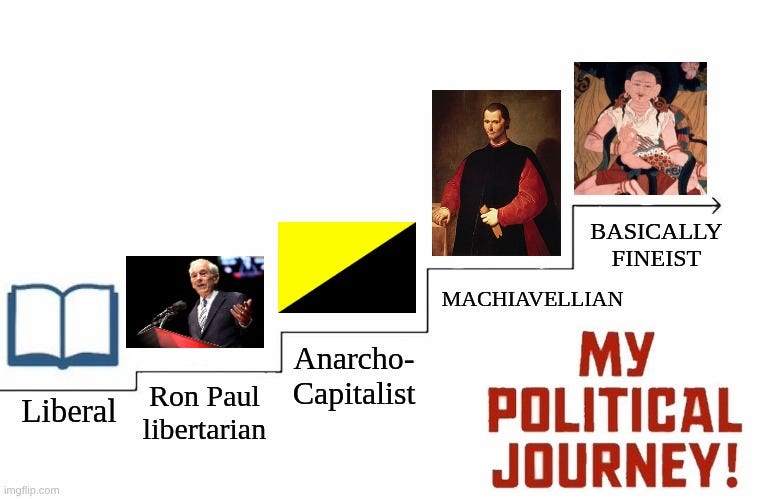
As it turns out, what I needed was a guru. I had seen Drukpa Kunley, who takes his name from a 15th and 16th century Tibetan Buddhist monk known as “The Divine Madman,” around Twitter, because he posts about a lot of niche topics of interest to me, but it was hard to know what to make of his account. He is, to put it lightly, at times esoteric to those not familiar with his work. I only started following him late summer of 2024, at a time when his influence was greatly growing. He has since been called “The King of the Anons” by GQ Magazine. He is without a doubt the greatest political theorist and anthropologist of our day. Modern British political debate has become little more than a series of footnotes to Kunley. He is creating the vocabulary of the discourse; it is outside of the scope of the present endeavor, but he is the one who coined both “gay race communism” and “the Yookay.” In Britain they speak of the “posting to policy pipeline.”
And most importantly, he has delivered unto us the philosophy of Basically Fineism, Mostly Competent Pragmatic government that works by working. We are all in his debt, but still have much to learn.
Background
Almost every sober and serious man throughout history who has picked up a pen and attempted to write on political affairs has ultimately advocated some form of moderation and compromise. “Moderate government” is the term one sees in the old texts, generally based on understanding the different currents within society and the real tendencies of man and looking at how a commonwealth can work for the common welfare, as the name suggests. It is notable that in modern America, “Moderate” and “Centrist” are profoundly different things, with a moderate generally supporting mild, reasonable government with a view towards human liberty, whereas a Centrist tends to support all of the state’s most oppressive policies, or at least those oppressive policies which are acceptable to Very Serious People. In short, a moderate, in American politics, is someone willing to take the best things from Republicans and Democrats- or at least what good things there are or once were- whereas a Centrist adopts the worst.
Moderate government, however, is not ideological “minarchism” but more accurately using a light touch. It does not posit that the government which governs least governs best, but that the government which governs best governs best. However, the art of statecraft is indeed to use the lightest touch possible while still achieving the desired results. It was Bismarck who said, “Politics is the art of the possible, the attainable — the art of the next best,” which perhaps the clearest statement in support of Basically Fineism of any major historical political figure. The premise of “mixed government” from Plato onward recognized that there are different power centers in a society which must be represented in government and kept reasonably satisfied and in balance. It was not until the French Revolution that modern ideology took off. Further, before Marx every thinker recognized class conflict as a permanent feature of society to be managed; it was the unique derangement of Marx and his ilk to believe one side permanently winning was the “end of history,” so to speak.
Most importantly though, the general advice of all of the great political theorists rests on just doing the best you can and trying to be satisfied with what you have while making marginal improvements towards improvements in government and society where possible. Even Hobbes, who has become some sort of an avatar of “big government” to the unlearned was largely advocating that a state of war is so terrible it is unlikely the government you live under is worse, and thus you should make the most of your own circumstances. In the Declaration of Independence, Thomas Jefferson wrote,
“Prudence, indeed, will dictate that Governments long established should not be changed for light and transient causes; and accordingly all experience hath shewn, that mankind are more disposed to suffer, while evils are sufferable, than to right themselves by abolishing the forms to which they are accustomed.”
This brings up a key point about Basically Fineism as a philosophy, which is that it works within the existing system instead of abolishing it, if it is possible to do so.
Something that becomes apparent in the study of human affairs is that almost any system is workable if it is managed by competent people and can get public buy-in. The best systems of government injure men as little as possible, select for competency, and avoid making big “asks” of the public unless it is truly necessary. Of course a high degree of demographic uniformity and low inter-ethnic conflict are a great benefit here. Your population, both the upper and lower orders, their disposition, education level, and the like, are more important than the ideology of the state.
We hear about how, for example, collective ownership doesn’t work, but employee owned corporations and Israeli Kibbutzes and the like actually work fine. The issue it that peasants by and large don’t want to be collectivized and are also not competent to run large commercial farms. We could argue about agrarian reform all day but for various reasons governments actually run plenty of farms that do fine, if overall somewhat less productive than private farms. The issue is that you have to sell the public on giving up their independence, which they are unlikely to want to do. Still, what sinks communism generally is not anything which specifically doesn’t work about government ownership of productive enterprises, it is the challenge at getting public buy-in and assuring competent, pragmatic management, particularly amidst the hostility of global financial interests who don’t want your system to work. Of course, the more total the communism the greater difficulty in management, which is why any communist system that has worked passably well tends to allow free markets on the lower level and primarily takes only the large industries.
When analyzing the Revolutionary government of France, such as it was, Burke wrote,
“I can’t stand up and praise or blame anything relating to human actions and human concerns, on a simple view of the object, as it stands stripped of every relation, in all the nakedness and solitude of metaphysical abstraction. Some gentlemen count circumstances as nothing, but in fact they are what give to every political principle its distinguishing colour and discriminating effect. The circumstances are what make every civil and political scheme beneficial or harmful to mankind.”
In this vein, I would certainly condemn the action of seizing a kulak’s land and sending him to work on a collectivized farm, but if a large government farm is opened elsewhere to employ the landless peasant, why should I condemn that for being socialism? It may not be the best way to do things, but if it is working decently enough for the people involved, what’s the harm?
Reading the classic theorists, one finds limited instances where it is recommended that a state be used to shape a society instead of a state being adapted for the society where it exists, though from there a state should do what is reasonable to promote public virtue. In Montesquieu’s The Spirit of the Laws, for example, an extraordinary amount of space, nearly half the book, is dedicated to how climate impacts what kind of state will be successful.1 Throughout Machiavelli it is also made clear that it is nearly impossible to change the nature of the city, but that instead one must work with it, which is why he provides so much specific advice about situations you may find yourself in. Utopian literature of course exists, but is generally much more of a thought experiment than advocating for adopting the system described.
Regarding liberty, Burke continues,
Abstractly speaking, government is good and so is liberty; but ten years ago could I in common sense have congratulated France on her enjoyment of a government (for she then had a government) without considering what the nature of that government was or how it was administered? Can I now congratulate the same nation on its freedom? Is it because liberty in the abstract is one of the blessings of mankind that I am seriously to congratulate a madman, who has escaped from the protecting restraint and wholesome darkness of his cell, on his restoration to the enjoyment of light and liberty? If a murderous highwayman escapes from prison, am I to congratulate him on the recovery of his natural rights?
Indeed even liberty and its importance is based on circumstance, what it is doing for people, and more. I have often had thoughts along the lines of “Just what is liberty doing for us, if we’re allowed freedom of speech and freedom of assembly and to vote but things almost never get better or change at all, is this not just an a pressure release valve in favor of an oppressive state?” It is something akin the premise that the more liberty one is able to allow slaves while still controlling them the more productive they are at a lower cost, such as the changes from serfdom to a rent system.
What is crucial for Anglos to understand is that liberty is a complex thing, much more than “don’t hurt people and don’t take their stuff” and certainly more than getting to vote before taxes screw you over regardless. For starters, all property rights are in fact conditional on living in a society that respects them. If you must at all times guard your person with a firearm you merely have the liberty of an escaped convict, while if one must always guard one’s property in the same way you only have the property rights of a man who has taken hostages at the bank and for that amount of time owns the room. Of course, that is not true of the theory of how property rights develop, merely the practical security of your property rights.
Political theorists, and people generally, have never agreed on what liberty means, and a man’s conception of liberty is based largely on how he is accustomed to living. A French friend recently suggested that it might be for the best if Americans were not allowed to post videos of deadly police encounters until they had been some way vetted to make sure they are not misleading, that we do not all tear each other apart. That may, in the abstract, not be a terrible idea, but I am an American, and better we should all die than accept prior restraint (the authority of the government to review media before approving it for publication.) In other countries this might be considered a sensible solution that ultimately safeguards liberty, but it is against our existing customs. Montesquieu, after acknowledging this being a word no one agrees on, gives the following definition of liberty, “In governments, that is, in societies directed by laws, liberty can consist only in the power of doing what we ought to will, and in not being constrained to do what we ought not to will” [I.XI.3.] His phrasing is egregiously unclear for such a key passage, but his point is that liberty is in being allowed to do what you should do and not made or allowed to do what you shouldn’t do.
By this standard, many Western “liberal democracies” measure up quite poorly in that they are always stopping one from doing entirely reasonable things which should be allowed and don’t hurt anyone else, while also forcing upon you random nonsense and making ridiculous and immoral moves internationally with your tax dollars. Meanwhile, a lot of smaller and more modest countries with fewer political rights as we understand them live up to these standards better. The UAE is far too ambitious to be Basically Fineist, but it feels like not complaining about a government that functions properly anyway and which doesn’t really tax you leaves a man with more liberty than he would have in London where there is a high tax rate and endless nonsense and harmful regulations and even so many things don’t work- and for that matter they will prosecute you for dissent!
My overall point though is that ultimately if the government and fighting the government and safeguarding your liberty is taking up too much of your time, you are actually much less free than ignoring it where possible. However, a government can generally only be good enough to largely ignore if it is ran along the lines of Mostly Competent Pragmatism.
I think that in the pre-ideology era, to some extent proto-Basically Fineism was considered to be self-evident. What other goal should man running a state pursue but that things are decent enough that the public does not revolt? It is essentially that or just looting and oppression. The number of political leaders throughout history who have been aggressive and expansionistic is actually much lower than those who have not been, it’s just that well behaved rulers rarely make history. It must be added though that really from the founding of the Principate to the American Revolution places having meaningfully free government, were mostly limited England, the Dutch Republic, the Holy Roman Empire’s Free Cities (especially in modern Switzerland) and Italian City States. Of course in all of these areas liberty was frequently challenged; writing in the earlier part of the 18th century, Montesquieu says England is the only country with a constitution geared towards the liberty of the subject. It would seem that under ancien regimes few felt the need for political theory, instead just running their states by custom and force, though optimally stewarding the realm they had inherited with some wisdom.
It was only in the 20th century the ideology became paramount, though its great evils were apparent in the 19th. But, as they say, the moral arc of history is long, and my hope is that it bends away from ideology and towards the sensible Basically Fineism.
Basically Fineism, Defined
The original definition which Kunley gave us for Basically Fineism is as follows:
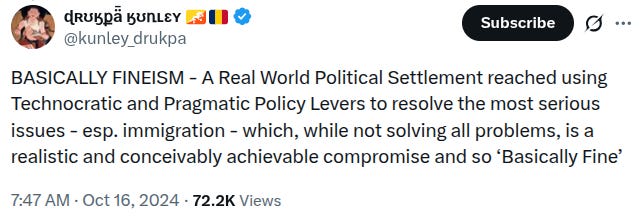
This is, at its core, a belief in the importance of the principle of compromise. It is also a belief in trying to enjoy your life without the personal being swallowed by the political, the inevitable result of any system where ideology is paramount. Once again, the point of a commonwealth is in the name, and instead of pursuing weird and impossible goals or viewing everything as some sort of deranged competition, the focus should be on making things work well, not just the proverbial trains running on time, but general well being. Often, when watching a crazy TV drama, I have felt somewhat exhausted and thought, “I would like to see these people live their normal lives, instead of some insane thing being introduced again at the beginning of every season.” Of course, for a TV show I actually wouldn’t, but that is how American life is, and it is no way for a man to live. The last semi-normal time we had in America was I believe the mid-Clinton era before the Lewinsky scandal and even then they were hyping the whole country up about war with neo-Nazi paramilitaries after burning a bunch of children to death at Waco.
A crucial component of Basically Fineism is also competent governance. In the United States this is very difficult because since 1965 the country has largely been based on a racial spoils system with ever increasing numbers of minorities. Basically Fineism can’t really be implemented with a vast state regulatory apparatus staffed by aggrieved minorities overseeing the country. Instead, it requires a spirit of cooperation whereby working for the government is seen as an honorable job but where the government also doesn’t spend all of its time bothering the citizenry about nonsense. It is key that some trust be put in administrators with the expectation that the maintain the modest standards of Mostly Competent Pragmatism in their position and that they can be fired if they do not. A degree of faith must be put in the public as well. There has to be a sense of shared purpose where the public as a whole wants things to go well instead of wishing things would fail as it will prove a political enemy wrong.
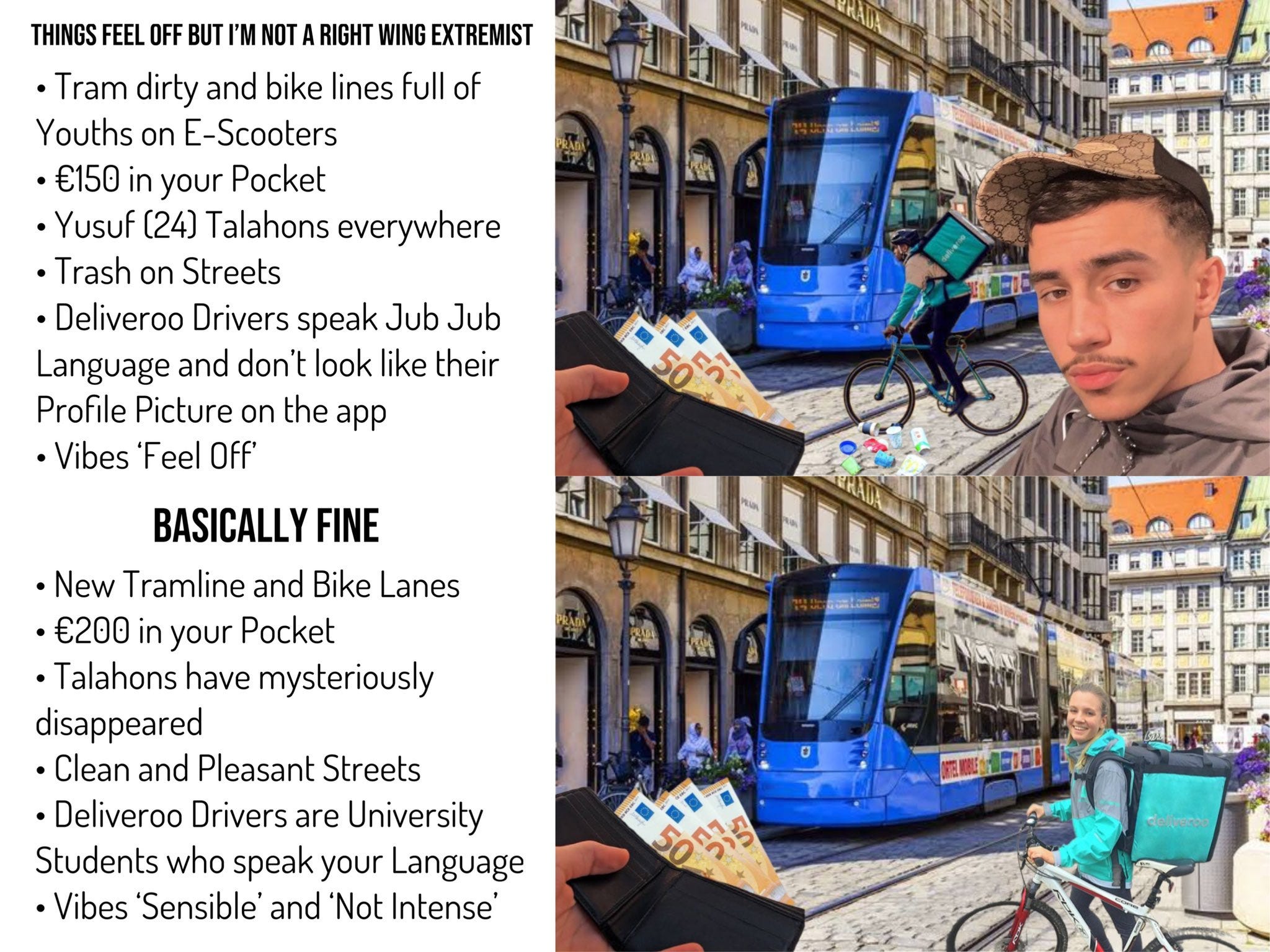
It needs to be emphasized that Basically Fineism can improve any country, but it is extremely difficult in a multicultural society with rapidly changing demographics. In part this is because that relies on a belief that your country is tied together with ideology that will be adopted by others who come there, which mandates an ideological polity. It is commonly said that the United States is the world’s only “propositional” nation, which is nonsense for several reasons. Firstly, that doesn’t mean anything, so its nonsense in the most basic way. Further, plenty of countries are based on “ideas” of some sort or other, for example the French Republics were all based on an idea, the Bolivarian Republics are quite similar to the United States in their founding, and even modern Turkiye was based on applying Enlightenment ideals to make a new secular Republic out of what had been an Empire. “Propositional nation” is just something Very Serious People like to say to midwits in support of importing infinity immigrants. The other matter is that accepting that many immigrants requires a lot of ambition and an ideology of constant rapid growth instead of being happy with modest but reliable and consistent improvement over time.
Though Basically Fineism can work in the context of any existing political and social settlement, it appears to be the most adapted to social democracy. I think this is because successful social democracy is already a relatively non-ideological compromise, in that it only works well when people understand that a free market in goods must be allowed to function in order to fund a welfare state. America is torn between oligarchs who promote regulations if they harm their competitors and anti-capitalists who want to regulate everything to death. This is rarely discussed in American politics, but businesses can generally handle high taxes much better than they can handle excessive regulations, because you can simply price things for taxes whereas excess regulations badly damage productivity while also wasting a ton of money and employing swarms of unnecessary bureaucrats and lawyers to leech off of the productive economy. Further, if a business is allowed to operate freely but in a relatively high tax environment, the money can actually improve the public weal instead of just employing those whose job it is to get in the way of economic productivity. Finally, successful social democracy already requires a cohesive, relatively uniform population to thrive, and competent governance to administer the benefits.
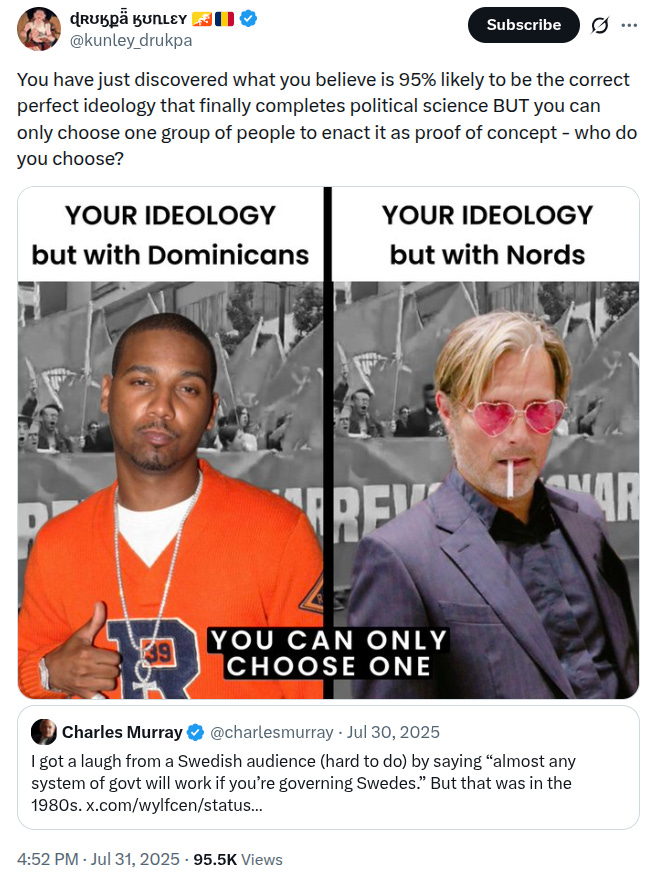
The problem that the Swedes run into is that they think their system of government is so great that anyone can adapt to it, so they invited a lot of third worlders they feel bad for to join. In reality a large part of why their system works so well is because the people they are governing are Nords. What we are seeing in Minneapolis, and in Sweden itself, is what happens when Scandinavian social democracy meets diversity and incompetence. It’s also well established in political science that people are more likely to support welfare programs if they perceive the people receiving benefits as being like themselves, which is presumably why the libs are always saying “you have more in common with an illegal immigrant than you do with a billionaire.”2 Regardless, the most important reason that this system can produce Basically Fine results is that social democracy in many way removes the bottom from society, which not only makes the public less stressed, but which does much to prevent the formation of a restive lumpenproletariat prone to become the masses who support extremist ideologies.
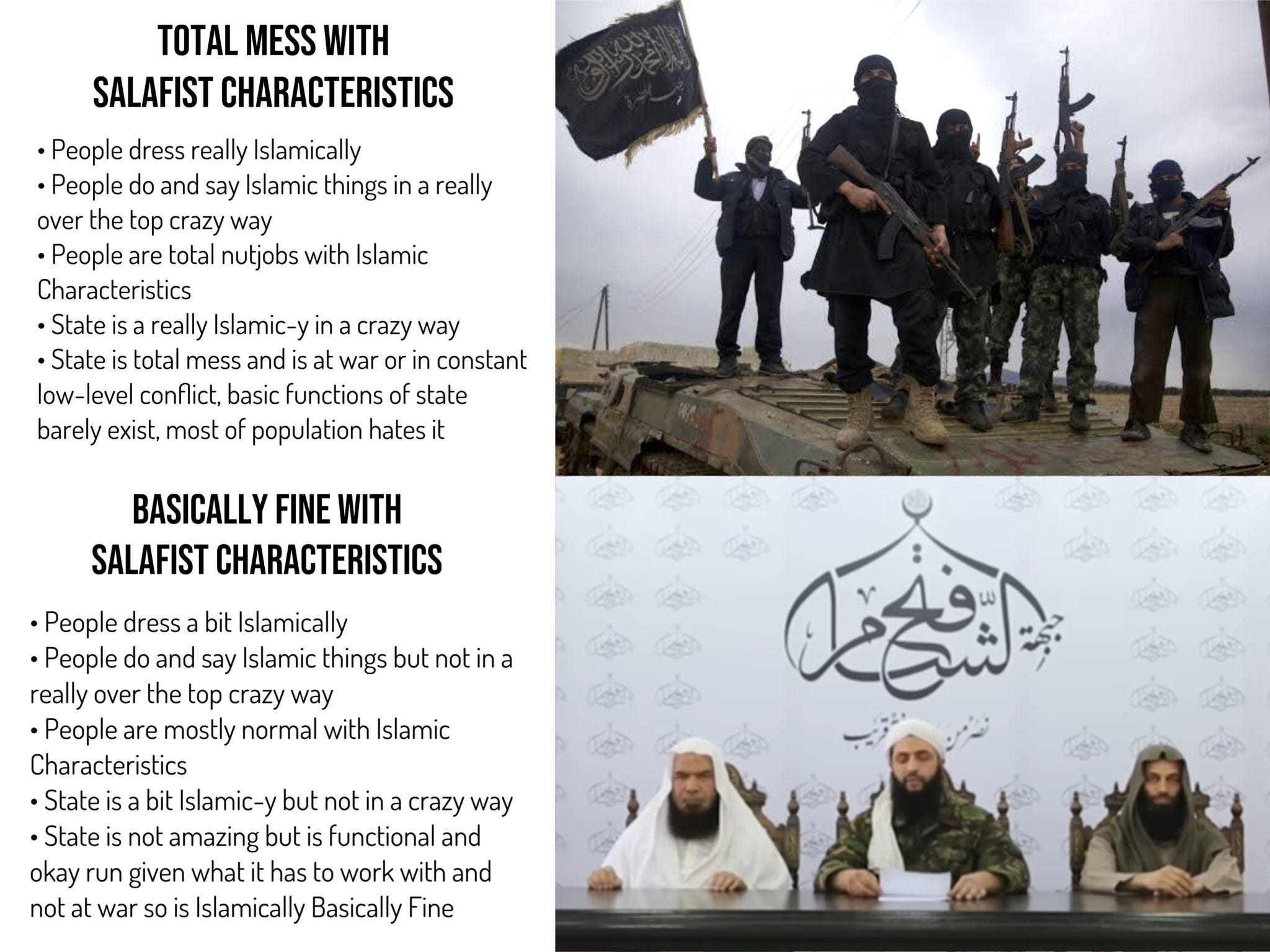
It is important to emphasize again though that Basically Fineism can improve the politics of almost any place if it is possible to implement, and even an ideology so aggressive as radical Islamism can be tempered by embracing Basically Fineism:
Challenges to Basically Fineism
The challenges to Basically Fineist government are several, particularly in the modern world. It is necessary to consistently work towards the public good while accepting the limitations of public policy and the resources available. The core of American progressivism, for example, is the belief that the combination of scientific progress and active government can solve the eternal problems of humanity which can only be managed. Basically Fineism requires the public acceptance of modest and reasonable goals, so excessive ambition and ideology are great dangers, as are things which scare the public. It is commonly better to do nothing at all if one cannot act with a reasonable degree of certainty that it will provide an improvement, be that immediately or as part of a process which the public can understand or believe in.
Ideology-Maxxing
Ideology is the greatest opponent of Basically Fineism, as should be clear by now. The stronger the ideology, the greater the threat. Kunley defines Ideology-Maxxing as follows:
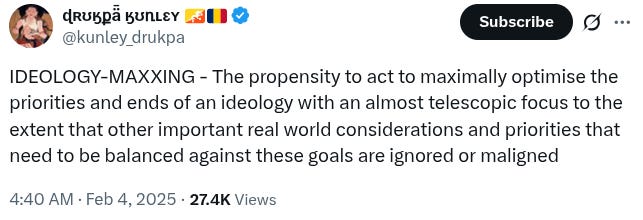
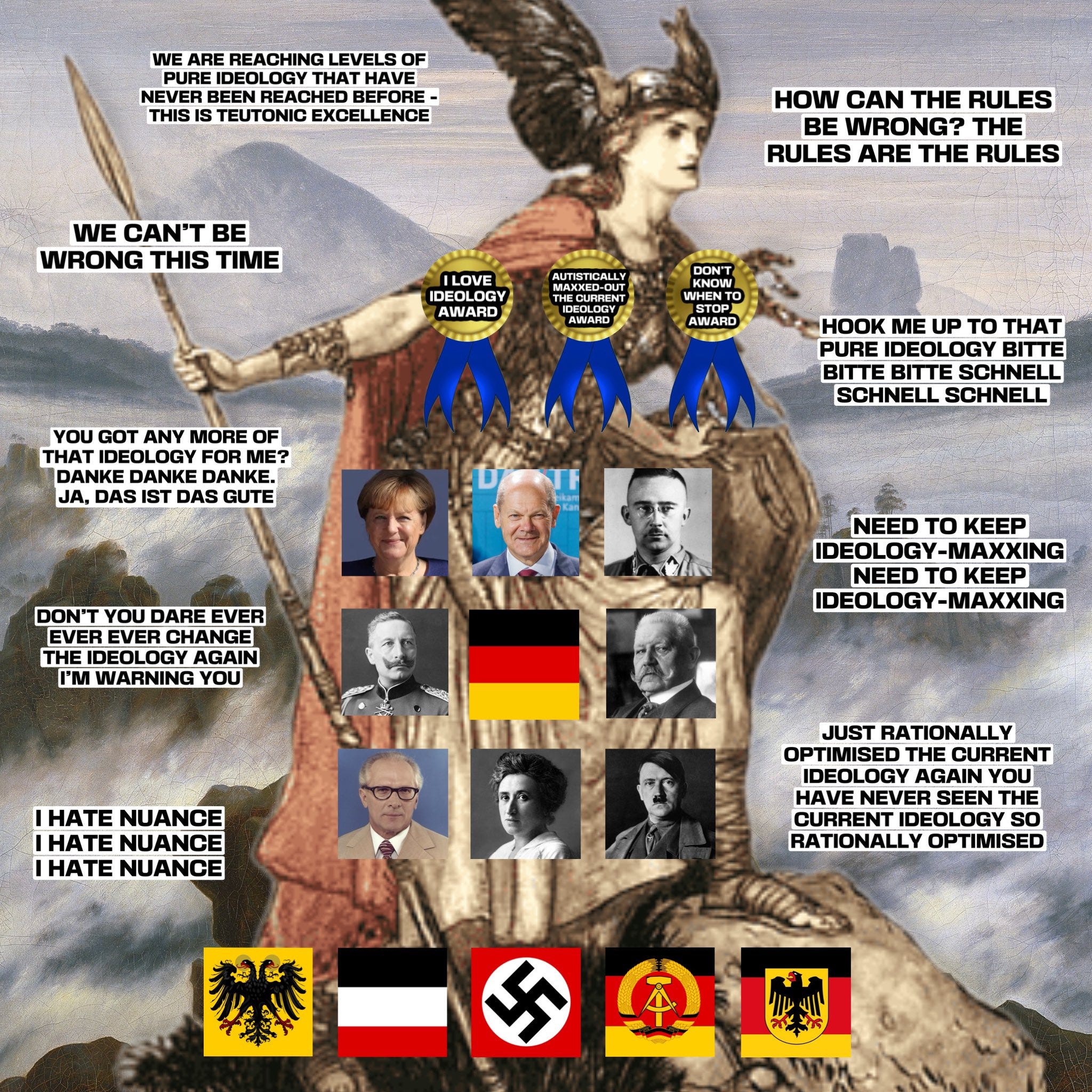
Governments by their nature have limited resources, financially, in terms of manpower, and in terms of what they can ask the public to support to achieve their goals, commonly known as “political capital.” To Ideology-Max involves not properly assessing costs, missed opportunities, and everything else necessary to pursue your ideology. To Stalin, the mass starvation of peasants was worth it to collectivize farms, though this is an extreme example. The Germans are the most prone to this failing. You may remember in War and Peace Tolstoy gives an extended explanation of German military theorists, and says that they are so in love with their theory that even if it doesn’t work they are delighted because they just see it as proof that their theory wasn’t followed or that it is a way to improve upon their theory. America being a heavily Germanic country, we too are prone to this. It remains something of a mystery why the Biden Administration adopted an extremist open borders ideology when Joe Biden had a 45 year record of supporting border security- and it was surely partially to do the opposite of the last guy- but this provides a clear example of the devastating impact this can have, on the country, on his party, and on even further increasing acrimony between the political sides.
Mass immigration is inherently a form of Ideology-Maxxing because it is the belief that, contrary to evidence, that the “values” of your society, such as they are, will integrate infinity people from all over and that you can make the public share this perspective, despite that mass immigration has not been popular among the native residents at any point in history. The reason reductio ad absurdum arguments are seemingly effective when arguing about public policy is that no policy actually works when taken to its extreme, they only work when implemented in a reasonable fashion. Of course, knowing this, those arguments lose their power in most instances.
The mass immigration ideology is primarily supported by the repeating the phrase “diversity is our strength,” which is a meaningless and clearly untrue statement. However, having become a core part of their ideology, its adherents find it unchallengable, and thus will do any crazy thing in support of “diversifying” all areas of public life, which has done much to promote the “Enshittification” we will get to below. While it is good to have principles, making government work properly requires flexibility, and you don’t want to go full Teutonic:
Another good example of ideology is everything related to “climate change” and “Net Zero.” It was obvious this would be disastrous while failing to achieve any benefits, but they all plowed right ahead, and of course high energy prices and reduced industrial production make life worse for everyone instead of keeping life Basically Fine. The irony is that assuming climate change is a real problem in the future the best way to deal with it is by having a strong economy and by being flexible instead of adhering to this destructive ideology in pursuit of dubious goals.
This should not be a difficult decision:
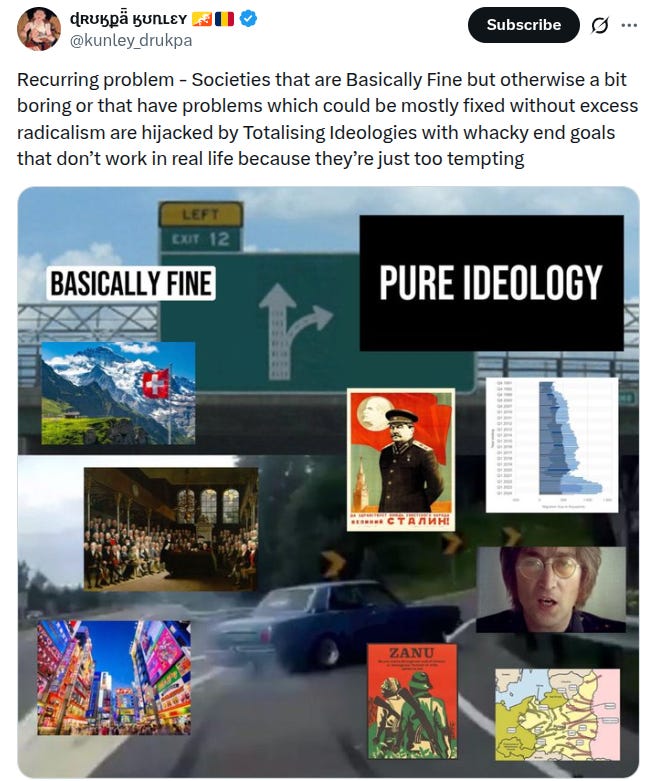
Really Obviously Bad Ideas
The debate over the invasion of Sicily in Thucydides’ The Peloponnesian War is one of the most distressing moments in history in that it is obvious that they are making a drastic unforced error. Their city has been infected with both avarice and optimism, and on a shoddy pretense Athens at its zenith decides to put all of its resources in an armada to attack Syracuse, partially in the belief that it will lead to rapid imperial expansion, for which they had no genuine need. Nicias makes what could be fairly called a Basically Fineist argument against this, that after years of war they should stay home to tend their own estates and enjoy the blessings of peace. It is as I said above about TV dramas, instead of starting a crazy new storyline, he suggested that they just live their lives, which were if anything better than Basically Fine. Despite this, they force him to be the general of this expedition, which becomes an absolute disaster, in part due to his hesitation but also due to its sheer insanity.
Its not clear to me what exact element of humanity causes such behavior, I suppose just the desire for glory. Regardless, many men have failed to learn the lesson and love to set goals with reckless audacity. In many cases, it’s not even clear why they should want to do this:
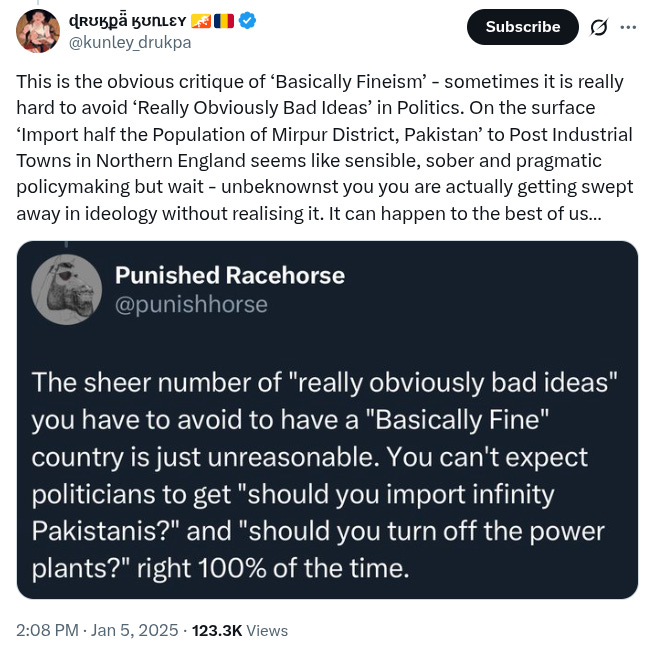
Sweden is in many ways a better example of the above than Britain, because there are at least historic reasons why the British were tied to the Pakistanis and they had spent decades teaching them English and cricket, the latter specifically on the grounds that it would teach them about following arbitrary rules and fair play. There is at least some argument that the Pakistanis appeared primed to join British society, or that Britain owed them something. Sweden, on the other hand, simply chose to become what they called a “humanitarian superpower” for no reason whatsoever. In the 30 or so years of this (which has, perhaps, finally ended) their country has become about 20% foreign born with about a total of 1/3rd being of some foreign heritage. The immigrants are bombing each other all the time and the country struggles with radical Islam. I suppose I have never tried that hard to get to the bottom of why they would do this, but I think simply to find a way to be a significant country globally despite their small size and population, which then accomplishes I don’t know what. I think they also wanted to prove that their institutions were so strong they could withstand that and anyone could be turned into Swedes, though why that is desirable is again beyond me. In short, it was just a Really Obviously Bad Idea they pursued based on some sort of Underpants Gnome logic that didn’t bother to discover the middle step where this is used to their benefit.
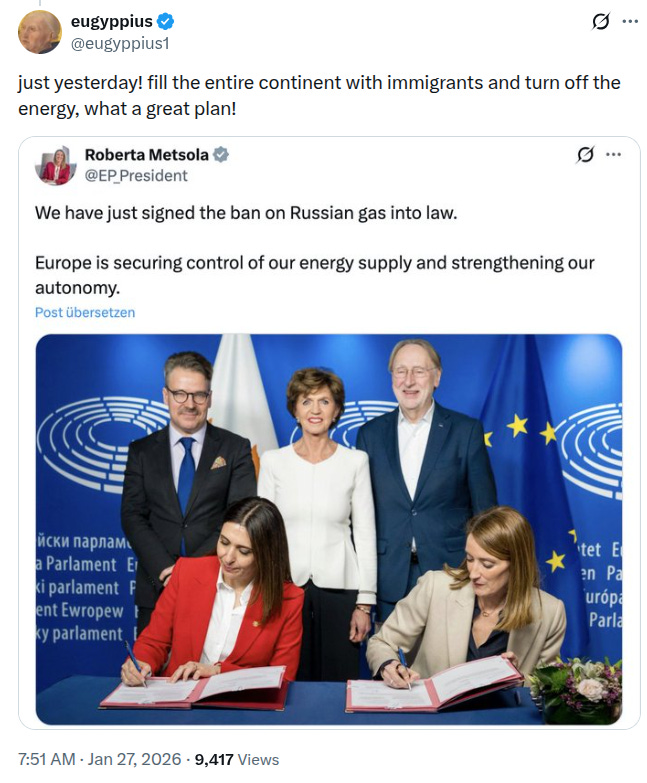
There are, of course, endless examples besides immigration and energy. They are of different severities, and sometimes would be fairly minor if not for the fact they will obviously antagonize the public. The biggest one besides those was shutting down society in a Kamikaze attack against a cold. Other examples include not arresting people who use drugs on the street, putting men pretending to be women in women’s prisons, and, to go back 20+ years, the Invasion of Iraq. I know that times change, but if a well-adjusted well-informed person from the 1990’s would find it unbelievably crazy to the extent that they thought you were putting them on, that is a sign it is a Really Obviously Bad Idea. Almost all of these are some form of Ideology-Maxxing, the main difference is that with Really Obviously Bad Ideas it is confounding that even an ideologue could believe they will work.
If It Saves One Life
Something progressives like to say is “You should judge a country by how it treats its weakest members.” This is, of course, myopic nonsense. A country should focus on treating the greater part of the population well knowing that the revenue and goodwill this generates will help everyone and allow for the care of edge cases that can’t get by on their own in the best circumstances. How would you judge a society where the mental defectives live in gilded mansions but the ordinary workers live in hovels?3 In America the compromise we have made- or our failure to make a compromise- has created a situation where the schizophrenics and drug addicts are on the streets because the left doesn’t want to confine them in what Burke above called “the wholesome darkness” of a cell, while the right doesn’t want to pay for any solution that helps them while still giving them access to the street. Thus we just let them die in the streets while harassing the citizenry, and try to pass this off as some combination of compassion and individualism.
This kind of emotional blackmail is common among progressives. In fact, one of the most fascinating things about the American left is their ability to, for any circumstance, invent the most disadvantaged and unsympathetic person imaginable and then demand you support that person. A common example of this is saying that some people don’t know how to cook, so there shouldn’t be limits on prepared food bought with EBT. I’ve even seen it said that the poor don’t have time to soak beans in the morning before work! Of course that takes about as much time as washing your hands. What is always funny about this line of reasoning is that most (but not all) poor people in fact have much more free time than they have money, which is why they are poor. Providing free adult education classes to teach the poors to cook is also an entirely reasonable and affordable public policy, but is paternalistic or something. The person they have invented is ludicrously helpless and unwilling to improve, and then we are supposed to base public policy on what will work for that individual, who clearly needs a social worker of some kind not just some financial support.
The way this emotional blackmail most badly damages the cause of wise public policy is all forms of “If it saves one life.” The thing about this is everything has costs. In many cases something may outright kill someone else, but also if something just marginally damages the economy some amount of people will have shorter lives so it is not obvious there has been a net improvement in years lived by the public.
The British comedian David Mitchell happens to be something of a sage in this area, so for this section I am sharing two separate radio sketches, which are both 15-20~ years old.
In this one, a man whose wife died in a train accident is sought out by a member of the media to interview him about if he thinks it is worth it to invest in the sensor technology which would have saved her life. The interviewee tries to say he is actually the worst person to talk to, but the interviewer will not listen. “Would you think it was worth having invested in this if it saved your wife’s life?” “Well yes, of course I would think it was worth it, but I must stress I have no objectivity whatsoever.” Finally, the interviewer demands to know what he would say to Minister, “Minister, good luck judging how to allocate your finite resources given the many competing demands you face.” This is a gold standard Basically Fineist position, which relies on both the citizen being sensible and having a degree of faith in the minister being a Mostly Competent Pragmatist, it is only the journalist who does not understand.
In the next sketch, “No One Drowned,” they talk to a local gadfly (who is truly a man of my own heart) who tries to explain that it is actually a bad thing that there were zero drowning deaths:
The argument here is flawless, which is that no one drowning in an area of a couple of million people actually demonstrates massive overspending on anti-drowning measures such as signage and sending people around to schools to talk to kids about drowning. Is keeping the 2 or 3 most drowning-prone people alive really more valuable than a pensioner who has diligently avoided falling into water his whole life who could freeze to death without a fuel subsidy? As he says, everyone has to die sometime, and in a fair, just, and democratic society, some of them should drown.
I shared this endless times during covid, where the relevance is obvious as they devoted tremendous resources to trying to keep the most death-prone members of society alive- who generally only had a couple of expected years left- at the expense of everyone else, and didn’t even help those people because what they were doing was a Really Obviously Bad Idea. But how can you put a price on a human life? (Every insurance company, large corporation, and government agency in fact has some amount they will pay out for wrongful deaths before going to court, by the way. Human lives have been formally priced throughout our economy.)
In my own state, Washington, which is known for being particularly moronic, for years they have promoted a traffic safety plan called “Target Zero” which aims to have zero traffic deaths in the state by 2030. I thought they had abandoned this as we got nearer, but looking it up, they last revised the plan in 2024, though they have been quiet about it. The commercials used to say, “How many traffic deaths do you think are acceptable in the state annually…now how many are acceptable in your own family?” This obviously is not how you set public policy. I seemed to be the only person who realized this was insane and would justify any amount of excess spending and oppression. There are 8 million or so people in this state. Say on average half of them get in a car every day, that is 4 million drivers 365 days a year, and you expect zero of them to die? Even if everyone drives perfectly safe on perfect roads, a moose is going to run in front of someone or an old guy will have a heart attack at the wheel and cross the center lane. Perhaps they would classify those things as acts of God, etc, but the goal is preposterous.
None of this is to say you shouldn’t work towards greater traffic safety, you absolutely should. However, I found something incredible looking to see if they were still doing this or gave up:
“Those 2023 numbers represent an 85% increase in fatalities and a 78% increase in serious injuries since 2013. With these increases in mind, and as we near the 2030 goal date, we must act boldly and urgently to continuously improve the way we design, operate, and maintain the transportation system and educate road users.”
85% increase in the first 10 years of the program, but won’t dump it for the last 5 realizing that the impossibility of this goal has clearly been counter-productive for reasons I can’t imagine. (I honestly assumed the first few times I read that it said “decrease” and thought they had cooked the numbers to get such impressive results.) Bear in mind that the state’s population hasn’t grown that much, cars are safer, and fewer teenagers drive these days, so this represents an unbelievable degree of failure. Maybe this has something to do with the divergence in driving habits during covid where a bunch of people like myself started driving faster and a certain group drove slower deciding needing a hospital was unethical, meanwhile the state turned against the police so they mostly stopped caring enough to pull people over. Either way, these people have not saved even one life with this absurd policy, and it seems as if they have cost many.
The important principle here though is to remember that once the government is emotionally blackmailing you with sob stories and setting impossible goals, they are liable to do whatever they want at any expense to your liberty and money.
Latinamericanization
Observers of international politics will be aware that even as America stands now our parties are generally to the center of the two main factions in any Latin American country. True, a more centrist candidate does sometimes come through but the fascinating thing about Latin American countries is that some percent of the population, perhaps as much as 10%, is a swing voter between communism and fascism. It is not clear how much of this is just that both sides suck so people go to the other thing. The background of this overall phenomenon is that in Latin America the old Iberian system of the haciendas and the clergy and landless peasantry and whatnot created a society where politics is very much based on economic identity and background. You may remember this from the sheer pointlessness of the wars of Col. Aureliano Buendia in One Hundred Years of Solitude. Regardless, this type of violent acrimony is exactly the fate one wants to avoid if the goal is Basically Fine governance, and America is already well on our way:
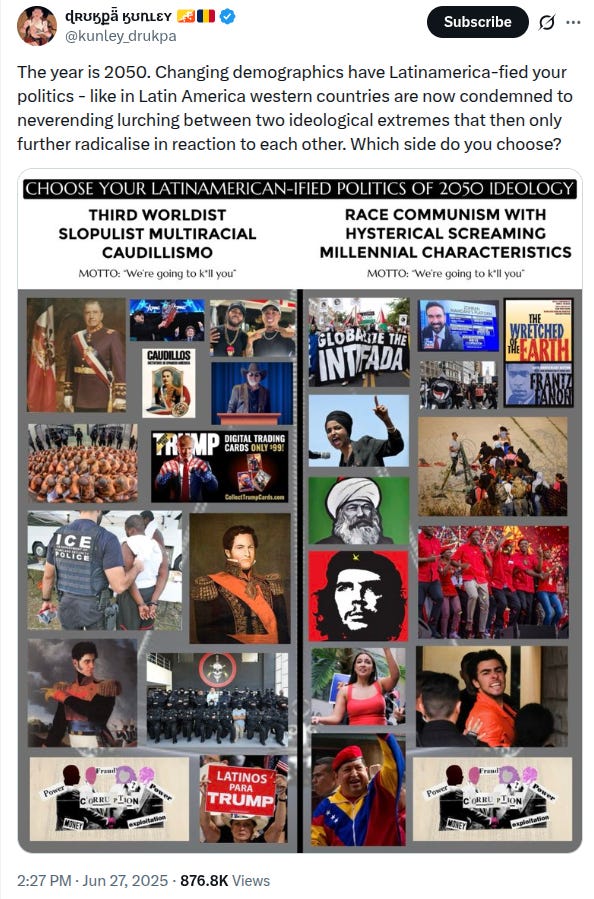
We find ourselves in a difficult situation regarding Latinamericanization because the Democrats both follow crazed ideologies and also operate as a coalition of minorities on a racial spoils system. On the other hand, prominent minorities on the right are absolutely Third Worldist Slopulist Caudillismos. The only good option is for whites is to vote like a minority, but then that plays into this problem. What we need is to all cool down and greatly slow immigration so they assimilate into our culture instead of us assimilating into theirs, but that ship may have sailed.
A key element of Latinamericanization is also the jailing of political opponents and former office holders. This is a difficult situation because optimally your politicians don’t do things for which they should be arrested and they should be held accountable if they do. However, when this comes up in our society it is never to try and arrest someone for something like starting the Iraq War or Barack Obama drone striking an American child, it is for paperwork violations or other nonsense. Currently, the DA of Philadelphia is claiming when Democrats take power they will hunt down ICE “like Nazis even if it takes decades.” This is absolutely deranged, even if you disagree with ICE’s behavior there is exactly one ICE agent who could currently be plausibly guilty for a homicide anyone has heard about.4 He seems to want them classified like the SS, and there are people saying we need new “Nuremberg Trials” against those enforcing immigration law. This is, by the way, an elderly white man, in one of the few positions where voters would generally chose the most responsible and competent person as opposed to voting on ideology!
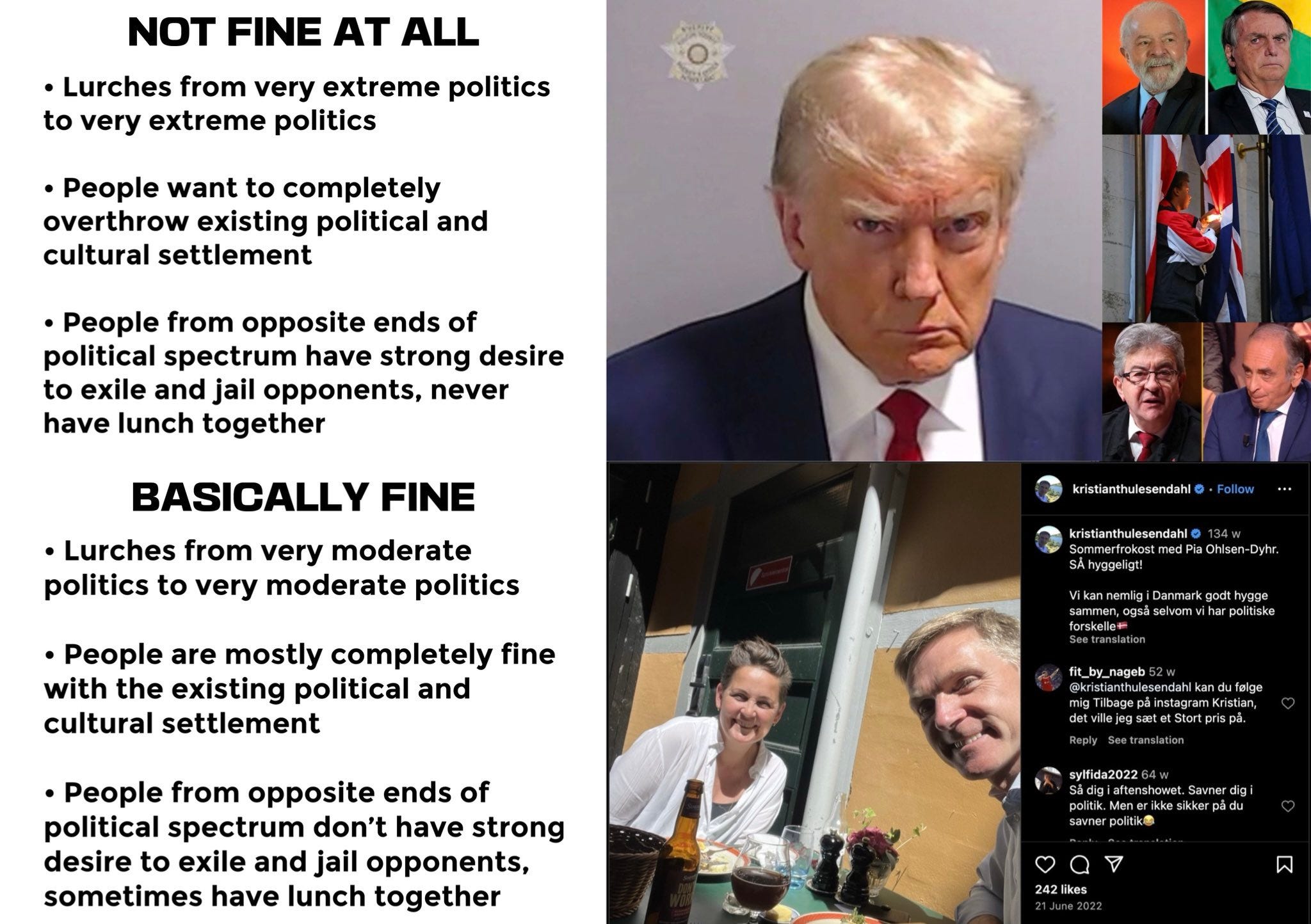
Something curious about all of this is that Americans, in their perpetual ignorance, usually say we will be a “third world country” or “Banana Republic” if we don’t prosecute our former leaders, when in reality it is almost exclusively third would countries which prosecute former leaders- the fear of such is presumably why African Heads of State almost never leave. The major exception is South Korea, where they almost all go to jail. In Europe, the only Head of State to be prosecuted and found guilty in recent history is France’s Nicolas Sarkozy, and that was after a careful process that no one but Sarkozy thought was political revenge, and for the quite serious crime of accepting illegal campaign donations from Gadaffi, who he then helped to overthrow. It’s hard in this situation to not go tit for tat, knowing what they will do to you, but constantly prosecuting, or even threatening to prosecute, your political opponents for fairly frivolous things or basic functions of of a state is Not Fine At All.
Scaring the Hoes
One severe problem that the modern West faces is “cowardice in the face of weakness,” which is actually the bigger theme of The Camp of the Saints than just to fear mass immigration. This creates issues when trying to fix problems, because in the mass media age there are endless pictures of upset children or whatever else and there is a tendency to let the sad story of one person prevent an action beneficial for a state of many millions. “Scaring the Hoes” is something like “using political capital” but the implication is more that people like the policy in theory but cannot stand to “see how the sausage is made,” so to speak.
I believe that “Scaring the Hoes” was first used in the political sense in this popular tweet:

The term isn’t strictly directed at women, really just anyone you have mild disrespect for who does not have the mettle to do what must be done, which is of course viewed as a feminine behavior.
Scaring the Hoes is a real problem for Basically Fineist government since it is supposed to be largely based on consensus and compromise and one wants to keep political conflict to a minimum where possible. However, avoiding Scaring the Hoes is the most possible in a society that is already Basically Fine. In a society with a high level of conflict and a hostile media a panic will be ginned up if you try to do anything at all, particularly regarding immigration enforcement. While one wants to try to avoid escalating unnecessarily, it is not always avoidable.
Machiavelli’s advice for people taking power is that if you must injure people you should injure them all at once, and then spread benefits over time. Good leadership does require leading and not just following the polls. To the extent that hoes must be scared, it is important to try and make it as brief as possible and to be able to show the benefits almost immediately instead of partaking in policies that antagonize people out proportion to what they accomplish.
What is crucial is that while one wants to avoid Scaring the Hoes you must also not let the fear of doing so become a neurosis, because there comes a point where it is just cowardice and prevents you from improving anything in your society.
This all, however, brings up a further issue, which is Boss Government vs. HR Government. More than any actual ideology or set of public policies, the grand pseudo-ideological struggle of our age is between government by bosses and government by HR Department. Trump has been wilding out in his second term, but his original sin, which led to a series of endless escalations, was just that they didn’t like his decorum. Instead, they want someone who behaves in a certain way and acts like the job is to make sure everyone diligently follows the rules moreso than that the job is to actually accomplish some political goal. It’s notable that HR Government really only works where things are already going fairly well, whereas if things must be strongly turned around Boss Government is more or less required. Modern Europe is largely an example of HR government in situations where government is already not going well, and no one is happy.
The perfect example of the hostility to Boss Government is Hungary’s Viktor Orban, who is not a great political leader but is in most ways fairly conventional besides that he is seen as a “boss” due to his mannerisms. Thus, the media and Eurocrats gin up panic about everything he does, because the EU is the ultimate form of HR Department government. In short, Boss Government Scares the Hoes. At the same time, those of us who detest schoolmarms and effeminate men find HR Government antagonizing. There is no clear solution to this but it is useful to realize much of the panic one hears about political leaders is solely due to superficial behaviors and has little to do with public policy, which is why Giorgia Meloni who we were assured was a neo-fascist became a darling while Orban remained an ogre.
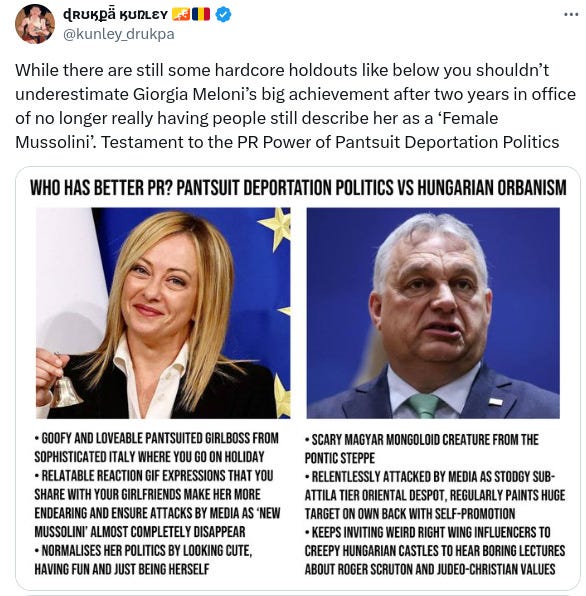
Basically Fineism is neutral on Boss Government vs HR Government, as which works better depends on the state of the country and the nature of the population. However, unless you have something they want and preferably wear some sort of exotic traditional outfit, Boss Government greatly scares the so-called “International Community,” or, if I may say, the International Hoe-ry
Do Somethingism
America is probably the worst country in the world for Do Somethingism. Even extremist ideological states, like fascists and communists, show more caution and willingness to delay. Do Somethingism is in our national character. It is as Thucydides says of the Athenians, “a scheme unexecuted with them is a positive loss” [1.70.7.] There are very few instances I can think of in American history where the government delayed action and let things work themselves out, and that was often due to gridlock instead of consensus, such as the Panic of 1819. Covid again is of course the worst instance of Do Somethingism, but the War on Terror is another egregious example, as were the Financial Crisis bailouts. These are just big examples. Few events happen that are not considered a pretense to take some great course of action, on the grounds that we will lose our influence if not involved. With covid they kept saying that “we don’t know” what it will do so responded by doing crazy ass unprecedented things instead of just assuming the virus would act like prior ones and behaving rationally and almost every government got away with behaving this way, since they were lead by the Americans.
Of course, drastic actions out of fear or ambition are death to Basically Fineist government since it is the belief that one can prevent somewhat bad things to happen. One has to be calm and take a Mostly Competent Pragmatic approach. One of the best scenes in the anime Avatar: the Last Airbender, known for being a profoundly wise children’s show, is when Bumi explains “neutral jing.” Yes, you “can just do things” as they like to say now, but you can also not do things, or wait for the right opportunity.
Unfortunately, this is extremely treacherous in American culture, where the bias for action is enormous. A politician will be forgiven for doing just about any idiot thing under the sun as long as he was pro-active and can say he tried, but choosing to not act and then things going even slightly bad is considered to be permanently unforgivable.
Machiavelli teaches the following, in his section called “When a Problem Has Arisen Either Within a State or Outside It, It Is Safer To Delay Dealing With It Than to Attack It”
“When a problem…has become so serious that it has begun to terrify everyone, the safest policy is to put off dealing with it rather than trying to eliminate it, because almost always those who eliminate it only increase its strength and the harm that is expected from it…When you put off dealing with them, they either fade away by themselves or at least the evil is postponed for a longer time.” [I.33]
This is going to be mostly impossible to do away with in America, and we need to be realistic about our circumstances, but it can at least be kept in mind for how you personally look at things and perhaps a few wise politicians will seek to stand against the storm that is America’s recklessness.
Enshittification
Enshittification is the gradual erosion of Basically Fine conditions. It is primarily a term used to describe technology and the tendency that the internet and its services have become continuously worse over time. However this also applies to governments and societies as a whole. It is something of a “boiling frog” situation where you just grow used to things becoming ever worse. Of course, part of this is nostalgia and the human condition, it is even in Plutarch’s “Sayings of the Spartans” that the King’s father and grandfather always said everything was “upside down” so you should only be surprised if things get better or stay the same. The reality is that much has improved, you know our coffee and motor oil and access to entertainment. If you were transported back 50 years you would find that many products you are used to are either much worse or entirely unavailable, so we need to be careful to make sure we’re not just failing to appreciate a variety of gradual improvements.
Still, my entire life I have been hearing about budget cuts to everything. This implies that at some prior point there was a proper amount of money, does it not? I assume much of the issue is just paying for a lot more nonsense, but at the very least we’re living in a mindset that is somehow simultaneously believing we need constantly belt tightening while also spending profligately. It is a curious thing. At least some cities have certainly got worse though. Perhaps not as extreme as when Detroit began to collapse but for example Portland was a very nice city when I was growing up and now the pictures look awful and almost everyone I knew there was moved away so I get few first hand reports. Fented out homeless people doing the junkie lean have made almost every American city worse than it used to be. It’s also true that this “diversity” we’re supposed to love so much seems to make everything in life more difficult. We always hear about academic standards falling.
However, the places Enshittification hits the hardest are regimes such as Cuba that are under long-term sanctions and also tied to ideology. Kunley wrote about this process from his travels, and has more to say about it than I possibly could. At its core, Enshittification is the erosion of social and material conditions and it is never clear where the bottom is or when the country will revolt. London, for example, has been Enshittifying for some time now, but is still largely livable, though it is apparent to all that standards are perpetually declining, in a way that is much more than just in your head.

Mass immigration is again a major cause of Enshittification. It invites people who are not used to the social expectations, are not habituated to caring for their new neighborhoods, and damages social cohesion. The rapid cultural changes are both aesthetically and culturally disorienting and all institutions suffer from challenges to communication and then from the steps taken to try and create a new social order.
The Limits of Basically Fineism
There are situations where things cannot be handled by moderation and compromise. It is impossible to make things Basically Fine with out of control crime, for example. In other instances one needs to wholly ignore entrenched interests who work in different industries and are set on doing Really Obviously Stupid Things. It requires a great deal of judgment about when to take another course, but there are circumstances where without strong leadership and a firm hand you will never get things to a level where a Basically Fine social and political settlement can be reached. These are just some examples where it may be necessary to accept some amount of antagonism that things may reach a peaceful medium in the future.
Skullcrusher Deporting
While Pantsuit Deportations (described below) are the ideal solution for immigration enforcement under modern Basically Fineist government, the reality is that immigration in many places has happened in too high of quantities to merely come at the issue from around the edges and only remove those who pose the greatest threat to your society, be that due to crime or just in various ways not fitting in. Thus, if you can find the political support, you may have to choose another option:

Skullcrusher Deporting may use any excess political capital you have and does increase antagonism in society for a time…in short, it absolutely Scares the Hoes. Plenty of normie votes who in theory oppose illegal immigration or at least want violent criminals deported will react badly to this method. The Trump Administration learned about the costs of this in January 2026, though it is very popular among his actual supporters and how much it is hurt him domestically is unclear. Further, when Joe Biden made whatever statement about having a more humane immigration policy it was widely amplified in Latin American media and encouraged more illegal immigration, whereas there is a strategic logic to brutality in immigration enforcement in that third worlders see videos on Whatsapp and decide not to come.
It is advisable that while actively employing Skullcrusher methods you try to not do other things which may unnecessarily upset people, such as abducting the President of a source country of illegal immigrants, or threatening to seize a rather large piece of land from an ally for no good reason.
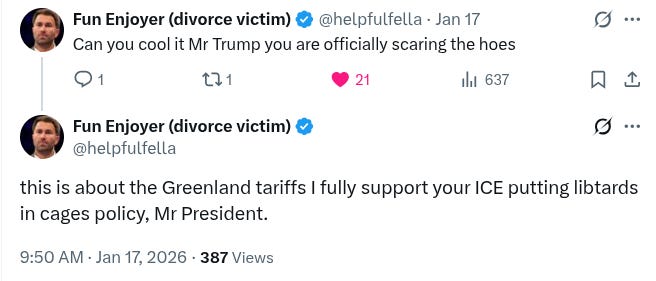
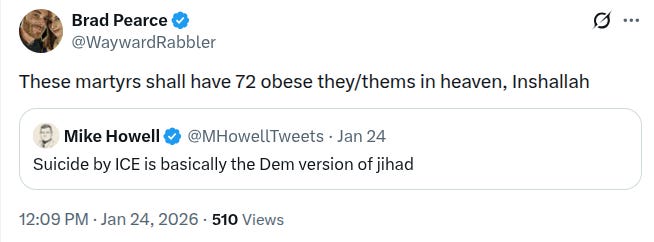
The most important defense of Skullcrusher Deportations is if the libs refuse to reach a compromise and do things the nice way. Unfortunately, this is still a situation where both sides are antagonizing the public, but it is an issue which has to be dealt with to improve other things and maintain your society and form of government. If an irate minority of the public is so against all immigration enforcement that they will give up their lives to keep illegal aliens in the country, there may be no other choice.
The Case of Bukele
El Salvador’s President Nayib Bukele has become a hero to many for his ability to get his country’s raging gang violence under control. Kunley has been to El Salvador and you can read his work directly if you are so inclined. It has of course been necessary to suspend various constitutional protections to make this progress, but it is hard to deny that there was a genuine emergency. Machiavelli teaches,
“Once a city has begun to decline through the corruption of its substance, if it ever manages to rise again, this occurs through the exceptional ability of a single man who is alive at the time…[who] at the risk of much danger and bloodshed, [has] brought about its rebirth…it is necessary to employ extraordinary measures, which few know how or wish to employ.” [Discourses, I.17]
Clearly El Salvador was deeply corrupt, and not just in the politicians stealing way, in the sense that the state was rotten inside and out. No normal method was ever going to fix this, so the options were to employ extraordinary methods or let people continue dying to uphold an ideology of “Liberal Democracy.” Really, the only man I can think of in our time who has been able to do the same thing for a deeply broken state is Rwanda’s Paul Kagame, who has a section below.
Most people who are fretting about Bukele’s methods have little to say besides, “It works in practice, but does it work in theory?”
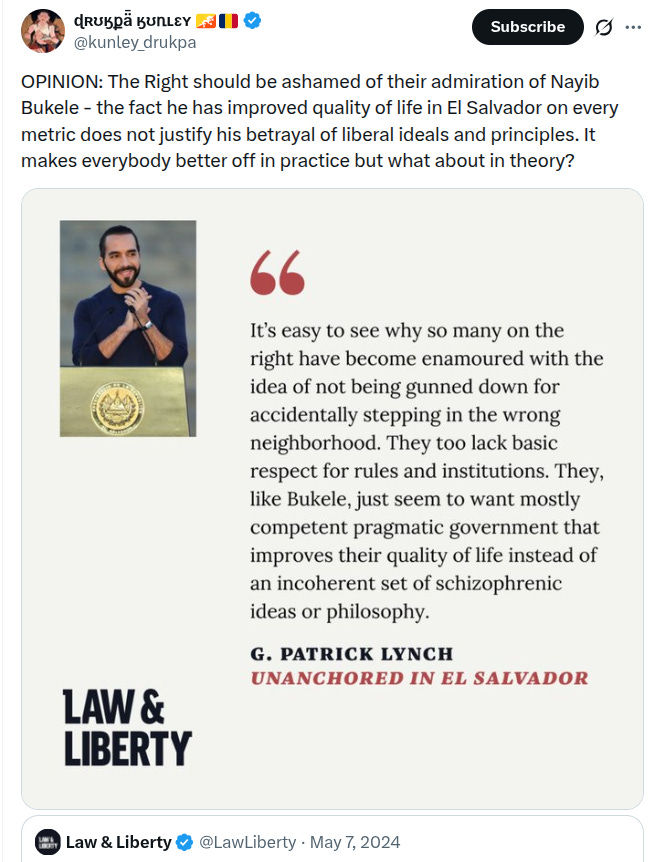
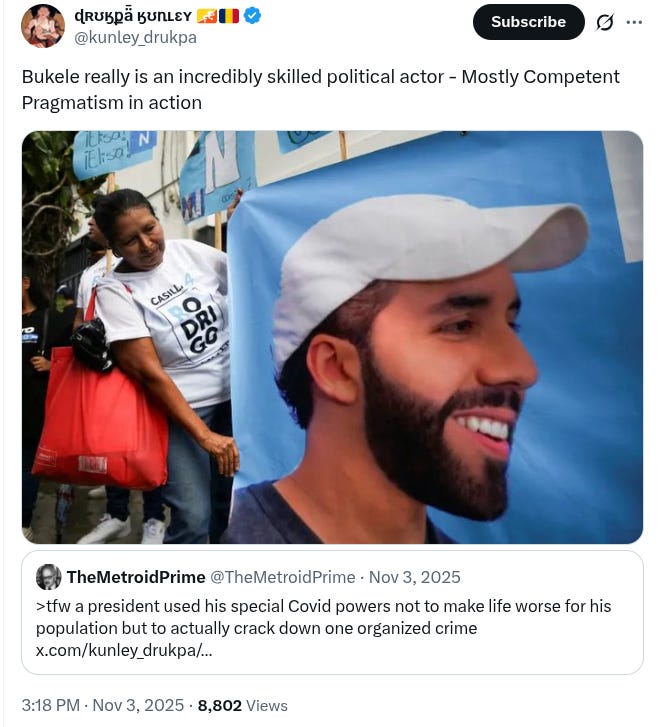
Bukele’s strategy was, in short, to consolidate political power, make bad-faith short term truces with the gangs, and then to mass arrest, all while under a state of emergency giving him extraordinary powers. Amusingly, he is the only world leader I know of who used his covid emergency powers to do something good instead of to ruin things for everyone.5 By mass arresting suspected gang members, Bukele disrupted their entire crime economy, and allowed some amount of normalcy to return to El Salvador after decades of insane violence. When criticized for this by a BBC reporter, Bukele said,
“You take your best government. Choose your best government...same people, same talent, same experts, same will to do things the right way. You take your best government, and you put them to govern Afghanistan, and you tell them 'Okay, you govern Afghanistan the same way you govern this European country. You'll be dead in a week because you cannot govern Afghanistan like you govern Europe.”
It really is as Burke said, that circumstances counts for nothing to some men.
No serious writer on political theory would posit that El Salvador could be fixed by the approved European methods of “liberal democracy.” It also is not even the case that the liberty of the citizens has overall been reduced by Bukele’s crime crackdown. Montesquieu, continuing the definition of liberty used above,
“We must have continually present to our minds the difference between independence and liberty. Liberty is a right of doing whatever the laws permit, and if a citizen could do what they forbid he would be no longer possessed of liberty, because all of his fellow citizens would have the same power.” [I.11.3]
One could argue all day about if unjust laws are laws at all, but the crimes under which El Salvador was previously suffering were murder, kidnapping, rape, extortion and the like, as well as all of the bribery and blackmail etc. which kept the criminal cartels safe. It cannot be said by any sophisticated conception that the status of human liberty was good in El Salvador pre-Bukele, whereas now people don’t get shot for wandering into the wrong neighborhood.
While Bukele seems to be coming out on top of incredible challenges, the intensity of this program and his power cannot continue in the long run if El Salvador is going to attain the status of being Basically Fine. For one thing, the combination of power and time corrupts (not merely power, as Machiavelli teaches regarding the Roman dictatorship, an institution which saved the Republic countless times.) The biggest challenge is that it is nearly impossible to reform a corrupt state, and that there is a great risk that El Salvador will fall into its old habits after he leaves, unless the people can be trained to live differently and not accept the corruption and violence that long plagued their country. Ultimately, Bukele needs to find a way to turn down the intensity and end his extraordinary measures or else all of his efforts will merely be a respite in a sea of chaos, though that respite would likely be remembered by many as the best time in their lives.
The Fix Everything Easily Switch
Wouldn’t it be nice if everything could be fixed easily without all of the nonsense? Sometimes it seems that way, and objections to reasonable solutions can be very stupid. You should be willing to “just do things” if have justified confidence that it will work.
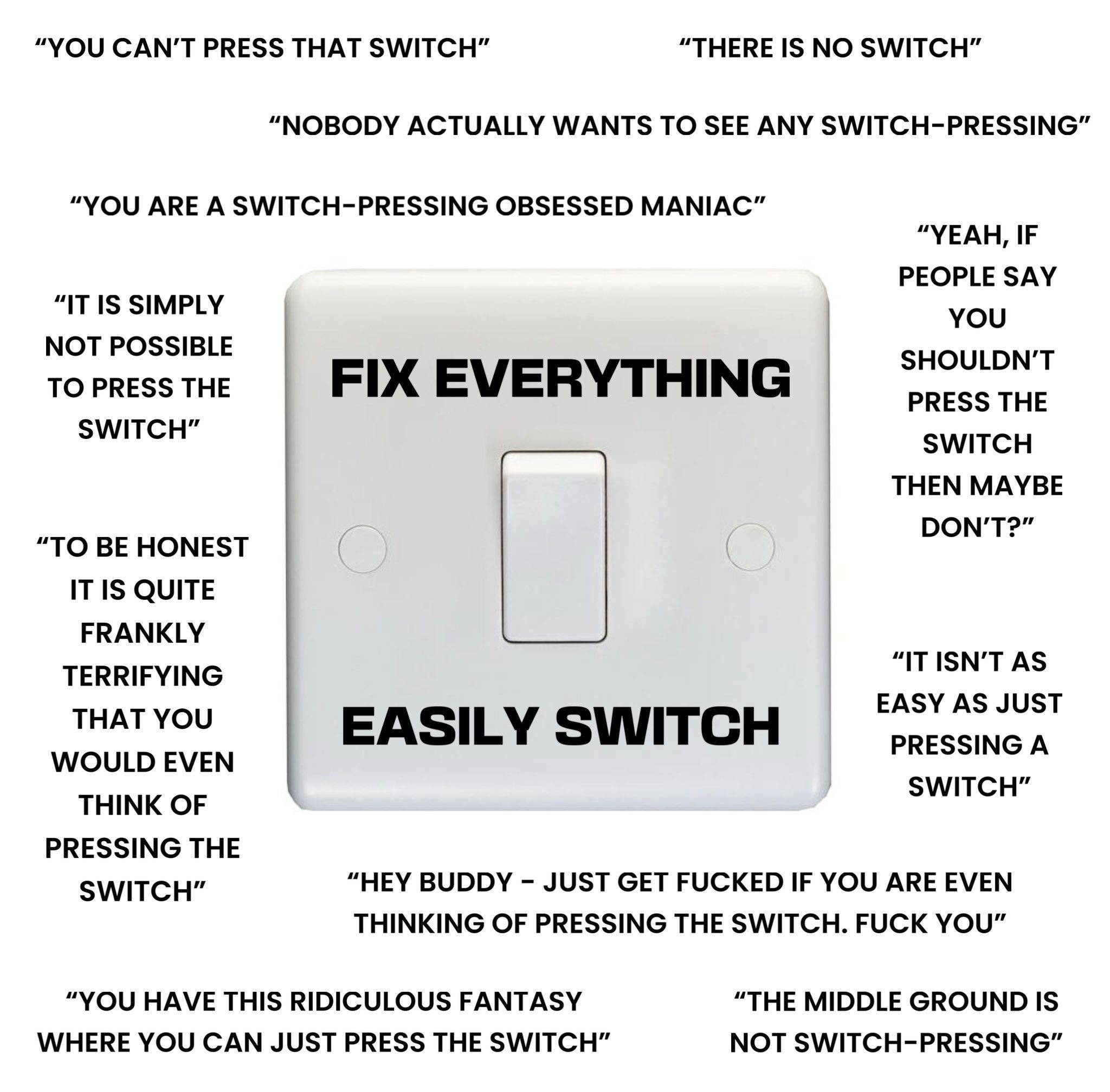
It is an unfortunate feature of politics that commonly when a leader is willing to act outside of the rules or established norms it is only to harm or punish. Tacitus tells a story of soldiers who were trying to to get their pay and terms of service improved, and note that before Tiberius was Emperor, they complained to him and he said he couldn’t help them because of Augustus, but now they appeal to Drusus who says he cannot help them because of Tiberius,
“How curious is it that the only army matters which the emperor refers to the senate are reforms in service conditions! If he does this, he ought to also consult them when death penalties or battles are in store. Clearly, when rewards are concerned, he is not his own master - whereas no one controls punishments.” [Annals, I.26]
Though the Prince does typically himself control the power of clemency, this remains the case that when the President wants to hurt you he can somehow do whatever he wants yet suddenly when something might help you all of those “checks and balances” you hear about greatly limit his power. There is no clearer example then everything they were apparently able to just do because of covid:
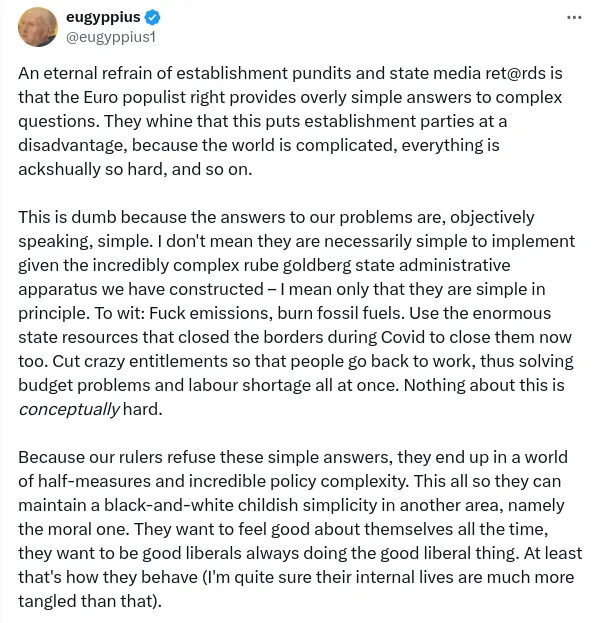
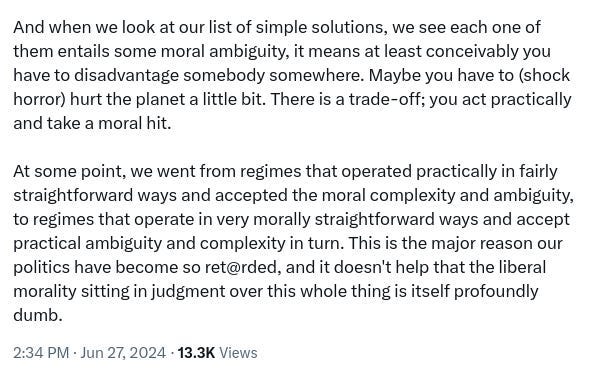
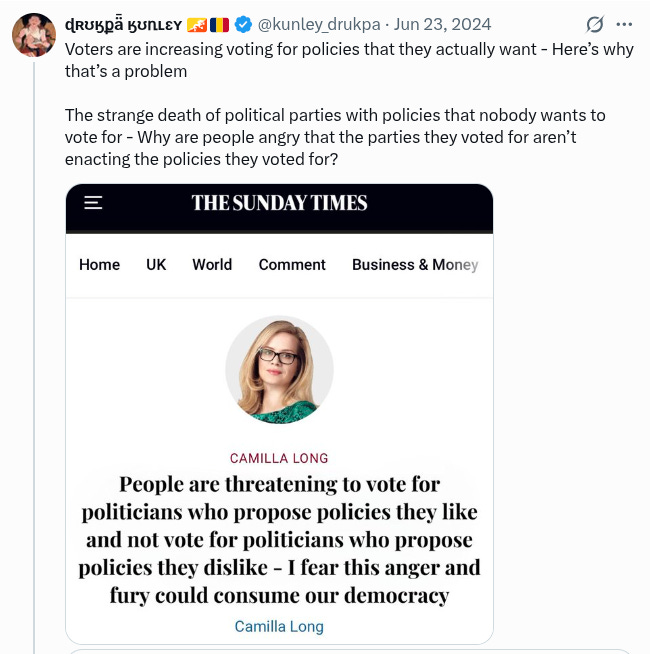
Many of the problems we face are complex or require compromise, but nevertheless, it is necessary to consider which things you could fix immediately if you ignore the nonsense. Some of the smaller issues, such as not putting men in women’s prisons or teaching the kids to read by sounding out words you really can just do. This is also true of bigger problems, like Europe’s “Net Zero” insanity. Britain simply stopped using North Sea oil that is still there for no reason but that their rulers are morons so they could fix their energy problem by just drilling new wells. It turned out that second term Trump was able to close our southern border shockingly easily and I’m not even sure what he’s done different from the first term.
The Fix Everything Easily Switch is more of a mental exercise than anything, to remember that not everything requires compromise and a middle road, sometimes your opponents are just morons whose concerns do not merit being taken seriously and if your legislators would actually enact reasonable policies the voters want that things could get much better rapidly.
Your Government Hates You
It is normal that in electoral politics some group should be blamed for some of the ills of society. It is not ideal, but what better way to get votes than to say “this group of people is a threat to your safety, and I will protect you.” There can be truth to this, and the utility is clear. Ideally this is limited to more or less real situations and is not hatred for its own sake, but regardless it’s all in the game. What was more shocking to me was the reckless audacity with which the Anglo political elites, specifically America’s Democrats, Canada’s Liberals, and Britain’s “traditional parties” employed the political strategy of hating the general public. The entire 10 years prior to the 2024 was all about the ways white people in general were evil. Granted, the Democrat coalition is primarily over-educated self-hating whites and aggrieved minorities, so there is some political sense to it, but it was still too much for many. We never stop hearing about all the ways minorities are superior to us, morally if not some of them in income and educational attainment as well. Meanwhile, they go on about how our culture is trash and our values are bad. An entire apparatus was set up to make sure every advantage in life went to non-white people, and it is just now that “respectable” people are allowed to talk about it. It has been one of the great reliefs of my life to watch this recede and to less have to imagine a fantasy world where the government doesn’t hate me, but is merely indifferent to my wellbeing.

Edmund Burke wrote, in “Letter to the Sheriffs of Bristol,” one of his essays on reconciliation with America,
“I never knew of a writer on the theory of government, so partial to authority, as not to allow, that the hostile mind of the rulers to their people, did fully justify a change of government”
Indeed, even Hobbes, who is overall considered the “writer on the theory of government” the most “partial to authority” does not make any such argument to the best of my memory. What he does, however, write the following,
“For those men who are so remissly governed, that they dare take up arms, to defend, or introduce an opinion, are still in war; and their condition not peace, but only a cessation of arms for fear of one another; and they live as it were, in the precincts of battle continuously.” [Leviathan, II.18.9]
I would not want anyone to think I should write a treatise on government without giving some thought to at what point revolution is necessary or justified. Of course, following the Declaration of Independence quote I used above, Jefferson wrote,
“But when a long train of abuses and usurpations, pursuing invariably the same Object evinces a design to reduce them under absolute Despotism, it is their right, it is their duty, to throw off such Government, and to provide new Guards for their future security.”
This depends on infinite circumstances, is unreliable, and necessarily requires to some extent throwing caution to the wind. There are a lot of kinds of revolution, and you should keep the existing forms of government where possible. The reason that the American Revolution worked out so well is that it was in defense of our own local governments that the Crown had been cracking down on.
I can not give a clear answer on when you have reached “When in the course of human events…” instead of simply needing to build a political movement based on clear, Basically Fineist principles, but certainly recommend caution, prudence, and tolerating things for as long as they stay tolerable.
Basically Fineist Public Policies
The root of Basically Fineist policy making is competence and compromise. It is the most important to actually understand how things work, allow administrators to do their jobs, and maintain a functioning society with social cohesion. There is no single right policy for Basically Fineism and as the social, economic, and political conditions vary from place to place, so will what is a reasonable compromise. Regardless, I want to give an idea of how some sample political issues can be handled with Mostly Competent Pragmatism.
Immigration
Mass immigration is, overall, the single biggest concrete threat to Basically Fineist government. There are several reasons why mass immigration is incompatible with Basically Fineism. The most important is that not a lot of people leave countries where things are fine, so outside of a few businessman and scientists and the like you will almost always be seeking to integrate people from countries where things are not Basically Fine but where they would be if the public had the skills and disposition to produce those government results for themselves. Further, Basically Fineism relies on a social cohesion and trust, the citizen must not feel alienated from his surroundings, and he should not be antagonized by crime. The reality is that in no time and place have the native public liked mass immigration, outside of what portion of the public is of a strongly cosmopolitan and artistic disposition as well as ideologues who detest their own culture. Further, mass immigration represents both ideology and ambition. The ideology is the belief that your beliefs are strong enough to make anyone become like you (the contradiction that far-left immigration maximalists tend to be anti-assimilation is too nonsensical to get into here.) The ambition is that you need permanent growth so that “Line Go Up” instead of a limited labor pool making it so that men who work every day jobs can have good lives.
There are two main sensible immigration policies I present here. The first is to allow some foreigners who can afford to do so to live in your country and any children they should happen to have can apply for citizenship once they become adults assuming they have continued to live in the country, perhaps after a period of conscription or public service if applicable. However, outside of exceptional circumstances there would be no “path to citizenship” for adults. I would note here that Americans have some trouble understanding the premise of being a long-term foreign national who does not get citizenship, but it is overall fine. Of a few guys I know around town whose foreign wives have become citizens, I have often thought, “It seems the only thing they get out of this is the ability to participate in our joke elections, which is actually degrading and not something to be proud of.” Of course, under Basically Fineism in theory your elections would be respectable affairs that primarily work towards competent and fair administration as opposed to fake and gay ideological struggles designed to bilk money out of the public and make them ignore the fact that the entire government is doing a bad job.
In America, which is designed to absorb immigrants, we have vacillated between allowing mass immigration and taking pauses. The current 60 years of mass immigration after a highly necessary and productive 40 year pause needs to end. My proposal for America itself, that is too sensible to ever happen, is that following each census we set a 10 year immigration plan based on the actual needs of the country and the desires of the citizenry. If managed properly this would not need to screw anyone in the process of immigrating or getting citizenship, as it would be understood that each plan respects past and future plans. This would of course “de-nuclearize” the issue while making it only a major political issue every 10 years instead of a constant source of acrimony. Ideally, the political struggle would be largely a Mostly Competent Pragmatic analysis of what is right for the country, and not an ideological battle.
The bigger issue is that we have huge amounts of immigrants, both legal and illegal, in America and Europe. I am not one of these radicals who thinks it is reasonable or desirable to denaturalize any large number of people or demand “remigration” of people with citizenship, but it is straight forward enough to have an immigration moratorium to figure things out and then just actually guard the border. As said by eugyppius above, they demonstrated during covid they are entirely capable of keeping illegal immigrants out if they simply choose to do so. Securing borders is popular enough one doesn’t need to give it any great thought. How to run deportations is more difficult, and for this the Euros have discovered what appears to be a winning compromise:
The Rise of Pantsuit Deporting

“One sees from experience in our times that the princes who have accomplished great deeds are those who have thought little about keeping faith and who have known how cunningly to manipulate men’s minds; and in the end they have surpassed those who laid their foundations upon sincerity.” - Machiavelli [
The basic premise of Pantsuit Deporting is that a no-nonsense girlboss explains why mass immigration is not working for the country and that immigration laws do need to be enforced for public safety. There are strong humanitarian, environmentalist, and labor arguments against mass immigration that can work well if said by a woman who can appeal to the left wing, at least to the extent that they don’t wage Jihad against the government. I mean, people are dying in the oceans, they’re leaving garbage all over in sensitive wild areas, wages for native low-skill workers are driven down, and they’re separated from their families for decades. Crucially, since this doesn’t Scare the Hoes, you don’t end up with a pendulum swing between no border enforcement and Skullcrusher Deportations keeping the country in a state of ferment. Importantly, the most sensible among the left are realizing that mass immigration is antagonizing the public well past the point of sustainability and have grown to fear the truism that “if democrats don’t enforce the law, fascists will.” The big downside is that it is hard for this method to do more than “nibble around the edges,” but it is the most sensible and viable solution for the situation which exists now, particularly if combined with secure borders.
Foreign Policy
The optimal foreign policy for a Basically Fineist state is to be safe due to your own harmlessness, though circumstances may require a more muscular armed neutrality or being a small part of a more powerful nation’s security scheme. The reality of foreign policy is that most of the public would like to not hear about it at all. The man on the street has his own concerns and doesn’t need to be hearing anything about foreign policy that isn’t occasional friendly diplomatic visits. Hysterical pronouncements of Very Serious People notwithstanding, in the modern world countries that have been minding their own business facing any kind of foreign aggression, except from the United States, is quite rare, and even of those at least much of the time their ideological leaders have set a confrontational course. It is harder for the United States to stay out of things, as it is and will remain at least some kind of major power, but simply being less ideological, grasping, and not doing Really Obviously Stupid Things would move the United States closer to a Basically Fineist foreign policy.
Regarding smaller states, to again reference the show LOST, there is a scene where this older couple Bernard and Rose have not been seen in a long time, and suddenly show up in an episode. It turns out they have been living on the beach in peace and not taking part in any of the nonsense in the show. They rescue the character Desmond from the bottom of a well, but send him on his way after he is rested and fed, saying, “We like you, but whatever got you thrown into that well is exactly what we are avoiding.” This is an optimal Basically Fineist foreign policy. Ultimately, they do get drawn back into the show’s nonsense as it is unavoidable, but no other actions they could have taken would have prevented that or made anything better. Similarly, it is not always possible to stay out of the world’s problems, but it is best to avoid trying to slay dragons or thinking you can change the world. Instead, a state should simply have friendly trade and diplomatic relationships with those who wish to and develop a reputation as a level-headed sensible country that minds its own business. In other circumstances, you may be forced to join someone, but if you join without a fight it is common that almost nothing is asked of you. By the time the aggression you face is so overwhelming that it cannot be handled in the above fashion, it is most likely the case that nothing would have saved the independence of your state, and the best you can do is be ruled by others while avoiding your own country becoming a battleground.
While Mexico has overall failed to achieve Basically Fineism, it has pursued a Basically Fineist foreign policy for almost a century. Despite being next to a much more powerful, sometimes aggressive neighbor which makes many demands, Mexico guards its independence and maintains a policy of strict neutrality. It did join WW2, but only after Germany attacked its oil tankers, and thus its neutrality was violated. Mexico has a policy against using “recognition” as a diplomatic tool and has good relations with everyone. It is also more respected by the US government than is realized by the US public, because it is assertive but only of its own rights, while recognizing the reality of its situation. People have commonly liked to say, of Russia and Ukraine, “How would we react if Mexico became allied with China” to which I say, “Leave Mexico out of this, Mexico is not some passive actor, it has a policy of neutrality and of not antagonizing its larger neighbor, and would never get into a situation like this.”
Healthcare
Of many things in America, healthcare is nearly the farthest from Basically Fine. On one side, there are people who believe healthcare is a “right,” while on the other side there are people who believe any government provision of healthcare is “socialism.” Both of these are idiotic forms of Ideology-Maxxing. If the government is the right way to provide healthcare is an important discussion and the answer is not obvious, but providing services is what governments do, when they aren’t finding ways to ruin your life. What we have ended up with is a system where healthcare is massively over-regulated, insanely expensive, and riddled with fraud- over-billing government insurance for nonsense is basically its own entirely legal industry. Meanwhile, if your income goes up enough that you have to pay for your own healthcare the slight increase in income will bankrupt you because the government wants you to pay $1,000 a month for insurance that must cover basically everything. I have poor people’s government health insurance and was trying to get my daughter a dentist appointment. When I found out the office didn’t take the insurance and it was listed in error, I asked “just so I know, what does it cost to pay out of pocket, in case I have trouble getting an appointment and decide to go anyway.” I was informed that if they found out you have paid for any healthcare, you get kicked off of Medicaid!
To the Democrats, the solution is to get as many people on government healthcare as possible and give insurance companies endless taxpayer money to “subsidize” everyone else. We have just been fighting about this and the numbers are insane, up to several hundred dollars a month per middle class adult. Much of the public believes no one should ever pay any amount out of pocket, despite that the last time I went for a normal doctor’s visit because I needed antibiotics it was only $75, which is completely affordable for the part of the population which is not entirely indigent. It’s actually insane that the ultra-wealthy use health insurance at all, because if you can pay out of pocket for any expense healthcare should be unlikely to save you any money, but the system is to have “coverage.” Reducing healthcare demand is almost never discussed, despite being the most over-medicated society on Earth with endless recommendations to go to the doctor over pointless matters and the inability to get some very basic and benign medications over the counter without a prescription.
Contrary to what the American left believes, almost no countries actually have national single payer healthcare, and in the one major example, Britain, it is such a bankrupting disaster that it is an albatross around the neck of their entire polity but also a sacred cow that can never be fixed or reformed. This would be an even bigger disaster in the United States, a vast, federal country where the political sides hate each other and there are asinine arguments against everything, such as that policies cannot be left to states because people in California would hate how Mississippi chooses to manage it. Further, the “faceless bureaucrat” problem would be out of control if this were directly federally managed. It would be worth discussing universal healthcare if they wanted to provide any sort of scheme that wasn’t obviously stupid. Meanwhile, Republicans continue to insist we “had the best healthcare in the world” before Obamacare while refusing to properly repeal it. In short, it is a Total Mess.
To get into some understanding of other countries, we hear constantly that “every other First World country has universal healthcare” which is kind of true but not in the way they think. Firstly, I’m going to tell you that I watch international TV shows all the time, and just about everywhere people worry that a major injury or illness may bankrupt them, despite that we are told that is only true in America. In the few instances where they don’t, the issue is that you die waiting for care. What is crucial to understand is that most countries have some form of regional multipayer healthcare. In Norway, for example, adults under a certain age pay their first whatever amount of healthcare every year, a little over $250. That seems nominal, but it is more than my healthcare cost most years and thus that person is all the way out of the system and not even using government care outside of an emergency. In many other countries there is universal healthcare but people can choose private health plans (strangely, in Germany this is only allowed if you are above a certain income threshold, as opposed to simply letting you choose to pay for it if you can afford it.)
There is a 2014 article from Forbes about how the American left doesn’t know anything about Scandinavia despite their admiration for it, most of all how low regulation classically liberal economies fund their welfare states. He explains Denmark’s healthcare system is based on “communes,” which are something like school districts, and are around 10,000 people. It is from this tax money where healthcare is funded, and it is locally administered. This creates what he calls the “Bjorn’s Beer” effect, which is to say that you know the bureaucrat in charge of administering healthcare spending, and know where he has a beer on a Friday night and can actually speak to him, solving the faceless bureaucrat problem. Being entirely predictable, one can presumably already imagine how the American left would react to that. People in poor neighborhoods will get worse healthcare! Yes, they will, you could federally subsidize them but that is simply how things work in practice, the poor don’t have access to as good of services. I assure you that in Britain the NHS clinics in wealthy suburbs are nicer than the ones near council estates. I further assure you that in fact under full blown communism members of the Politboro get better healthcare than peasants.
It is a childish fantasy that everyone in a country will get the same healthcare treatment. It is idiotic to think that people should be able to waste infinity healthcare resources at government expense. It misunderstands the political, social, and economic structure of America to think that Medicare For All would be anything but a disaster. It ignores the political reality of the people who have come to rely on entitlement programs to think they can be done away with. By dropping ideology on both sides in favor of what actually works, we could reach some sort of Basically Fine compromise on this interminable and overpriced political issue.
Crime
A well-founded fear of crime is one of the top variables between whether living somewhere is Basically Fine or is Not Fine At All. Crime is a highly localized issue, and few things antagonize the public more than feeling unsafe. Crime also prevents social and economic development. People like to argue about whether crime causes poverty or poverty causes crime and the former is much more true, but it is a vicious cycle. The reality is that a level of safety needs to be attained for there to be meaningful economic development in an area, which encourages children to get jobs instead of become criminals. Unfortunately, deranged leftists have attacked the police as an institution and then tried to find stupid ways to replace them
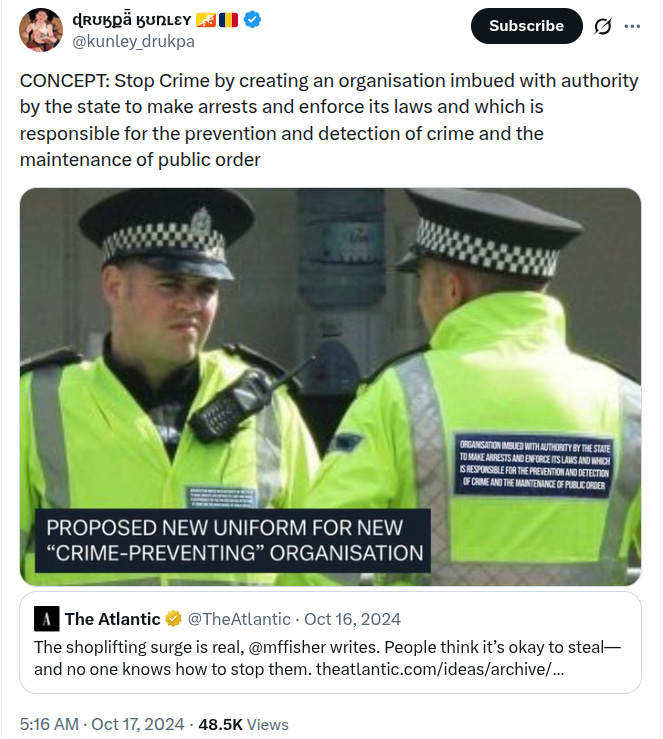
The problem we have ran into with this is that many whites have decided it is somehow racist to police minority communities, despite that those minorities are the primary victims of the crimes. It is in fact a national disgrace to a country as wealthy as America that our inner cities are as violent as they are and we owe it to our fellow citizens to devote the resources necessary to secure their neighborhoods. This does not call for a heavy handed occupation, it calls for a sensible law and order approach. Yet, we still run into people who oppose all policing of public conduct because they think it is black culture to do drugs on public transit and that this should be allowed. In Seattle a few years ago they did a study about the effects of second hand fentanyl smoke on passengers on public busses, which is a batshit insane decision compared to just arresting people who smoke fentanyl on the bus.
For a long time it was said by both libertarians and the left that drugs should be decriminalized because it is a public health issue. What many of them failed to realize is that in European states where this has been done it is taken quite seriously as a public health issue and drug addicts are closely monitored and made to behave in a socially acceptable way. In the United States, when Oregon decriminalized drugs for a couple of years it was basically the case that they didn’t treat it like a public health issue and the junkies were just left to die on the streets. I have been told this was because compromise failed, and they got far enough to do the first part but then there was no funding to actually care for them. It became similar to our problem with closing the asylums, where people were scared of abuse, so now we just leave schizophrenics to die in the streets, which is not at all compassionate. Over and over again, America fails to compromise and lives with the results for decades while both sides blame the other. It is not actually complex to keep the streets clean and care for people with severe problems while only focusing investigative resources on high level organized crime but mostly not bothering people about what goes on inside their own homes or what happens to be in their pockets. In short, don’t frisk random people for drugs, but also arrest people who shoot up in the street.
It is often mentioned how many more police per capita European countries typically have than the United States, but this does not tell the whole story. Most police in Western Europe are like glorified mall cops, which is to say as well as traffic enforcement they drive around and say “please don’t do that” or “move along, sir” and give minor tickets or write things down. There are separate criminal and/or judicial police (varying by country) who are the ones who actually deal with investigations and crime, which makes the security police a random person in the margins of society deals with less scary. Neither “Defund the Police” or “Give the police all the power” to end crime are sensible policies, but it’s worth considering that American police have had a lot of responsibility creep over the decades by simply being those who governments have on hand when they need employees to carry out tasks.
Education
There is probably no single bigger “Can you people please be normal” issue in America than public education. For decades academics have come up with asinine pedagogical theories. There are endless concerns about kids using technology or being prepared for the “jobs of tomorrow” that may no longer exist by the time they enter the work force. There are constant appeals about “Competing with China.” Standardized tests are frequently changed so that schools can be judged and funded. Massive resources are thrown into a pit of urban schools that accomplishes nothing. At some point leftist activists decided that schools are the heart of the revolution and that they just need to get to the children. States never stop modifying curriculum that they can meet a bunch of different goals, many of which are not even desirable.
The truth is that kids learn to read like they always have. They should understand basic math. It is important to know how to write. Throwing money at this problem and constantly coming up with new schemes has only made things worse. The reality is if a kid leaves school literate and with basic math skills and ideally with some conception of the country we live in and his responsibilities as a citizen, he will be fine. Most people are capable of learning and if so they can learn or are not capable of learning and if so you are just wasting everyone’s time and resources trying to make them something that they are not. The results of trying to do anything different have been abysmal and it has made everyone unhappy. Academic results and school quality are never going to be equal. Some kids will be left behind because they are bad at school. Some schools will be bad because they are incompetently managed.
There is only one solution to all of this and it is our original system: school boards are elected. Communities get the school boards they choose, those school boards hire people, and hopefully those people do alright. Mostly Competent Pragmatism solves this entire issue. If there is a Fix Everything Easily Switch here it is to break up or at least de-fang the awful activist teacher’s unions, so that the school boards have the necessary control to perform their elected function.
We are fortunately seeing some return to sanity, with several Southern states abandoning “whole word reading” and going back to phonics and achieving impressive results.
It must be added here that the entire period of modern era panic about education quality has been at a time of mass immigration. Where I grew up apparently my school is highly rated, though it didn’t seem like anything special. My cousin moved in with us from Las Vegas when he was around 12 and they kept saying that he was so ahead they wanted to send him to a magnet school and he was behind here and really struggled, though he is a smart guy. As it turned out, native English speakers from English-speaking households were a minority in his school there, so he just seemed really ahead because he actually knew English. With mass immigration we basically set up an impossible task for our teachers and then instead of recognizing the challenges created just came up with a whole series of stupid ideas to try to cover for the fact that unsurprisingly immigrants from non-English speaking households with uneducated parents often don’t do great in our schools. Who would have thought!
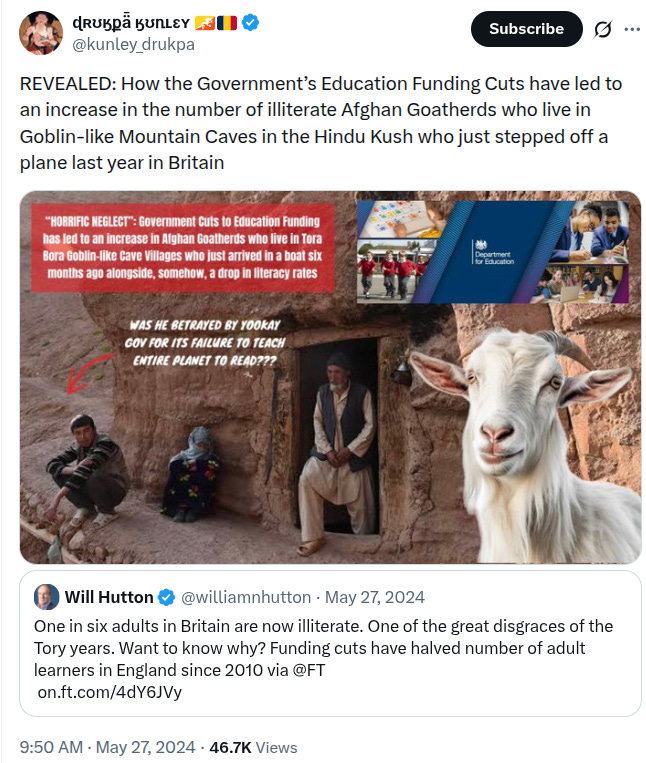
Regarding higher education, one shouldn’t let some sort of ideological loyalty to “academic freedom” prevent government interference where necessary to make sure taxpayer funded universities serve their function. The Trump Administration’s moves to go after the courses teaching “critical race theory” is good policy. I can tell you from my own time in university I have never seen a person who benefited from these “diversity” courses. They radicalize people in both directions, antagonizing those who don’t believe in them while those who do believe in them end up demoralized and less happy and functional as individuals. Further, they specifically teach you to never accept society as it is, and that race and gender conflict are core parts of society, which means to never accept things being Basically Fine but to instead pursue idiotic goals. As far as training you for any future career, they more or less only prepare you to sue a future employer or to become the horrible HR person. If you take anything from these courses it makes you a worse citizen of your country.
Denmark provides an interesting case study in this regard. In 1986 after an independent review by the government, the sociology program at the University of Copenhagen was entirely shut down because it was ideologically captured by neo-Marxism and was concerned with political activism instead of quality scholarship. Now, the rebuilt one is one of the most respected sociology departments on Earth, because the government was willing to “violate academic freedom” so that the department could genuinely be a place of (social) science and rational inquiry. There was an article on substack about this last summer, and the author, Jukka Savolainen, argues as follows,
“When a democratic government establishes and funds a university, it carries a legitimate expectation that the institution will advance impartial scholarship and avoid political grandstanding. Hence, when academic departments become ideological echo chambers – prioritizing activism and suppressing free inquiry – the government has a responsibility to intervene.”
It is actually crazy that anyone would have let tax-payer funded universities mandate these courses upon students when they are actively harmful to society and the state, but that is what ideology does, it causes you to accept completely irrational things.
Trade/Economy
In general trade is good but free trade as an ideology has been a disaster because it only recognizes “Line Go Up” or at best getting the most goods and services at the lowest price. It is not obvious that either of these things are the best for the public welfare, but public policy has been geared towards tempting you to fill your house with Chinese junk as the corporations control ever more of the economy. This doesn’t seem to be making anyone happy or to do anything for the long term stability of the country. It’s notable that whenever there is “deregulation” it is almost always “let financial interests screw you in some new way” and never “leave small businesses alone.”
This entire issue calls for a non-ideological approach that uses the lightest hand possible while recognizing that a nation is more than an economic zone. I am overall a China dove but the morons who rule us have really created an artificial bind by promoting outsourcing on the grounds we would be a “service economy” and making us dependent on China for key goods while also maintaining high levels of tension with China for no good reason. Some of the things the government has allowed, such as letting China become our sole supplier of all sorts of pharmaceutical supplies are just crazy. It’s also the case that, free marketeers be damned, some of our greatest economic progress has come from times where the government was willing to partake in huge projects to develop the economy, such as the Columbia River Dam System, which not only generates massive amounts of power but also irrigates previously unarable farmland connects a large section of the country to ocean trade.
Trump’s tariff policies have been arbitrary, seemingly sparsely thought out, and have caused all sorts of unnecessary tension, but the general premise that we should collect revenue from tariffs and also show concern about certain industries is correct. It is important to let the free market work and try to make competent decisions, but the premise that the free market always works better than any government involvement- particularly in a holistic, health of the country sense and not just a “Line Goes Up” sense- seems to be largely made up. Both domestic manufacturing and diverse trade partners should be promoted, at times with government subsidies, and subsidies that don’t come with asinine policies like preferring minority businesses. It is completely reasonable to recognize certain unique or necessary industries within your country and to protect them.
An example of a good policy in this regard would be to promote component manufacturing in the Central American countries, particularly of things we need for medical or military purpose where in a large scale conflict we would be completely screwed by our reliance on China. The benefits of taking a hand in industrializing Central America are myriad. For one thing, it is divided weak states which will never present major competition to us, they are reachable by the sea from both sides and Mexico by land, and developing their legal economies will reduce emigration pressure and the power of the cartels. No specific economic or geopolitical ideology promotes doing such a thing, it is merely a recognition of real world conditions and positively using state power to do something productive in a way that doesn’t really hurt anyone.
A while ago there was this study below that showed 80% of Americans think it would be good for more Americans to work in manufacturing, but only about 25% would themselves be better off if they worked in a factory.
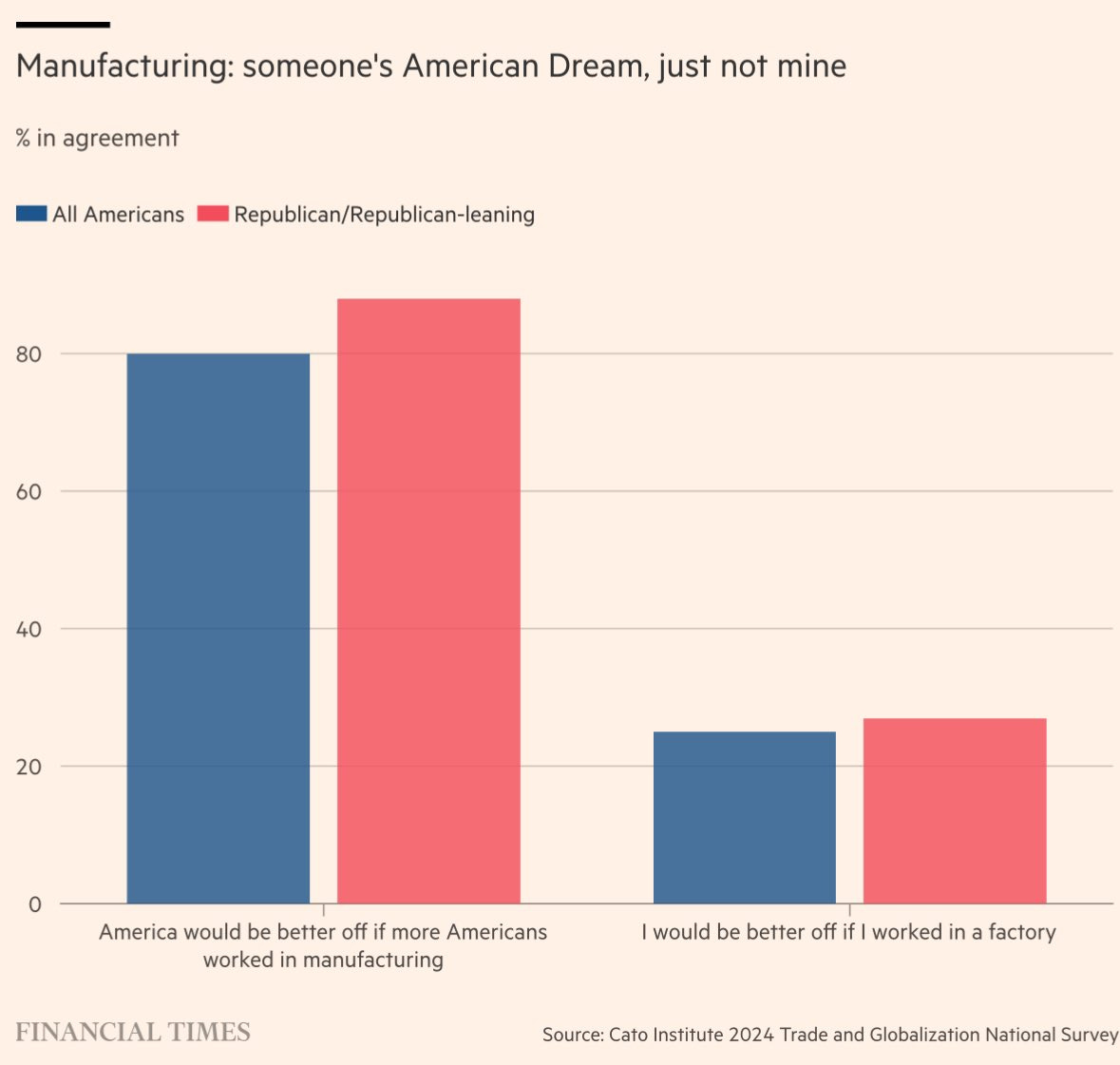
This was treated as some sort of own by ideological free traders who thought it showed that people like the idea of factory work but would not do it themselves. What this actually shows is that there is a policy that would benefit 25% of Americans and has 80% support. Only ideology would stop someone from pursuing such a policy sensibly and with what reasonable powers the state has to get that outcome. Nevertheless, ideology is such a blinder that people read something entirely different and just mocked the supposed hypocrisy of people who would not themselves want to work in a factory. It is particularly funny because given population age in this country, a substantial amount of that gap is simply the retired who don’t want any job.
I don’t doubt that prioritizing manufacturing is not the best way to continue the concentrate of wealth to financial interests, but it seems like it could do a lot for having a happy, stable, non-alienated population who form something of a coherent country. Economists can only tell a statesman how, in their view, to make an economy grow or perhaps what impacts certain policies may have. It is not their job to consider how the public prefers to live or what will improve them as citizens.
The Basically Fine States
A collection of states across the world, which all have unique attributes, can be fairly called Basically Fine. Most of them are small, middle income states with little relevance to global affairs. All have in recent years maintained political stability, avoided ideology, and minded their own business where possible to do so. It is noteworthy that most of these states are more or less aligned with the US, and one could argue this demonstrates that Basically Fineism requires a “security blanket” of a stronger and more ambitious state. However, I would argue instead that the United States is the country in the world the most likely to make you miserable if you don’t go along with them, so this is in most cases clearly a pragmatic recognition of real world conditions. These are not all the states in the world which could be called “Basically Fine” but most of the significant ones.
Some nations have Basically Fine characteristics but for various reasons are excluded, such as being petrostates, excessive ambition, or pro-actively playing a unique role in world affairs. Some countries which are on the edge of inclusion are Norway, Switzerland, and Oman. The last I particularly regret not writing about as Oman is a pleasant and modest country in a sea of extreme ambition (or dysfunction, in the case of Yemen), but it is more of a Gulf PetroMonarchy with Basically Fineist Characteristics than the opposite. Sweden is a formerly Basically Fineist state which fell to Ideology-Maxxing and Really Obviously Bad Ideas, but is similar enough to Denmark before doing those things to not merit a section its historical status, whereas with Canada I wanted a chance to write about how this relates to the English system of government.
In some instances Kunley has named these and written about them extensively. I will link to his writing where possible at the start of each section.
Denmark: Basically Fineism with Autistic Nordic Excellence Characteristics
Denmark is the archetypal Basically Fineist state and has been known for its rational and pragmatic governance for a century. Even getting occupied by the Nazis, when there was nothing they really could have done, Denmark was somehow spared the reputation as either a victim or an aggressor in the Second World War, which speaks volumes about the pragmatic and rational nature of the state and its people. The journalist John Gunther, who did have broad social democrat tendencies, was an enormous fan of Denmark’s government in the earlier part of the 20th century, when the rest of Europe was Ideology-Maxxing more than at any other point in history. To hear Danes talk about their country it can at times be somewhat depressing to Americans, who tend to see life as “make or break” (itself something of a privileged delusion promoted by those with a private generational wealth safety net) but by all accounts things in the country go well and this small nation of around 6 million is consistently competently governed with a view towards doing what works for the public. Besides Trump’s Greenland obsession, which they are not any more to be blamed for than “she shouldn’t have been wearing that,” and the aforementioned Nazi-occupation, for which the tide of history was irresistible, I could not name a single crisis or major scandal that Denmark has ever had in the modern era.
Denmark has at this point been mentioned throughout this treatise, as exemplary in its pursuit of Basically Fineism, but I want to give some more details about how Denmark has handled the migration crisis challenging all of Europe. Firstly, Denmark got itself some carve-outs from EU asylum policies in the first place, so has more sovereignty over these matters than other states in Europe. Unlike Sweden’s “humanitarian superpower” Really Obviously Bad Idea, Denmark just dealt with a persistent small flow of immigration as it came. The country is around 12% foreign born, however around half of those are workers from nearby EU states who will likely work in the country for a number of years and then return home, not third worlders they are never getting rid of.
Last year there was an interview between a BBC journalist and a Danish politician which presented a fascinating disconnect. The BBC journalist is asking why the country publishes crime statistics by national origin and the Danish politician replies, in short, that it is accurate information and the public has a right to know it when making decisions about how to run the country. He mentions that when the public senses something, IE that non-European immigrants are committing crimes at much higher rates, and the government denies it, this antagonizes the public. The BBC mind cannot comprehend this. The original video was taken down, so this is people discussing it, though they are quiet through the relevant part. I have this timestamped, but if it doesn’t work it’s around 16:50.
The video also discusses Denmark’s ghetto law, now known as the “Parallel Societies Law.” The crux of this is that majority non-Western neighborhoods or buildings are not allowed. This may be implemented through social housing policies, IE spreading them across the country instead of jamming them all into majority migrant Council Estates like in Britain, or in extreme cases buildings may be demolished. In the conversation between the politician and the British journalist, he says, “It seems like you’re targeting Muslims,” to which the politician more or less says “yes” and then explains that certain things like gender equality are key parts of Danish society and culture. There seems to be genuine concern about not antagonizing the public and maintaining the friendly and equitable spirit of the Danes, and one can sense that the government doesn’t hate the public. Have you ever heard of such a thing?
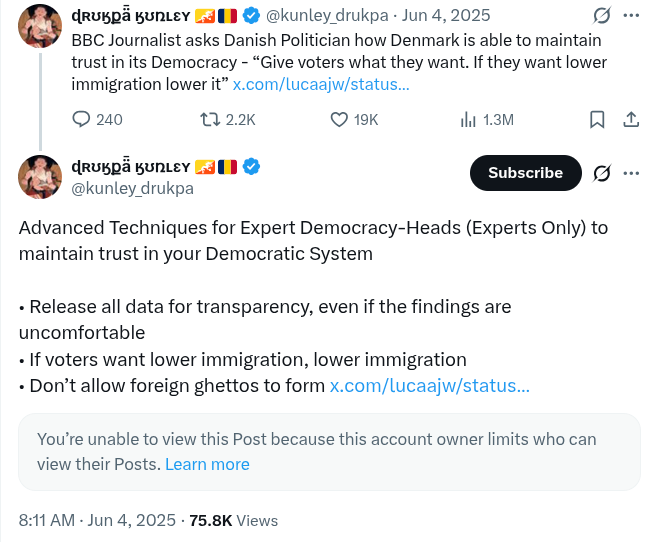
Also to be clear, the Danish crime statistics are wild. In many countries they do absolutely gas light you even if they have to say things as stupid as “well most crimes in this 90% white country are committed by white people!”
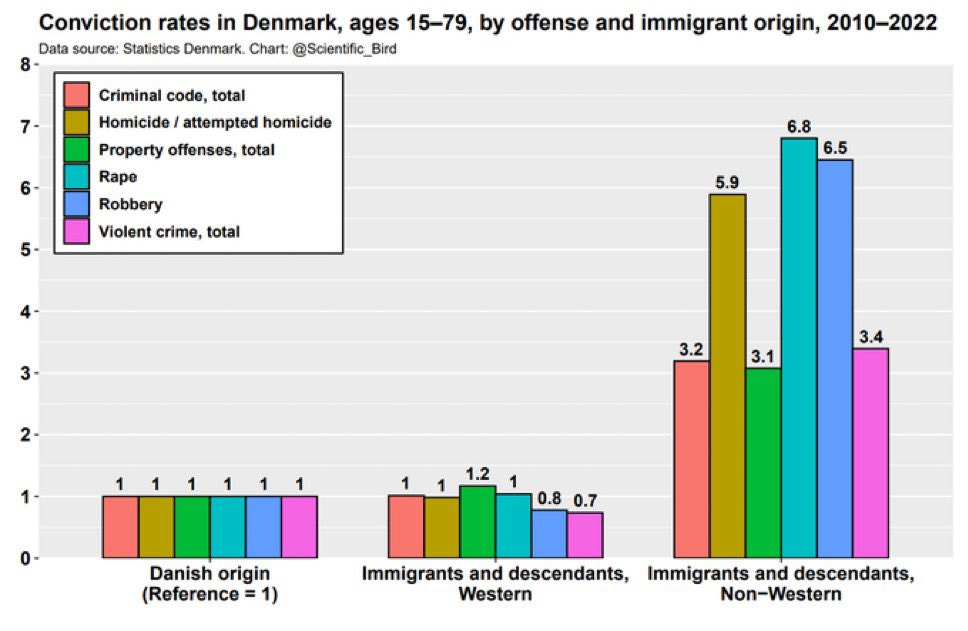
Denmark’s PM Mette Fredrikson is one of the main innovators of Pantsuit Deportations and Denmark continues to value social cohesion and the happiness of its public over ideology or stupid EU “human rights” laws, which as it turns out force you to keep people who are 6.8x more likely to rape someone in your country. I suppose it should be added here that since Denmark is a functional country and abolished its neo-Marxist sociology departments as said above, it is unlikely anyone is successfully selling the narrative that this reflects Muslims being treated unfairly.
Even just watching Danish vs Swedish shows one notices the different racial makeup in the countries as well as the fact that parts of Sweden are heavily ghettoized. Netflix did recently release a Danish show where some sort of Muslim is a cocaine trafficker, but there isn’t a religious extremism aspect and he lives in a middle class neighborhood and is mostly around white people. Kunley notes that Denmark passes what he called “the McDonald’s test,” where the workers at McDonald’s and delivery drivers are not migrants, and in fact are often attractive young women a man might try to wife up. Of course, much of America does not pass that (though where I live does.) For all of this, it was just announced they are further stepping up deportations, “challenging the European human rights” framework and moving forward without waiting for court approval, like some sort of rogue state! How do they do it?
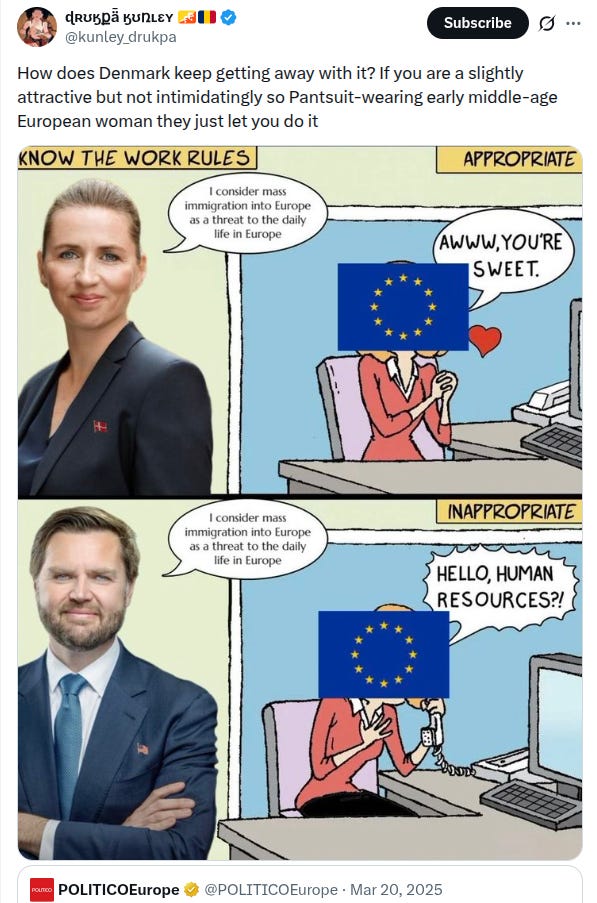
Canada (Historic): Basically Fineism with Apologetic Extractivist Characteristics
For most of its history Canada was the most significant and longest lasting Basically Fineist country in the world. While the British model of government is optimal for Basically Fineism, especially if your country is populated by 130+ IQ Anglos, Britain itself was too ambitious to really be called Basically Fineist and its involvement in everything left it lurching from one crisis to the next throughout history, whereas Canada calmly contributed some troops to whatever Britain had going on. Of course, unlike us, Canada patiently endured its status as a colony until it was peacefully freed and that did turn out Basically Fine. But, by all accounts Canada has now reached a point where things are Not Fine At All.
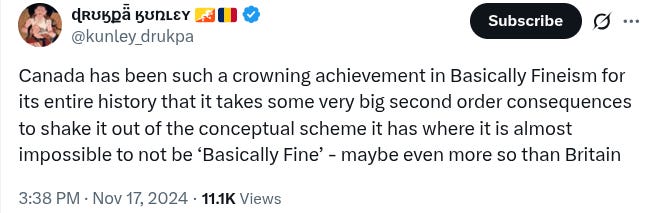
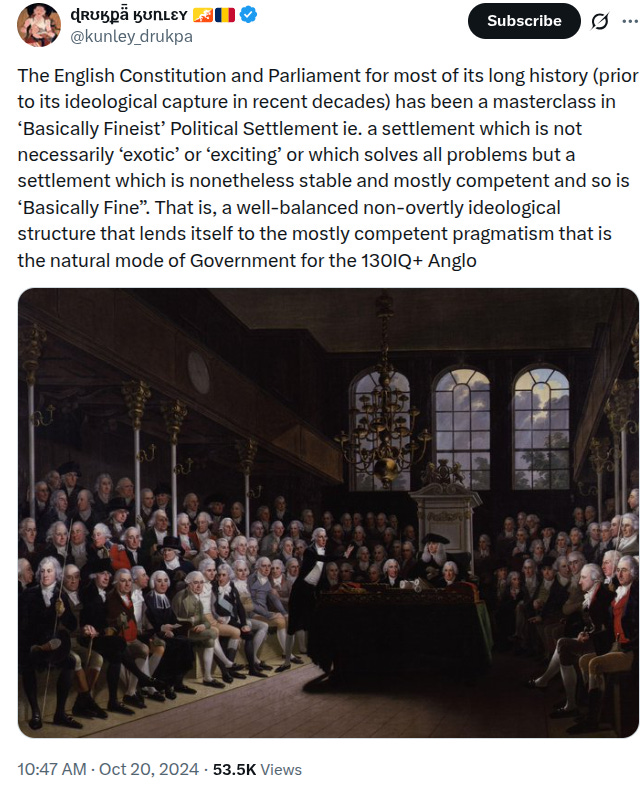
Canada’s often mocked national habit of apologizing for everything demonstrates the country’s proneness to Basically Fineism as this reflects a inherent desire towards conciliation that is a key part of the Canadian character. They have always been much less ambitious than the Yanks to their south. At the same time, Canada is in fact a brutal extractivist power that is a leading exploiter of the third world, a reality to which they would respond, “I’m sorry, I swear I’m your buddy, guy.” It is this disarming affability combined with expertise and willingness to go after natural resources which has made this sparsely populated semi-Arctic wasteland one of the most prosperous and stable countries on Earth, at least until perhaps 10 years ago.
While Canada always had some domestic problems, particularly regarding the Francophone population’s tendency towards separatism, most battles between Quebec and Ottawa strengthened the provinces- all of them getting the rights Quebec was demanding- instead of centralizing the state or causing dangerous dissension. It provides an interesting example of Machiavelli’s thesis that certain degree of conflict within a state can be the thing which strengthens it and leads to innovations in good governance.
I don’t have a coherent “theory of mind” for what happened to the white Anglosphere of the Great Britain, Ireland, Canada, Australia, New Zealand, and to a lesser extent, the United States. At some point these countries lost faith in themselves and their history while simultaneously having the reckless audacity that they could absorb endless Men from Everywhere into the systems that they themselves no longer believe in. It is some sort of bizarre national humiliation ritual. No where is this more clear than “Land Acknowledgements,” which in the US was primarily a weird university and left wing conference thing, but which in Australia they say every time you fly in. The King himself gave a land acknowledgement in Canada, which clearly no one could have forced him to do and anyway it would be better than Canada should be a republic than that he say such a thing. Also, while Australia really didn’t make treaties with the Aborigines, in most of the Americas tribes did actually cede land, whether or not you feel those treaties were fair. One way or another, these countries have allowed endless immigration while they hate their own people and history. Canada went from being Basically Fine to suffering from almost every challenge to Basically Fineist government listed above. Just look at the fake “residential school” scandal started by some fake (feather) Indian that tore their country apart and turned out to be truly entirely made up, though which lead to many church arsons:
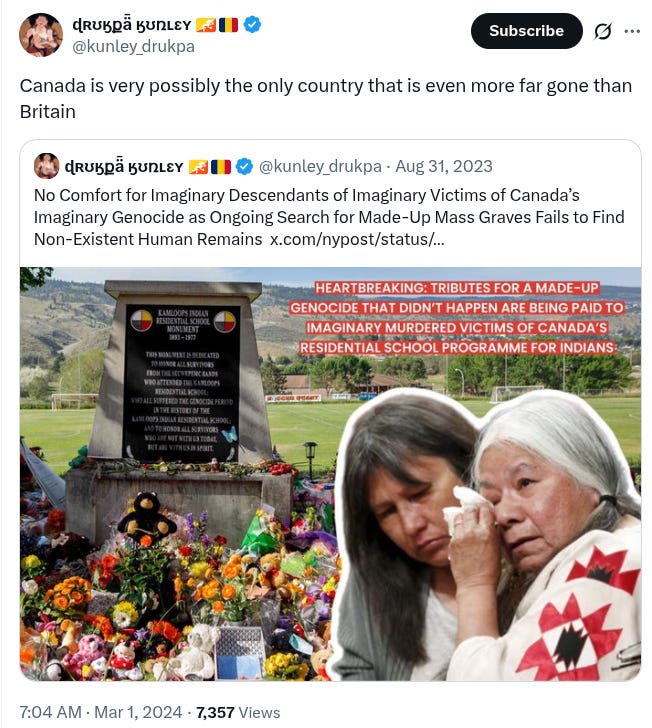
More than anything, mass immigration has Latinamericafied the nation, though in such a way that Race Communism with Hysterical Screaming Millennial Characteristics has at least for now remained dominant. Much of this was “second world” immigration, which is where we got the episode of their joke Parliament clapping for a former SS member and one of their top politicians, Chrystia Freeland, being an unreconstructed Nazi. What they have now though are endless (dot) Indians. The moron Trudeau let them work on student visas then issued infinity visas so all the jobs were taken up by Indians nominally going to school while working full time at the gas station or delivering food. A whopping 23% of Canada’s population was foreign born in 2021 and that is estimated to have gone up to 30% just by 2024. Many of those are “non-permanent residents” but do you think that if many Americans don’t have the stomach for mass deportations that the Canadians of all people will? Look at this:
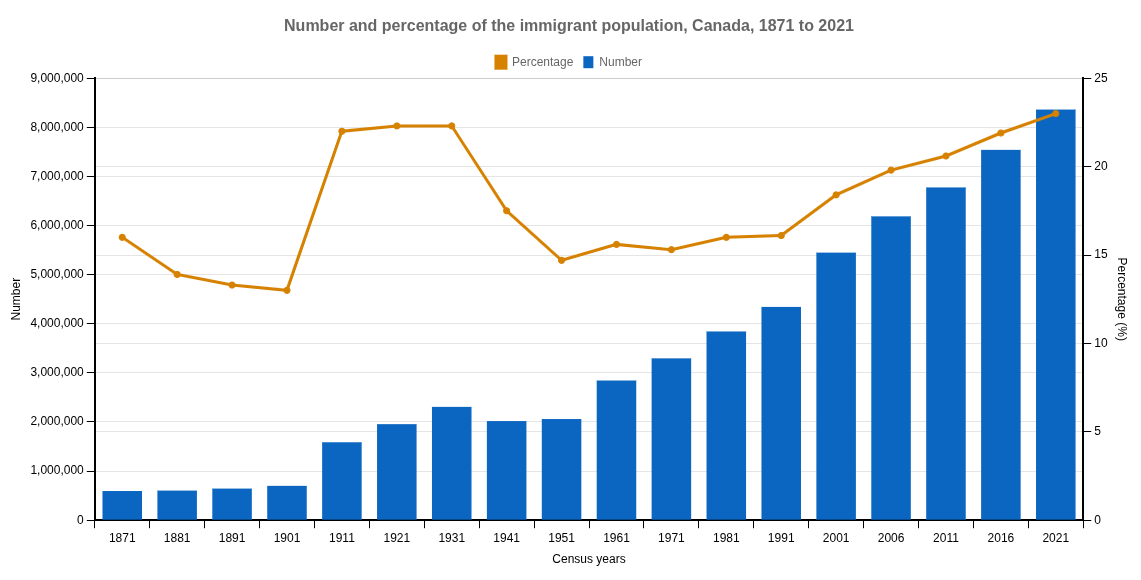
Bear in mind that the last time the percentage was this high, in 1911-1931, immigrants were primarily pioneers busting out new land, and that’s also the era when immigration began to be restricted in the new world because it was too much. Just by 2024 the number would have gone off this chart. No one wants this many immigrants in their society and you can’t have a stable democracy with a strong national character living like that. The only system under which such a thing works is one where there is virtually no path to citizenship and preferably little or no democracy, such as the Gulf Monarchies. They say immigration is being reduced now, but Canada’s national character will prevent them from fixing this extremely difficult problem that Trudeau has gotten them into for no reason whatsoever. The South Asians are going to eat them alive.
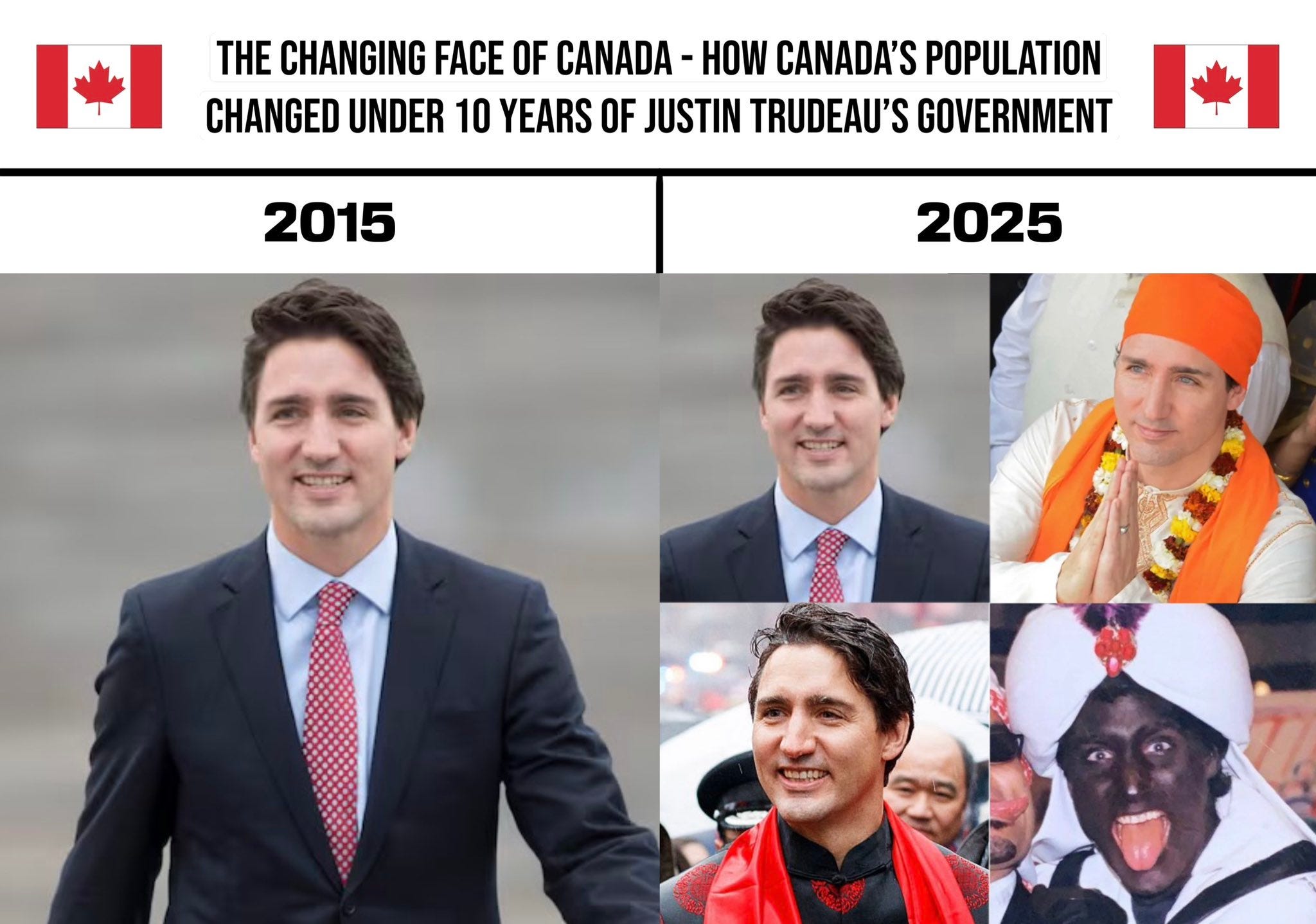
On top of everything else, I would be remiss if I didn’t mention that while housing is far too expensive, wages are suppressed, there is a shortage of access to healthcare, and their generous social safety net is strained the government’s advice if you can’t make it in that society is “kill yourself.” Carney seems to be relatively less of an idiot, but Canada’s political culture is now one where all is subsumed by trying to make space for endless squabbling and grasping immigrants.
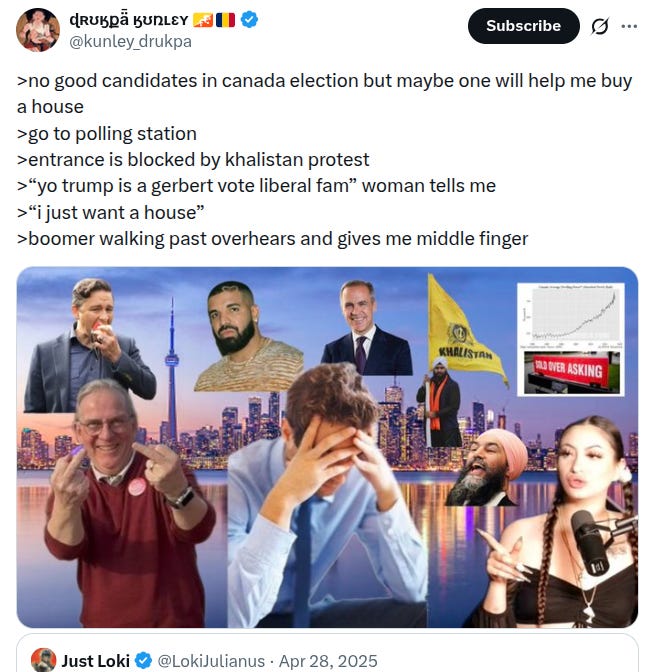
Costa Rica: Basically Fineism with Nothing Ever Happens Here Central American Characteristics
Costa Rica famously abolished its military in 1948 and everything has been Basically Fine since. Before that it was also Basically Fine and in fact the military was just the national marching band but no combat troops, a responsibility now taken over by various civil society groups. It is perhaps the best instance of the security of harmlessness on Earth. Throughout the last 75 years there has been endless strife and suffering in Central America and yet this stable little democracy just chugs along with no real problem.
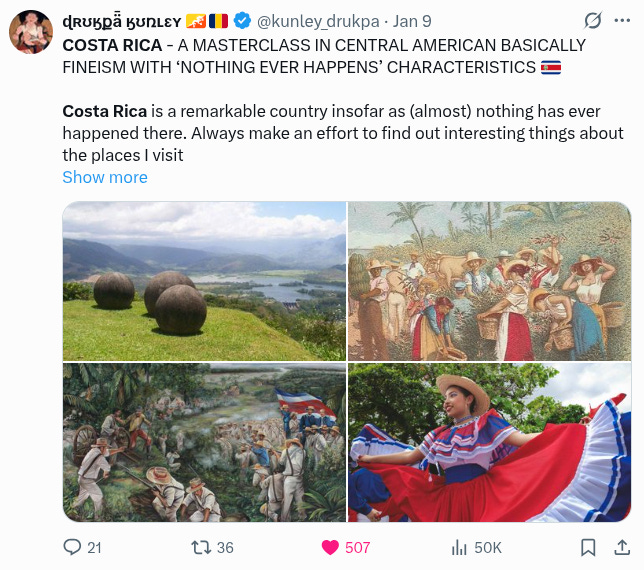
It could be said that Costa Rica relies on the US keeping order for safety, and to some extent that is true, but also no one has any reason to want to harm it, and it has little others would covet. The thing is that is also true of all of the other Central American states, outside of Panama, and they have all had persistent conflict and political chaos. I need to emphasize again that in history while sometimes an aggressive state just attacks, more often war and conquest start from a long series of diplomatic failures and recriminations and low-level border conflicts. If you just don’t do that, you are more likely to be fine, and commonly such countries couldn’t properly defend themselves regardless, though on the other hand Yugoslavia (the most Basically Fineist of the Eastern Bloc states) did more or less defeat the Nazis in their country with limited assistance when it was considered to be suicidal to resist them. Regardless, for the most part if you have chosen the security strategy of being harmless and someone does covet your country for whatever reason and they decide to attack commonly they would just walk through without hurting you and start guarding your far border and at most demand free trade. As it has played out, Costa Rica doesn’t have a military and it has not caused any problems and allowed them to devote more money to social services and things which actually improve the quality of life of the public.
For all of that, Costa Rica is much less of a vassal of the United States than one would think. They only have a fairly normal security agreement about narcotics and the like and Costa Rica votes how it wants at the UN, including many times against the Cuba Embargo and for recognizing Palestinian Statehood, which are situations where the US is generally only supported by a few very close countries such as Israel itself and some tiny little Pacific Island nations. There is obviously a massive imbalance in power but its a nice little country that isn’t that important and never causes the US meaningful grief, so there is no reason to not leave it alone.
I am reminded of the Romans, who often favored this situation with states, where if they did not practice war they could have their own complete self-government. It could perhaps be something like our Marseilles, which was a “free city” for hundreds of years under Rome, though it is not always clear what that means. When Marseilles comes up in histories its usually because exiles were allowed to go there, either as a punishment or fleeing prosecution and then the Romans would not extradite them. It was something a fiction because obviously the Romans could take them if they wanted to, but it was a sort of pressure relief valve for the country. We should consider using Costa Rica in this same way, as a point of exile for powerful men we don’t quite want to prosecute but also need to be rid of. The public would dislike the idea of being punished with a “tropical vacation” but that’s because they would be thinking of themselves, not of the sort of ambitious high functioning man that exile is used for.
Also, while we are here, Kunley shared one of the funniest stories I have ever heard about going out into the rain forest with a Costa Rican guide and two German tourists, which I think is illustrative of how the Costa Ricans live.
Panama: Basically Fineism with Giant Tax Haven Characteristics
Panama indisputably owes its existence to a greater power, having been carved out of Colombia for the purpose of making the Canal. A middle section of the country was long owned by the United States, and both that section and the Canal were ultimately returned. Panama is absolutely a US vassal and when the US didn’t like its President Manuel Noriega he was quickly captured and brought to America to stand charges in a brief, brutal invasion (at this point I just assume such charges are made up, but have never looked deeply into this specific matter.) The country primarily makes its living off of ecotourism, as a tax haven, and off of the Canal, which of course is one of the most valuable shipping lanes in the world. There is complete clarity that the United States would overthrow any government in Panama that threatens its access to the Canal. A lot of what are called “Zonians,” Americans who lived in the Canal Zone before it was returned, are dual citizens.
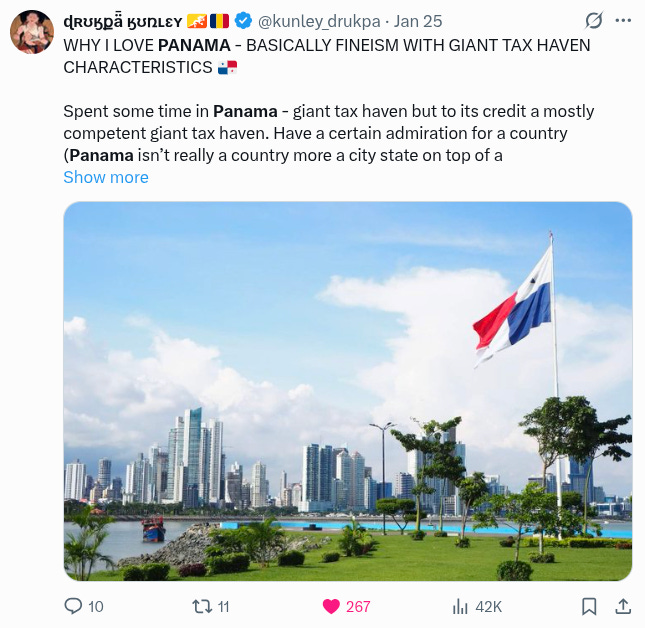
They say much of the real estate in Panama is just sitting empty, built by people who wanted to get their money into the country and are hoping the population grows, but of course for the man on the street building a luxury tower no one will live in is all the same.
In 2023 Panama had an enormous political dispute over a very large Canadian copper mine, which they felt was a bad deal. There was a general strike, you know an actual one not Americans pretending, and the entire country was shut down. Part of the issue was that they didn’t feel that they were getting enough money. However, the bigger issue was that the mine was basically eating their rain forest and the public didn’t want to be a mining country. Panama is a fairly well developed middle income country, at least in Panama City, and it doesn’t seem the public was greedy enough to want the money at the cost to the value the environment provides their economy. It also used water necessary for the Canal, which was of concern to everyone (the lock system uses a lot of water, though it is not clear to me how much of it is consumed, as opposed to endlessly poured back and forth.) The mine is currently shut down while they decide what to do, essentially breaking the contract with the Canadian firm. What as interesting about this at the time, is many people were saying “No one will ever do business in Panama again!” Well, maybe not mining business which they’ve decided they don’t want, but the Canal and tax evasion and ecotourism will stay fine, and they seem happy to make a living off of those things.
It was notable when those protests were going on, which led to a Zonian shooting two teachers who were blocking a street, Americans couldn’t conceptualize it outside of a lens of ideological partisan politics. When the people were called “environmental protesters” it was imagined they were like the people who throw paint on paintings to stop oil, or 8 people shutting down a random highway, not a nationwide strike over a very concrete matter, and environmentalism in the sense of preserving beautiful local ecology and not letting a foreign firm pillage it, not in a vague “climate change” sense. The people killed were government employees whose union was on strike, not random Antifa malcontents. This was all lost on Americans, though to be fair the conservatives would have hated the public school teachers on strike regardless.
Of course, a tropical climate and beautiful nature as are seen in both Panama and Costa Rica are great attributes for living in a relaxed Basically Fineist country.
Uruguay: Basically Fineism with Latino Denmark Characteristics
If you think nothing has ever happened in Costa Rica, Uruguay is a country which has barely entered the historical record since the War of the Triple Alliance in the mid-19th century, and even then it was the most minor player of the four belligerents. A nation of 3.5 million people, Uruguay is the wealthiest independent country of any size in Latin America besides Guyana6, which struck oil and has experienced rapid GDP growth in the last 10 years. The sources of Uruguay’s wealth are not apparent, it has simply been peaceful for a long time and is urbanized. They have no special exports or industries. Historically, their primary challenge has been that the neighboring and much larger Argentina is a perpetual basket-case and an Argentine economic crisis damages Uruguay, but now their biggest trade partner is China. Uruguay technically avoided recession during the global financial crisis.
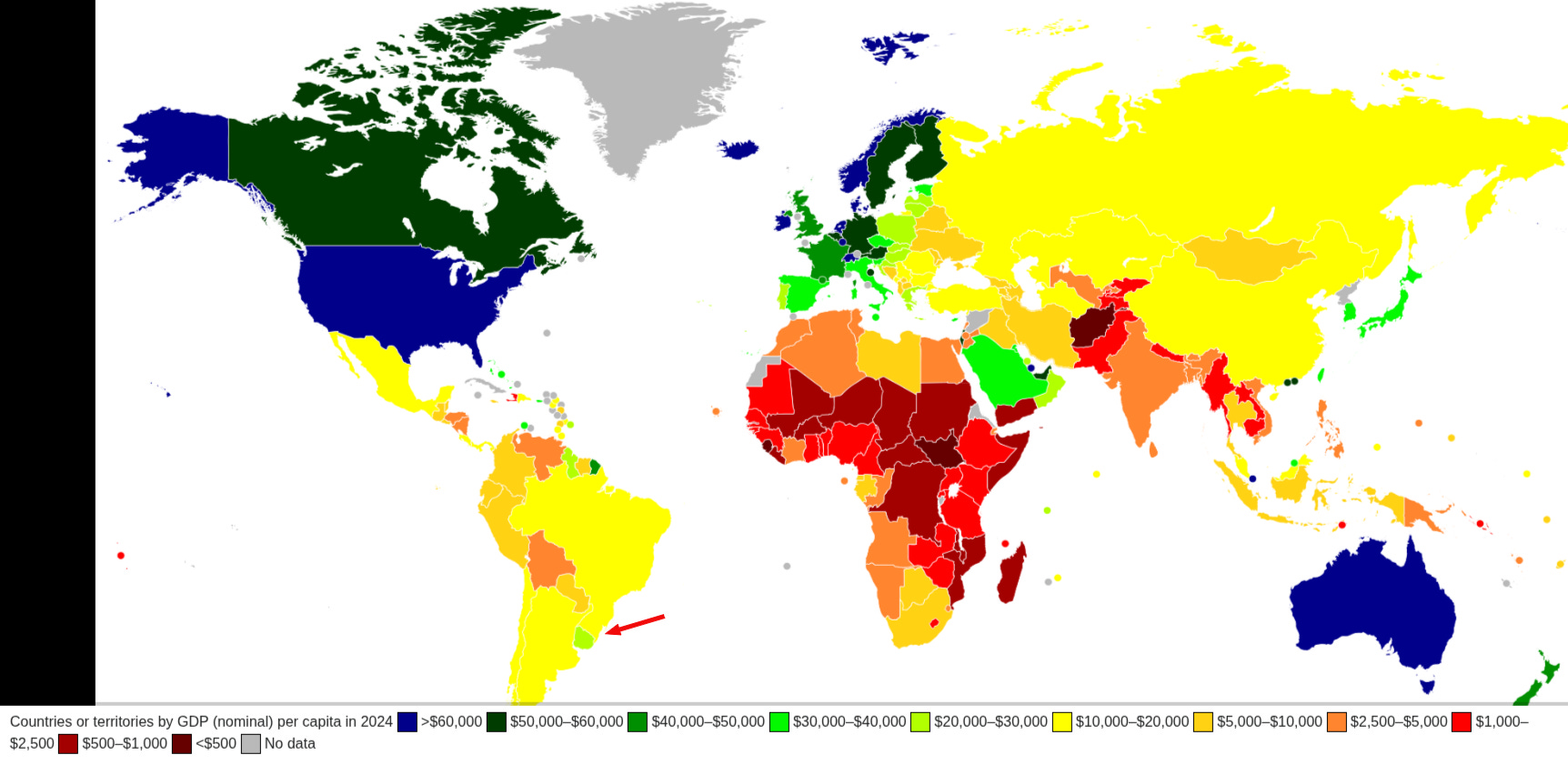
When John Gunther wrote Inside Latin America in 1941 he described Uruguay as “The Denmark of Latin America” (and then is fast to note that he means pre-Hitler Denmark.) He describes it as follows,
“A compact and homogeneous small state living on agriculture, highly progressive, orderly, and honest; a country that believes deeply in democratic institutions and honors them in practice as well as theory; a republic with as advanced social legislation as any in the world.” [335]
The state had much control over the economy including monopolies in several sectors. There was a great amount of social legislation, including a minimum wage extending to rural workers, a robust pension system, universal healthcare for the poor, and paid vacation. At the time, the trade unions were weak due to a lack of need for trade unions, and there was no unemployment. For around 30 years there was no military to speak of- not formally abolished, just entirely unfunded, but they did rebuild a modest military starting in 1940 due to fear of Germans. Currently, besides shore patrol functions, their military primarily participates in UN Peacekeeping missions, one of the 5 or so small countries that contributes a lot to these missions because they want to help out and don’t have beef with anyone and thus their presence is never provocative.
Over the last 50 years, Uruguay has seen some economic liberalization in keeping with more modern global economic and trade standards, but the state remains heavily involved in the economy and there are robust social programs. It is interesting that Uruguay did ultimately succeed at making “Line Go Up” more than other states in Latin America, many which would seem to have more natural advantages and had periods of extreme free markets. I attribute Uruguay’s advantage to what Machiavelli would call “equality,” which means to him both limited income disparity but also equality before the law. More than anything what has helped them has been stability and cooperation, instead of sudden and disruptive alternations between far left and far right, which leads to a situation where programs and regulations are rapidly implemented and just as rapidly removed. Uruguay has not gotten rich, what it has gotten is a comfortable middle class economic status for the general public, which is as Basically Fine as it gets.
Jordan: Basically Fineism with Anglo-Arab Characteristics
Jordan is known as the most modest and stable country in the Middle East. King Abdullah is half-British on his mother’s side. It is notable that as many bad things as people say about colonialism, it is a reliable feature of post-colonial countries that the ones with the best relationship to their former overlords will be in the relatively best economic and political position. This is unpopular among the anti-Imperialists, but is nevertheless accurate. Abdullah is particularly unpopular among some for his tolerance of Israel, but it is accepting reality which is the competent and pragmatic decision in these situations, and the country is already home to a whole lot of Palestinians.
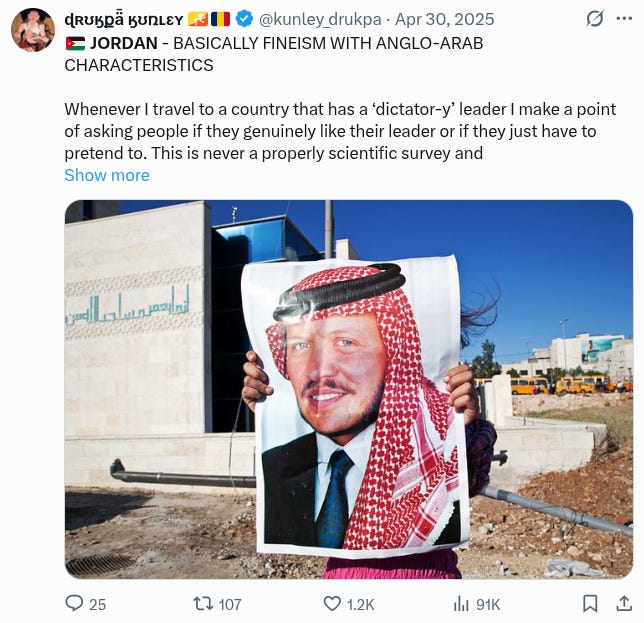
Kunley notes from his time in Jordan an important principle about government,
“In Jordan whenever I asked people if they liked Abdullah II he would receive similar near universal praise. Here is a little trick in governance - if you are an actually mostly competent leader who doesn’t dislike your own populace you can get away with being a little ‘dictator-y’, if people like you enough they just let you do it.”
This is significant as all public opinion surveys show that several leaders we are told to detest as dictators are genuinely popular whereas many “democratic” leaders hang out around 20%, which makes one wonder if “fair” electoral democracy is actually serving the people’s will as well as what one might call “enlightened despotism.” Also, Arabs, in general, demand Boss Government and are not the type to appreciate pantsuit ladies telling them what to do.
Jordan, which has no special natural resources, is remarkable for its ethno-religious stability in a region known for exactly the opposite. In some ways the regime does act like a satrap of the Anglo-Americans, but the quality of life is better for the public than in most of the surrounding states besides the Gulf Monarchies. Jordan would perhaps be one of the less nice countries to live in of any on this list, but not being a “basketcaseistan” is a big accomplishment in this particular region.
Rwanda: Basically Fineism with Esoteric Kagameist Characteristics
How does one even begin to describe the Rwanda miracle? Besides possibly Nayib Bukele, Rwandan President Paul Kagame is the modern world’s sole Philosopher King. In many ways one shouldn’t call Kagame a “Basically Fineist” in that he is an ambitious man of remarkable success, but he started from such a bad point that getting Rwanda to the point of being the nicest country in sub-Saharan Africa (possibly tied with Botswana) is a truly incredible achievement. He took over the country in a worse state than Burundi, which has the same history, resources, and ethnic makeup, and has made it quite nice, while Burundi remains one of the world’s most impoverished countries.
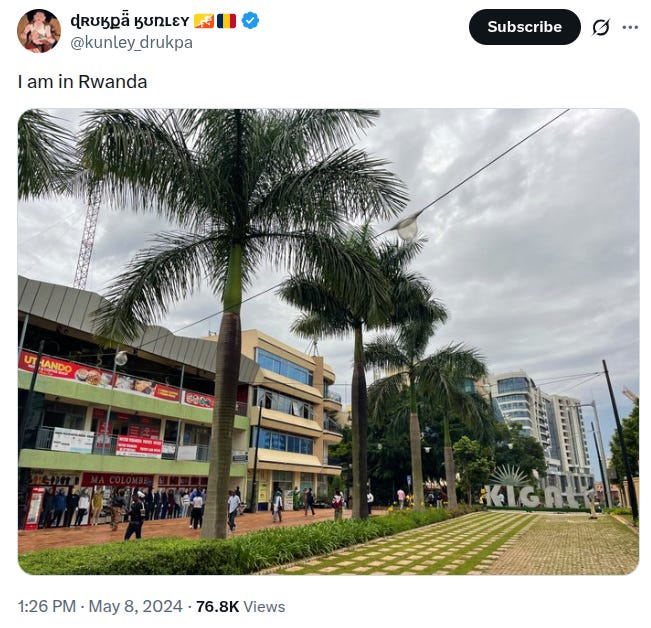
The story of the Rwandan Genocide is not well understood in America besides that a lot of people died. Firstly, despite what you may have been told, the Hutus and Tutsis were separate groups in this Virunga Mountains region well before the Europeans arrived. More or less, the Tutsis are cattle herding nobles who arrived later, while the Hutus were agricultural serfs under them. Whether these constituted “races” is irrelevant, because they were understood as different population groups within society. The Europeans did sort them in arbitrary ways, I believe at one time by height (Tutsis are extremely tall, Paul Kagame is 6’2 and appears to be the shortest person in his family, including the women) and at another time by wealth. Regardless, it had been a kingdom with Tutsi nobility, but after independence the Hutus were in power, as they still are in Burundi. Of course as is done in such circumstances, the group with political power spent a lot of time blaming the group with economic power for all of their problems, as Tutsis are a fairly small minority, perhaps 15% of the population pre-genocide. Once the genocide started, Kagame and the Rwanda Patriotic Front, a rebel group based in Uganda, invaded the country and chased out the genocidaires, and the country has been under Tutsi rule since, with insanely positive results:
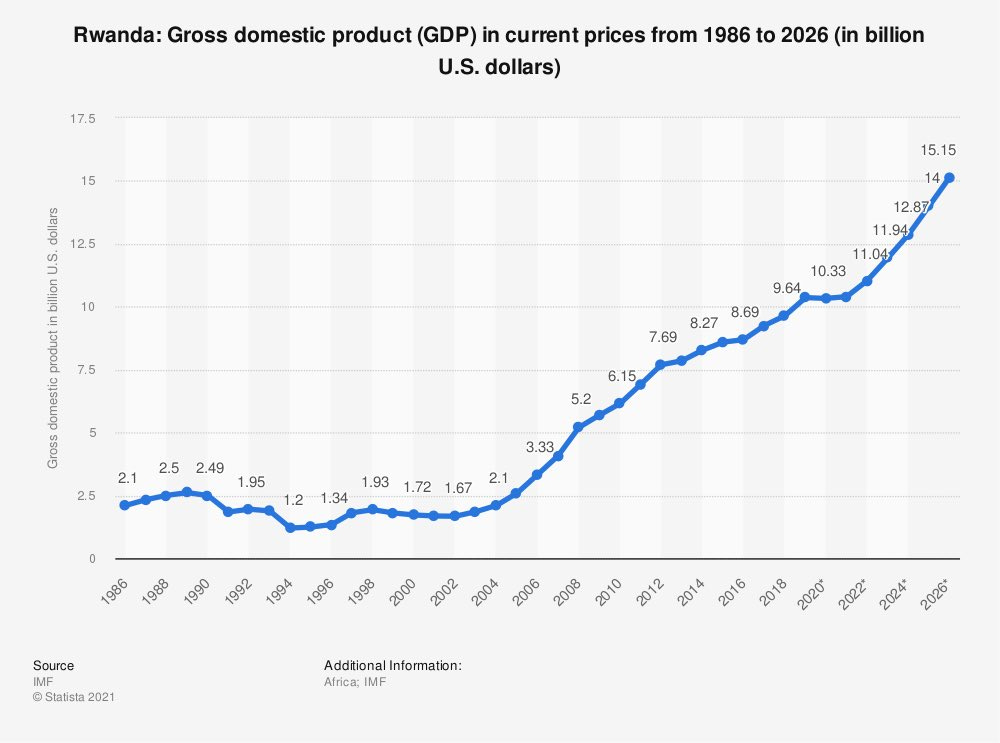
Though Rwanda has been ruled by a Tutsi since the genocide, Kagame’s policy has been to downplay ethnicity in favor of a single Rwandan identity. It seems to be the case that since everything is going remarkably well there is little resentment among the Hutus and even many in Burundi are jealous of their neighbor’s President. Humans are not, by nature, that ideological, it is educated into them either in universities or merely in the form of hatred and racial supremacy through demagogues, but most people don’t care how things are ran as long as the country is functional and they can feed and house their children decently. I don’t even know if Kagame has an ideology besides somehow winning all the time.
As well as having becoming relatively prosperous, Rwanda is remarkably clean. It’s true that Kagame is somewhat authoritarian, but so are most leaders in Africa and they don’t keep the streets clean nor make the proverbial trains run on time. Not that many cities in Africa are well mapped on Google Street View, but the ones that are generally have piles of garbage everywhere and endless half constructed or torn down buildings. If you drop a pin anywhere in Kigali outside of the city center what you will most likely see are well-kept single family homes in meticulously clean neighborhoods. It is rare to see a single piece of litter. One could argue all day about what we should value the most, but for normal people cleanliness, low crime, and functional infrastructure are enormous factors in if things are Basically Fine or a Total Mess. The method by which they do this is called Umuganda, meaning “Coming together for common purpose.”7 How this works in practice is that there is mandatory community service for everyone in the country for 3 hours on the last Saturday of the month, including the President himself.
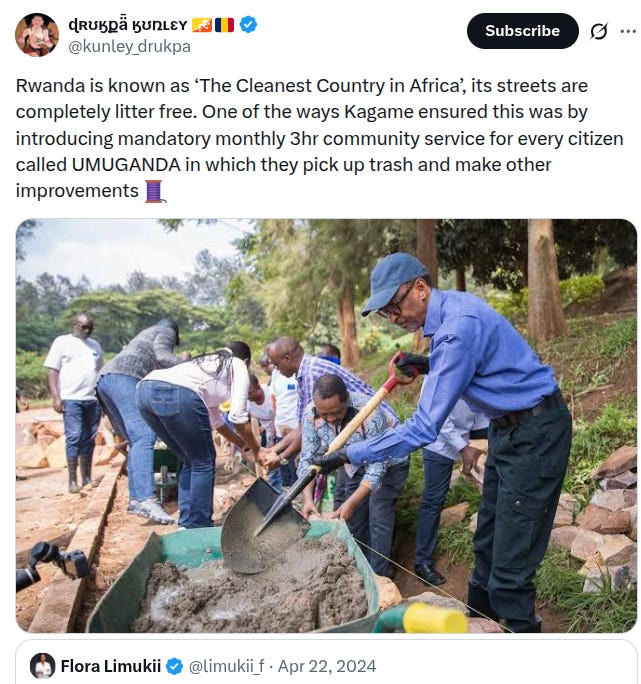
A lot of rulers have tried this sort of thing, and it commonly breeds resentment and the countries still look bleak. It is hard to say by what magic this has worked so well, since this was a resented form of forced labor earlier in Rwanda’s history, and then these meetings were later used to mobilize Hutus for genocide. I couldn’t describe the clear truth better than Kunley himself did in a response, “It’s obviously easy to make something like this coercive and pointless if you design it in the wrong way, whether through incompetence or malice.” The upshot of all of this is that Kigali is one of the only cities in sub-Saharan Africa where an international businessman could live with his family in a normal part of the city- not an isolated gated community or upper class high rise- and feel good about it. And people have taken notice, with Kigali now being a top African city for international business. I should add briefly that the climate in the East African Highlands is among the best in the world- the average daily high temperature in Kigali is within 3 degrees of 80 all 12 months of they year and it has never gotten above 96 or below 48 degrees.
On top of all of this, Kagame somehow always wins at foreign policy to an incredible extent, both with these crazy deals to pay him to send migrants there as well as in his relations with neighboring DRC, which is almost 100x bigger.
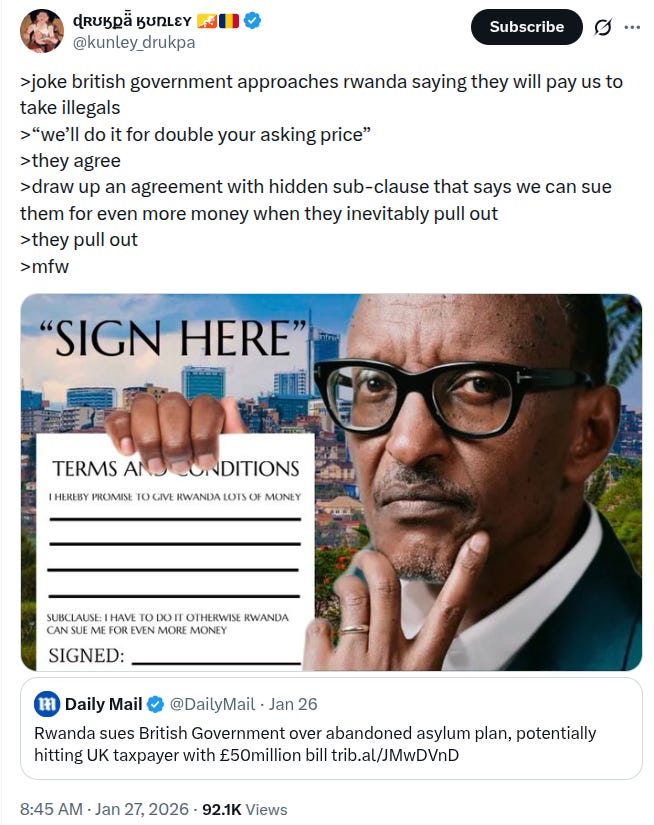
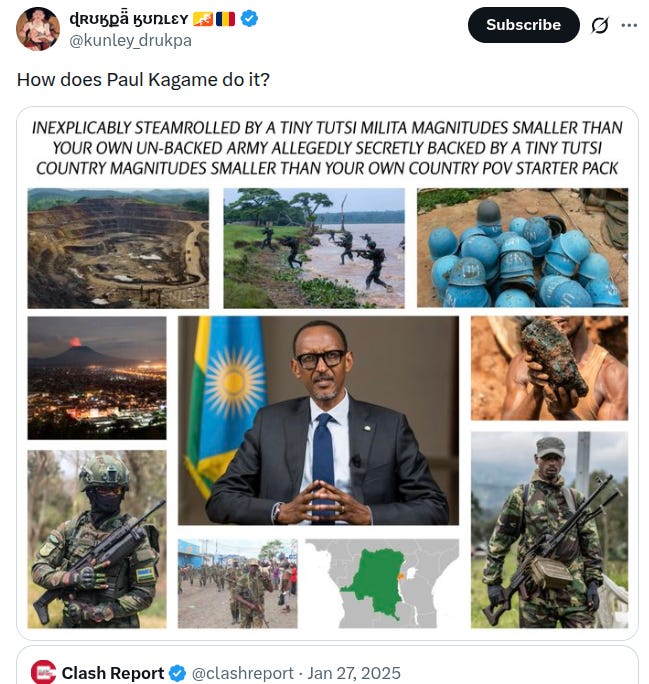
I wish I could tell you how he does it. What I can tell you is that leadership matters and besides blaming bad leadership, almost every cause people attribute to Africa’s dysfunction must be untrue. I would expect the 68 year old Kagame to stay in power for the rest of his life, but we shall see if he has managed to fix Rwandan society or if this is merely the impact of one good leader, like Epaminondas in Thebes.
Singapore: Basically Fineism with Chinese Mostly Competent Pragmatism Characteristics
Singapore is a nice enough country, well, city-state, that it may seem like it shouldn’t be included as “Basically Fine.” However, unlike small Gulf States, it is not excessively ambitious and doesn’t have its hands in everything. Further, Basically Fineism is holistic, and we have to consider that there are some sacrifices to personal liberty in Singapore, so while the economic conditions are great, many may find it a less pleasant place to live than, for example, Denmark or Uruguay. That being said, Basically Fineism also recognizes the real world cultural conditions, and the other countries in South East Asia are generally similarly strict without producing the same quality of life. I’ve also heard law enforcement there is not as repressive as you would think, they just keep everything off the street, but the night clubs are still cool.
Firstly though, the premise that Singapore was some sort of undeveloped backwater upon independence needs to be debunked. It was in fact the most important British trade post and military base at the intersection of India, Australia, and Hong Kong, and they inherited quite a lot from the British. On the other hand, a lot of countries inherited a lot at the time of independence and still went to shit or did not add anything to them. With Singapore, it has been quite the opposite. Lee Kuan Yew who was the country’s Prime Minister for its first 31 years of independence did an incredible job with the newly independent country, making it one of the most prosperous in the world, in fact the highest GDP per capita PPP for 2025 according to the IMF. Lee Kuan Yew’s Mostly Competent Pragmatism form of government serves as a great example, and his son Lee Hsien Loong also proved a worthy leader, if somewhat less of a legend than his father. The People’s Action Party has now been in power for 66 consecutive years, which seems almost entirely attributable to actually consistently doing a good job.
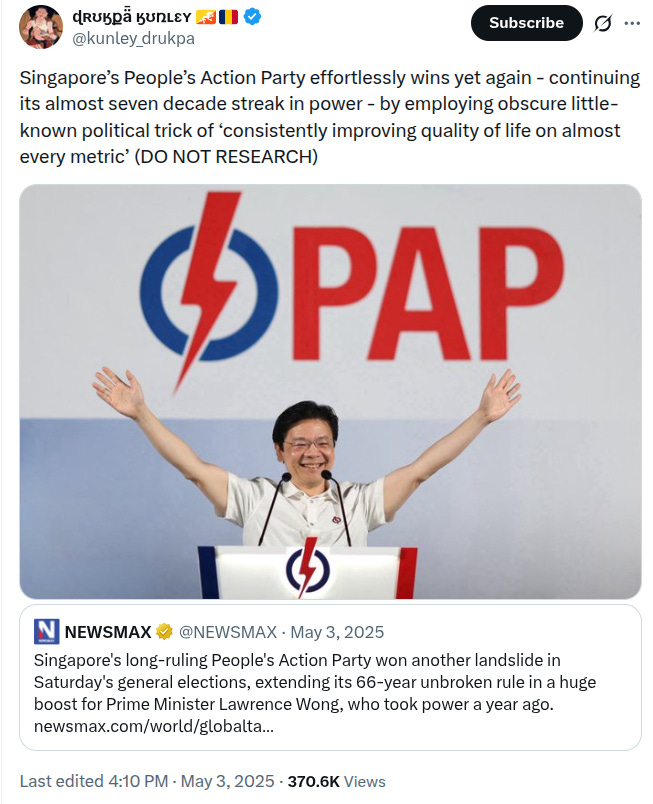
One notable thing about Singapore is that it has managed to be this successful while being a “diverse” country that also hosts a large foreign population. This was seen as a necessary decision due to low birth rates among its affluent population, but only a small number of foreign workers are ever allowed to become citizens. It was accepted that the multicultural nature of Singapore could not be changed, but quietly, and then later admittedly, they made sure to only allow immigration into the country to match the existing demographic makeup, much as the United States once did when it had a better immigration policy:
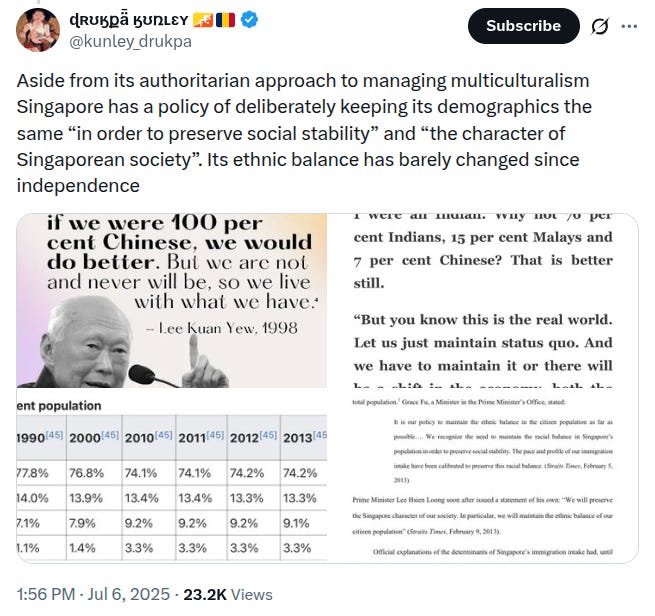
As much as the “diversity is our strength” lie is repeated, changing demographics horribly destabilize countries, be it the Irish replacing the Anglos in Boston or Men from Everywhere filling up British council estates. By maintaining a racial balance they have maintained stability, and one can’t argue that it has stagnated the country: the GDP per capita has increased around 200x since independence:
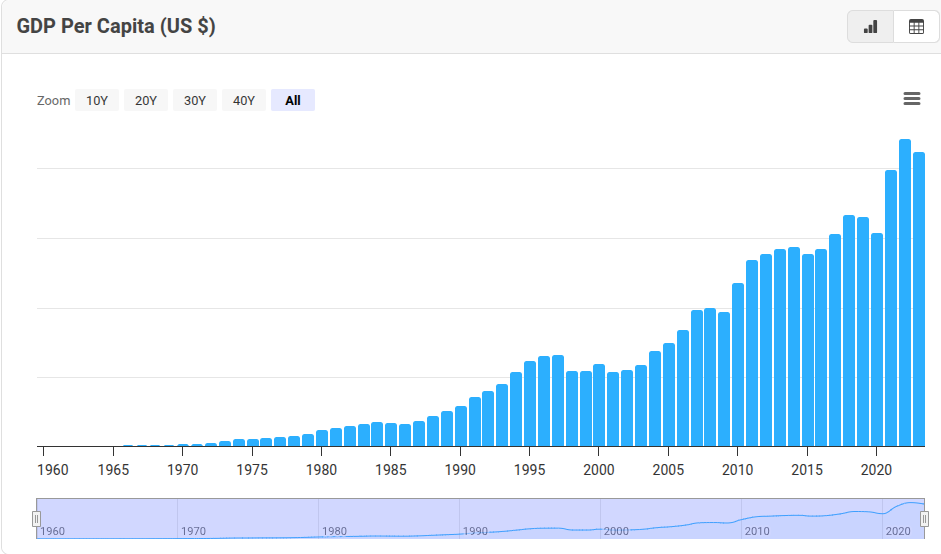
Of course, there is more to life than GDP, but things are in a balance, and being extremely wealthy makes everything else more tolerable. This does make a great argument in favor of consistent free market policies, much more than Uruguay’s wealth relative to the rest of Latin America due to their stable democratic socialism. What I think is shown is that a fairly consistent political and economic environment with well understood rules that people follow is the most important, as well as not getting bored and Ideology-Maxxing or doing Really Obviously Stupid Things.
It is somewhat amusing that a city of this level of wealth is simultaneously so barbaric as to famously cane people:
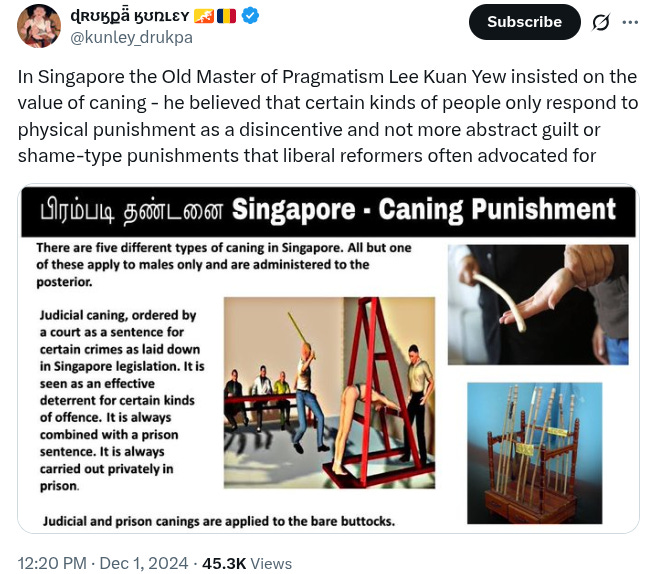
I don’t know if I believe there is any good doing this to adults, but it would seem to me that no one in Singapore has a reason to commit crimes for economic reasons or really to be suffering from having had a highly dysfunctional or deprived life. Though he implemented this policy well before Singapore was as wealthy as it is now, one is left to wonder if anyone who would still become a criminal having grown up in Singapore can be reasoned with or shamed.
What I would say though is it speaks to all the bullshit we put up with for our own form of government that Americans will see a country where the the GDP per capita is pushing $200k a year and think that some people getting their asses beat with canes by the state is such a bad thing that the other lessons of the country could be ignored or that it must be a bad place to live.
Conclusion: For a Mostly Competent Pragmatism
It is the nature of any examination into the Art of Politics to show at least some concern to how things should be. However, while Plato may have invented a fictional Republic (that there is no indication he believed in as a form of social organization) for the great majority of history works on political theory were dedicated to examining things how they are, or at most using a fictional city to show the same. All of the great theorists spent their time examining different systems with the view of giving advice about how to adapt government to human nature and existing social organizations. Machiavelli deeply examined the ancient histories, but even in his own time, and more so later, people failed to understand that in most cases he was merely analyzing and explaining how things work, and in only few cases was advocating for how things should be. Those who looked deeply into the laws, such as Grotius and Montesquieu, were in many ways examining what the laws are, based on both precedents from Ancient Rome and also what is fair or natural to human nature.
It was not until John Locke that there starts to be more idealism, and this is also where the discovery of the new world and its colonization started presenting opportunities to try new forms of government based on study instead of simply based on power and traditional custom; at the time, Venice was really the only new city that had been established and given a unique form of government in perhaps nearly 2000 years. Locke’s Constitution of the Carolinas is a remarkable document that does recognize various rights of the citizenry, but it is also a deeply practical, reflecting the existing social and economic organization that it was meant to preserve in an orderly fashion. Our own Constitution of the United States of America did found a nation but again was largely a recognition of the traditional rights and duties of free Englishman and the ways which they could best be preserved under a Republican system.
I think it was with the release of Rousseau’s On the Social Contract that we began to see a move from “is” to “ought,” as they say. It is a curious little text to the well-read student of political theory looking back on its place in history. The main contribution this book makes is to re-state what every scholar knew about government and human affairs and add a new layer of pleas for how things should be which were in many cases fundamentally unworkable. In many ways this was the birth of ideology. What made it so nefarious was that it was targeted to the common man, who, encountering these ideas for the first time, found Rousseau a genius. The same criticism could be made of Thomas Paine’s Common Sense, I suppose, but it was more narrowly targeted to matters at hand and further the American public was remarkably literate and well read so not encountering some of the ideas for the first time. This was of course followed by Marx and Engels doing something similar, where they looked at the eternal but often unnoticed conflict between the upper and lower orders in a society, and decided this could be permanently won, instead of just managed, and further that the lower orders would win it. From here we have seen every reaction, struggle, education and re-education fighting over these matters, and it has, for the most part, only resulted in human misery, even if there are good ideas here or there. Often, a man is made less personally happy and productive for the sheer fact that the bad ideas drilled into him have not been implemented, and those bad ideas being implemented would make him materially worse and less free, though perhaps subjectively happier since they are how he has been told he wants to live
Political ideology and its consequences have been a disaster for the human race. The common man, now generally expected to be a responsible member of a self-governing free society, is meant to hold a set of beliefs which may or may not be relevant to his life or work at all. He is further expected to vote for his perception of the common good, though perhaps more commonly he expects everyone else is voting in self-interest and does so himself. It is often not apparent what the “Common Good” is, and he is more likely to serve it by using instinct and voting for a man who seems like he’s not a complete moron than he is voting for the person who agrees with him on some set of ideological beliefs about what society should be. However, as much as he may detest eggheads, it is hard to break the assumption that people in charge know what their doing and that the people who come up with political ideologies are not all morons.
Part of the problem here is the concept of “political science” itself. Now, you could say that what someone like Nate Silver does, with collecting and analyzing a large body of statistics, is a kind of political science, but overall, statecraft is an art not a science. Of course, how the idiots who rule us do it, statecraft is more like unskilled labor at the hands of a drunken fool, but men like Lee Kuan Yew and Paul Kagame mastered their art as well as Michelangelo mastered his. However, ideology, particularly progressive ideology, fails to recognize the art in statecraft, instead believing that a clearly defined set of ideas and doing what experts say is the best way for man to be governed.
An illustrative case of such insanity was during covid how the Democrats insisted on “listening to the experts.” I will grant you that listening is different from obeying (which is what they meant anyway) but beyond that the experts had already proved themselves morons, statecraft is its own art. An expert will think whatever thing he studies is the most important thing facing society and unless he is a man of great breadth and wisdom will likely tell you to do whatever works towards that specific goal. A statesman instead must look at several things, including what is possible, second order consequences, resource limitations, and perhaps more importantly, what the public wants and what it will accept. However, on the other hand, one shouldn’t be a slave to polling, as a leader leads and if things go well, the public will go along with you; the public will often go along with you leading them into folly as well, but it is the statesman’s job to not do so.
A few years into the covid nonsense, the economist Steve Hanke released a meta-analysis of lockdowns, which determined they were almost entirely useless and economically harmful. That much was obvious, but what is noteworthy is that detractors said, “These authors are not even epidemiologists, they are economists.” What was curious about this, or more accurately typical, was that they had specified in the introduction that economists look at second-order consequences and examine existing data, which isn’t what “public health officials” and the like generally do. In short, the people obsessed with trusting the experts are not overall capable of understand how expertise works, in that there is generally a large opportunity cost to specialization and in fact experts are regularly analyzing and contributing to the work of experts in other fields.8
What mankind greatly needs is to trust “the experts” less and to instead have political leadership who are are at least Mostly Competent at being political leaders. However, what is more important is to recognize the way things are and have a government that is adapted to the place, society, and economic limitations of the nation in which you live. Instead of letting ideology make you unhappy and ruining your society, realize that things being Basically Fine is all you need from the government and everything else you want should be sought through the wise stewardship of your own affairs.
My hope for all of this is that with his simple, if at times simultaneously esoteric, message and communication, Kunley has made a great parry against ideology, and can move us towards maintaining Basically Fine conditions where they exist and attaining them where they do not:
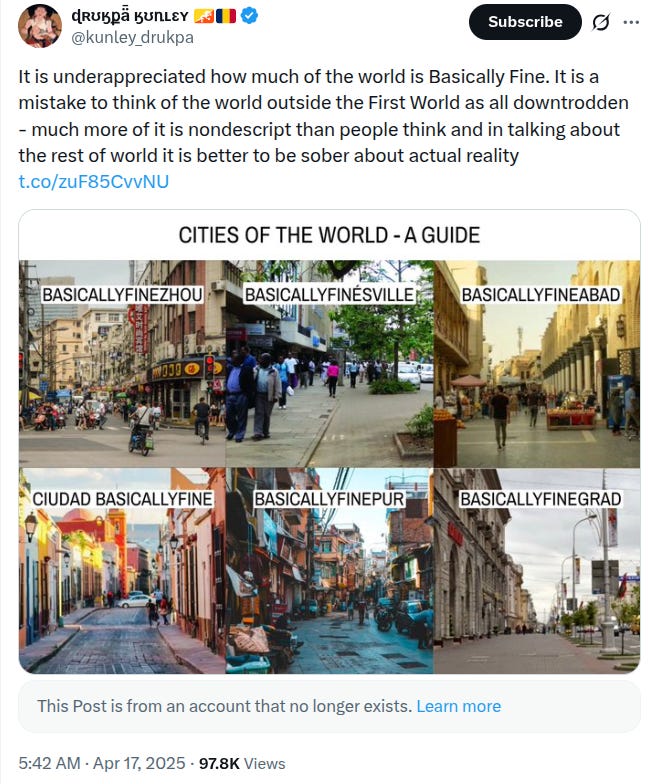
Glossary of Terms
Here I will provide my own short definition of some terms used which may not have been previously familiar to readers.
Anon: An internet user who generally has “unacceptable” views and thus uses an account which does not expose his real identity. The notable anons are more accurately pseudonymous rather than anonymous, using the same name for several years.
Basically Fineism: A political philosophy based doing the best you can and seeking to make life pleasant while accepting real social, economic, and political limitations.
Boss Government vs HR Government: The idea that the real pseudo-ideological struggle of our era is between politicians who act like bosses and those who act like HR ladies.
Do Somethingism: The belief that it is better to recklessly act immediately than to wait and make sure you make a wise decision.
Fix Everything Easily Switch: The idea that the reasons why things can not be improved are nonsense and that you can “just do things.” In many cases, more of a thought exercise.
Ideology-Maxxing: Taking ideology to its illogical conclusion while ignoring real world impacts and limitations.
Line Go Up: A disparaging term for people who think that GDP is the most importation measure of the health of a society.
Men from Everywhere: Mass immigrants who are no longer from a single place or concentrated in their own ethnic communities, but who then come together and create a new multicultural ethnic culture and dialect, such as “roadmen” in Britain.
Mostly Competent Pragmatism: A description of political leadership mastered by Singapore’s Lee Kuan Yew which eschews ideology in favor of having competent people do what works.
Pantsuit Deportations: A form of immigration enforcement developed in Europe whereby self-confident girlbosses who appear to have a genuine interest in human rights humanely deport people.
Really Obviously Bad Idea: The very dumb things that ruin Basically Fine conditions which ideological politicians come up with for no reasons.
Scaring the Hoes: Upsetting the “normie” segment of your population who likely agrees with the bigger picture policy but is unable to handle seeing anything unpleasant.
Skullcrusher Deportations: The antithesis of Pantsuit Deportations, where you do scare and chase all of the illegal immigrants out of your country without trying to appear compassionate.
Total Mess/Not Fine At All: The antithesis of Basically Fine. A political and social situation of high tension where people hate each other, bad things frequently happen, and little works as it should.
Very Serious People: A widely known derogatory term for mainstream think tankers and editorialists who are wrong about everything but nevertheless demand to continue to be taken seriously.
Thank you for reading! The Wayward Rabbler is written by Brad Pearce. If you enjoyed this content please subscribe and share. My main articles are free but paid subscriptions help me a huge amount. I also have a tip jar at Ko-Fi. My Facebook page is The Wayward Rabbler. You can see my shitposting and serious commentary on Twitter @WaywardRabbler.
In one of my favorite moves by any philosopher ever, Montesquieu froze a lamb’s tongue and then looked at it under a microscope, and based on its condition speculated wildly about what this could mean for human organization.
I think if I were to meet one at a bar not knowing who it was, I would find I have a lot more in common with the average American-born billionaire than the average Pakistani, though I presumably have more in common with the average Mexican, as they are not that different from us. This again presumes all groups of people are the same, which they are not.
I don’t mean to cast shade on France, where if TV shows are to be believed, insane asylums are often in noble estates. This is, as far as I know, not due to priorities, but merely because the government seized a lot of noble estates after the Revolution and thus these are the large buildings the government owns. In that circumstance, where the government already owns the building, it is perfectly reasonable to use a noble estate to house wards of the state.
The second killing, of Alex Pretti, was by Customs and Border Patrol, who it is much less plausible to say you want to shut down.
There was a Roman dictator whose name I can’t recall who was appointed but then it was discovered the crisis had already ended before his appointment, but the news had not yet reached Rome. Not wanting to waste his dictatorship, he made some reform to public debt and then resigned.
Guyana is not properly Latin American as the country speaks Guyanese Creole, and English-based language. Also, French Guiana is an integral part of France and as such has France’s GDP per capita, though it is much poorer than metropolitan France.
The way Bantu languages work is that a prefix modifies the root word, so without doing a ton of unnecessary research on a minor topic, I am going to assume that is the same root as the country Uganda, because its in all sorts of words meaning variations of person, group of people, etc. I happen to know this one because Gunther lists 8 “ganda” words explaining the principle in Inside Africa.
There was a stunning example of this 10 years ago in the Wall Street Journal. An article called “My Unhappy Life as a Climate Change Heretic” told the story of a statistician who was a full and complete believer in climate change and has his life ruined by conducting a study showing the financial costs of natural disasters had gone down. The argument was “He isn’t even a meteorologist!” as if that is who would be analyzing the costs of historic events.
I didn't want to break this up by asking for donations, but if you have finished this, know that I make peanuts off of this substack and please consider a paid subscription or a donation at this link:
https://ko-fi.com/waywardrabbler
This is magnificent and something that one can share to explain all the deep basically fineism lore to normies.